
How they differ, practical automation examples and what a cell costs
Automating a fiber laser welder lets a shop repeat the same weld at the same speed, position and settings every time. In general metal fabrication, choosing between a cobot and a conventional industrial robot comes down to a few questions. How many different parts do you make, and how many of each? How easy are the joints to reach, and how is the whole cell designed?
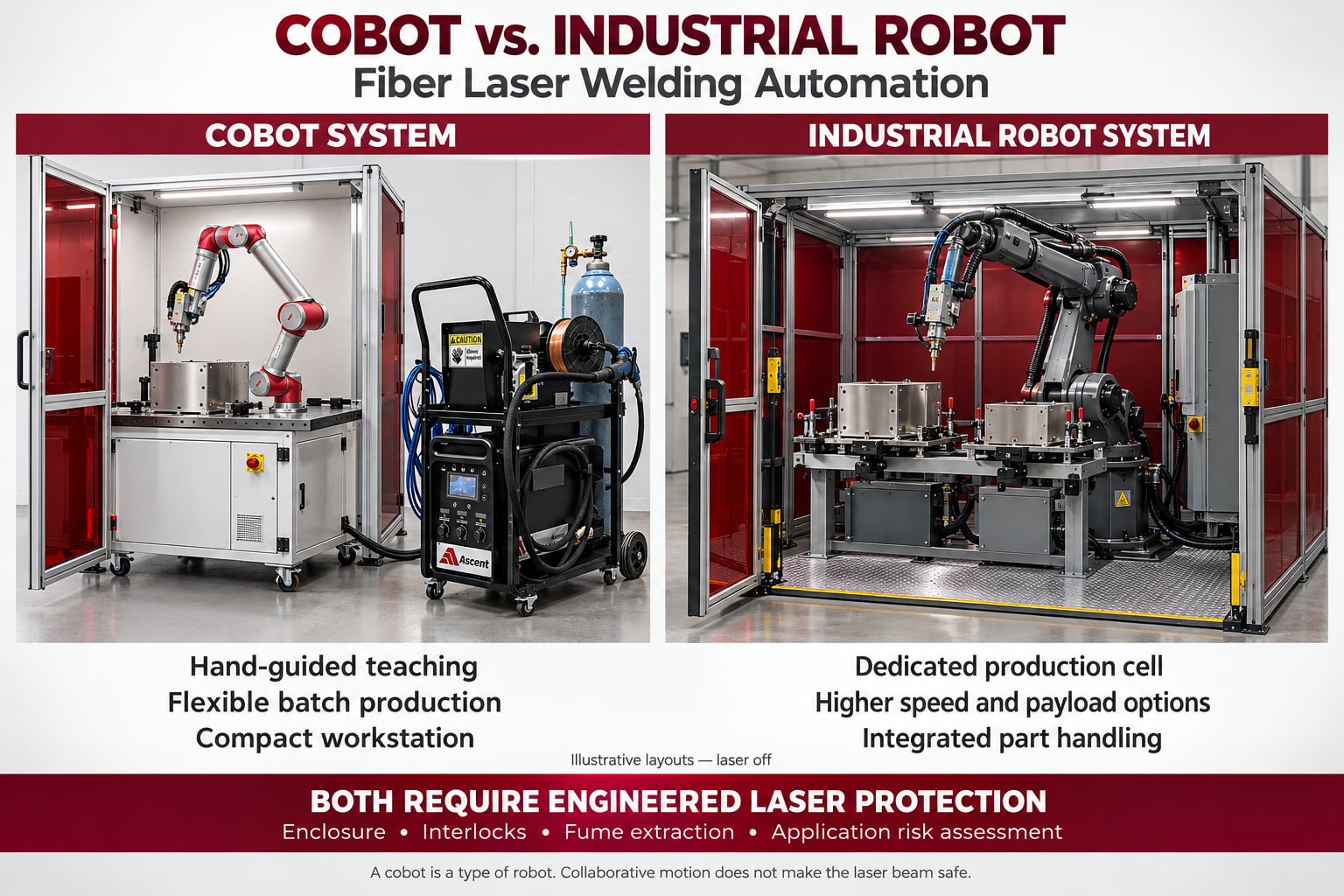
A cobot is a type of robot. The real comparison is between a robot built for collaborative use and a conventional industrial robot that usually works in a dedicated cell. Either one can carry a fiber laser welding head, and either one can run anything from an operator-loaded fixture to a fully automatic line.
How the two systems work
Many welding cobots can be taught by hand. With the laser switched off, the operator guides the arm to each point, records it and saves the welding program. A simple interface makes repeat jobs easier to set up, but operators still need training in welding parameters, joint preparation and safe operation.
A conventional industrial robot is usually programmed with a teach pendant or offline software. It can be tied into automatic clamps, positioners, conveyors and handling robots, and a dedicated laser welding cell suits repetitive production and coordinated manufacturing.
The safety standards now say the same thing. The 2025 edition of the international robot safety standard, ISO 10218 Parts 1 and 2, uses "collaborative" to describe the application, not the robot. The collaborative guidance that used to be a separate technical specification is now part of the standard itself. The U.S. version, ANSI/A3 R15.06-2025, was published in September 2025; Canada's equivalent is CSA Z434. Whatever the arm is called, the whole application has to be risk assessed.
Typical differences
| Factor | Cobot | Industrial robot |
|---|---|---|
| Common fit | Changing jobs and repeat batches | Repetitive production and integrated lines |
| Programming | Often taught by hand | Often a teach pendant or offline programming |
| Motion and payload | Check the limits of the model you choose | Wide choice of speed, reach and payload |
| Changeovers | Often designed for quick changes | Fast when tooling and programs are set up for them |
| Investment | A simple cell may need less integration | A complex cell may need more integration |
| Laser protection | Engineered protection required | Engineered protection required |
Treat these as general tendencies. Neither type of robot makes a better weld on its own.
Practical automation examples
The examples below are possible cell designs. Whether one works for you has to be confirmed with your own parts, fixtures and welding trials.
Metal cabinets and enclosures
An operator places a sheet metal enclosure in a locating fixture, clamps it, closes the interlocked enclosure and starts a saved program. The robot welds the corner joints it can reach, and the operator removes and inspects the part. The head movement is automated; loading and inspection stay manual.
Brackets and small assemblies
A fixture holds several brackets or small assemblies in known positions, and the robot welds them one after another. Loading several parts at once cuts handling stops, as long as every joint can be reached and the fixture controls gaps, movement and heat.
Stainless steel trays and housings
A manufacturer makes repeat batches of trays, covers or machine housings, and saved programs set the welding sequence and travel speed for each design. Thin sheet needs careful joint preparation and clamping. Check appearance, distortion and leak tightness where they matter, because automation alone doesn't guarantee a sealed product.
Circular seams on a rotary positioner
For suitable round parts, a motorized positioner turns the part while the laser head stays still or moves with it, and the controller keeps rotation and laser emission in step. When the joint is simple and the parts don't change much, a dedicated rotary welding machine can cost less than a six-axis robot.
Two-station welding
A cell with two fixture stations lets the operator load one assembly while the other is being welded, and a rotary indexer or shuttle swaps them. Engineered guarding between the stations has to protect the person loading parts from the laser and from moving parts while the cell welds and indexes.
Fully automated production
A handling robot loads the parts, automatic clamps hold them and a welding robot makes the joints. The cell then passes the assembly on to inspection and unloading. That automates handling as well as welding, and it depends on consistent incoming parts, coordinated controls, a plan for faults and a defined inspection step.
Automation can grow in stages
A sensible path is to automate the welding first, then add multi-part fixtures or a second station, and automate loading and unloading when demand justifies it. A cobot doesn't have to stay operator-loaded, and a conventional robot doesn't have to sit in a fully automatic line.
What makes welding automation work
Repeatable parts and reliable fixtures
A robot repeats its programmed path exactly. If the joint has moved, it will precisely follow the wrong line. Fixtures locate the part, control the gaps and hold the assembly during welding, which is why consistent cut edges, bends and material matter so much. Our guide to fit-up and gap control covers the details.
A proven welding process
Qualify the process on representative parts before you commit to production. Confirm the material is suitable and check penetration, appearance, distortion and any required strength or leak performance. Choose laser power, focus, travel speed, shielding gas, beam wobble and filler wire for each joint instead of copying them from another job.
A system built for automation
A handheld laser welder isn't automatically suitable for a robot. The laser source, welding head, controls, cooling, cable routing and safety interfaces all have to support automated operation. Cable bend limits and access to the joint can restrict the robot's path even when the arm has the reach.
Sensors where they help
Seam finding, vision and seam tracking can handle some variation when they're properly integrated. Not every robot comes with them, and they can't make up for poor joint preparation or an unproven process. Inspection systems can flag problems, but their detection limits have to be established too.
Measuring productivity and savings
The savings come from the whole production cycle: less repetitive welding labor, more consistent output, less rework and less finishing. Measure loading, clamping, welding, repositioning, unloading and inspection together.
Here's an example. Say manual production takes 10 minutes per part and an automated cell takes 6 minutes, including handling and inspection. At 60 parts a day, that's 240 minutes, or four hours of production time saved every day. It's only an example; your own results will depend on your parts and your cell.
Production time saved isn't the same as labor saved. If an operator has to watch the cell for the whole cycle, the labor saving may be small. If the operator can safely do other work while the cell welds, the same cell saves much more.
Look at the total installed cost: laser equipment, robot, fixtures, enclosure, extraction, integration, training and commissioning. Add the ongoing costs of programming, changeovers, maintenance, consumables and inspection, and base the savings on the throughput you can actually reach and the demand you actually have.
Estimated prices
The budget figures below are in U.S. dollars as of October 2026. They're planning allowances for the configurations described. They aren't quotations or verified market averages, and they leave out sales tax, import duties, major building work and unusual process requirements.
| Configuration | Planning allowance (USD) | What to budget for |
|---|---|---|
| Cobot cell with simple tooling | $50,000 to $150,000 | Laser, arm, controls, enclosure, extraction, basic fixtures, integration and training |
| Industrial robot cell with simple tooling | $75,000 to $200,000 | A comparable basic scope with a conventional arm and dedicated guarding |
| Industrial production cell | $200,000 to $500,000 or more | Custom tooling, indexing, sensing, engineering and installation; handling automation adds more |
The ranges overlap because a simple industrial robot package can cost less than a premium cobot cell. The type of robot alone doesn't set the final price.
For larger cobot setups, estimate about $72,500 for a 1,500 W laser cobot on a seventh-axis rail and about $87,500 for one on an overhead gantry. Those estimates may not cover a laser enclosure, fume extraction, installation or commissioning, so check what each quote includes before you compare it with the cost of a finished cell.
As an illustration, if a simple enclosed cobot cell is quoted at $90,000 and a similar industrial robot cell at $120,000, the difference is $30,000, and the cobot cell costs 25% less. Get quotes with matching scope to find the real difference for your parts.
Laser safety applies to both
A cobot's motion safety features do nothing to protect people from the laser beam, its reflections, hot material or fumes. The whole application has to be assessed: the arm, the welding head, the workpiece, the fixtures and everything around them. A collaborative label is no substitute for an application risk assessment.
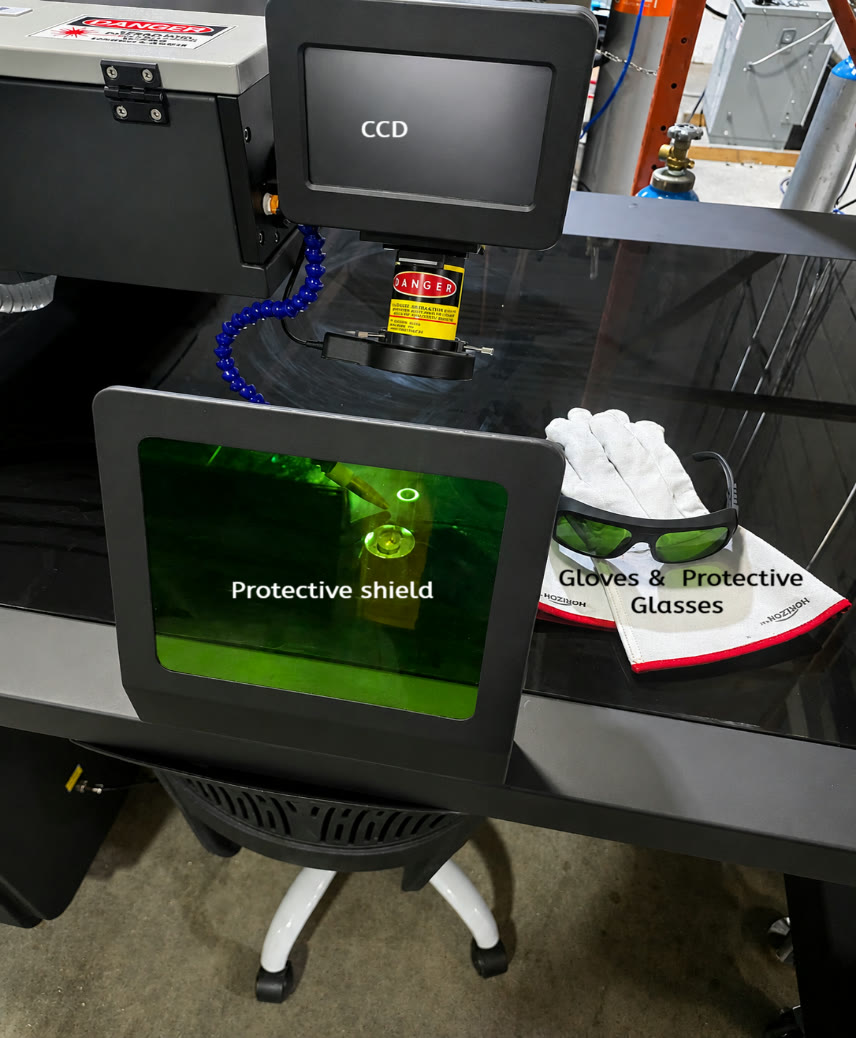
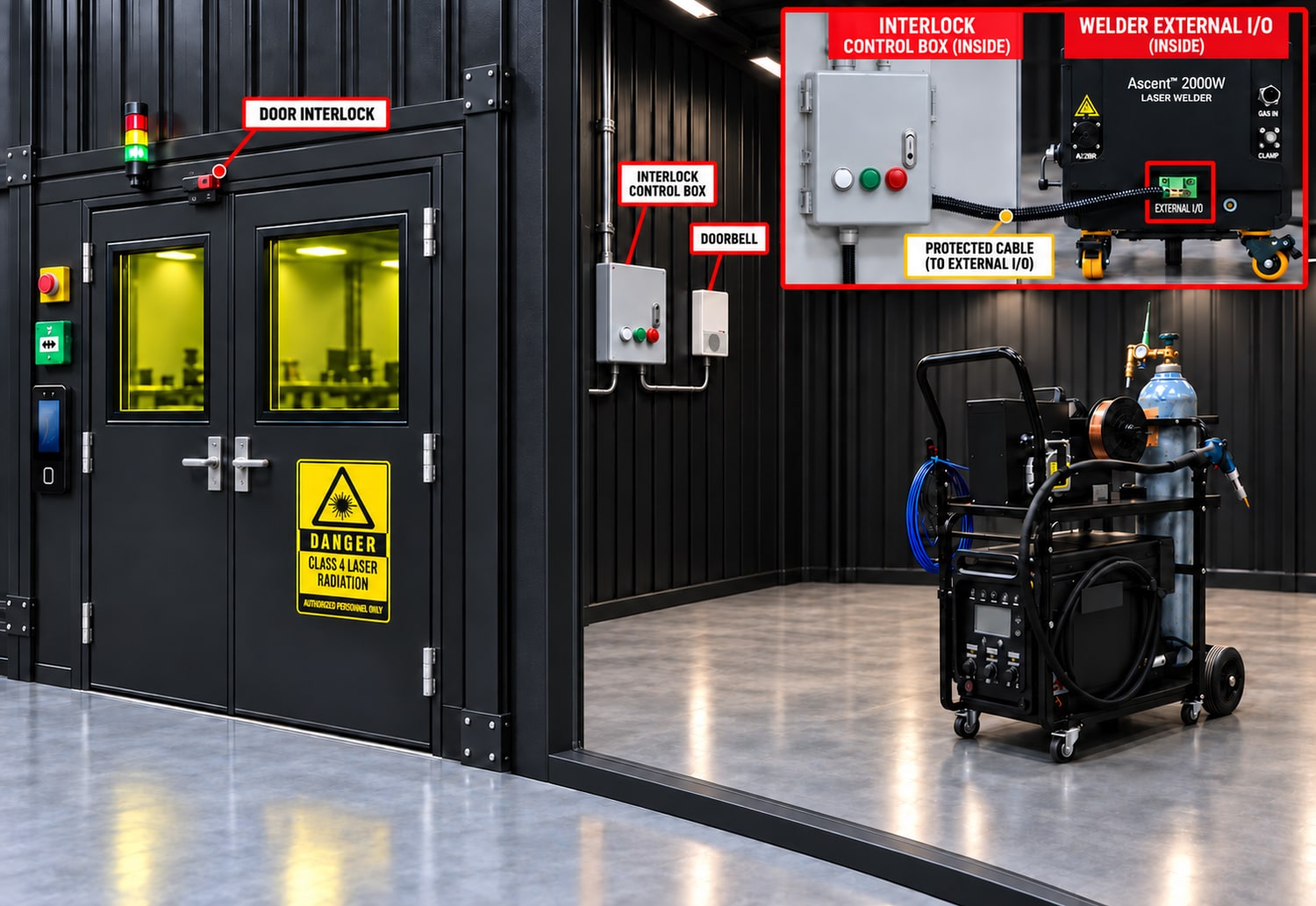
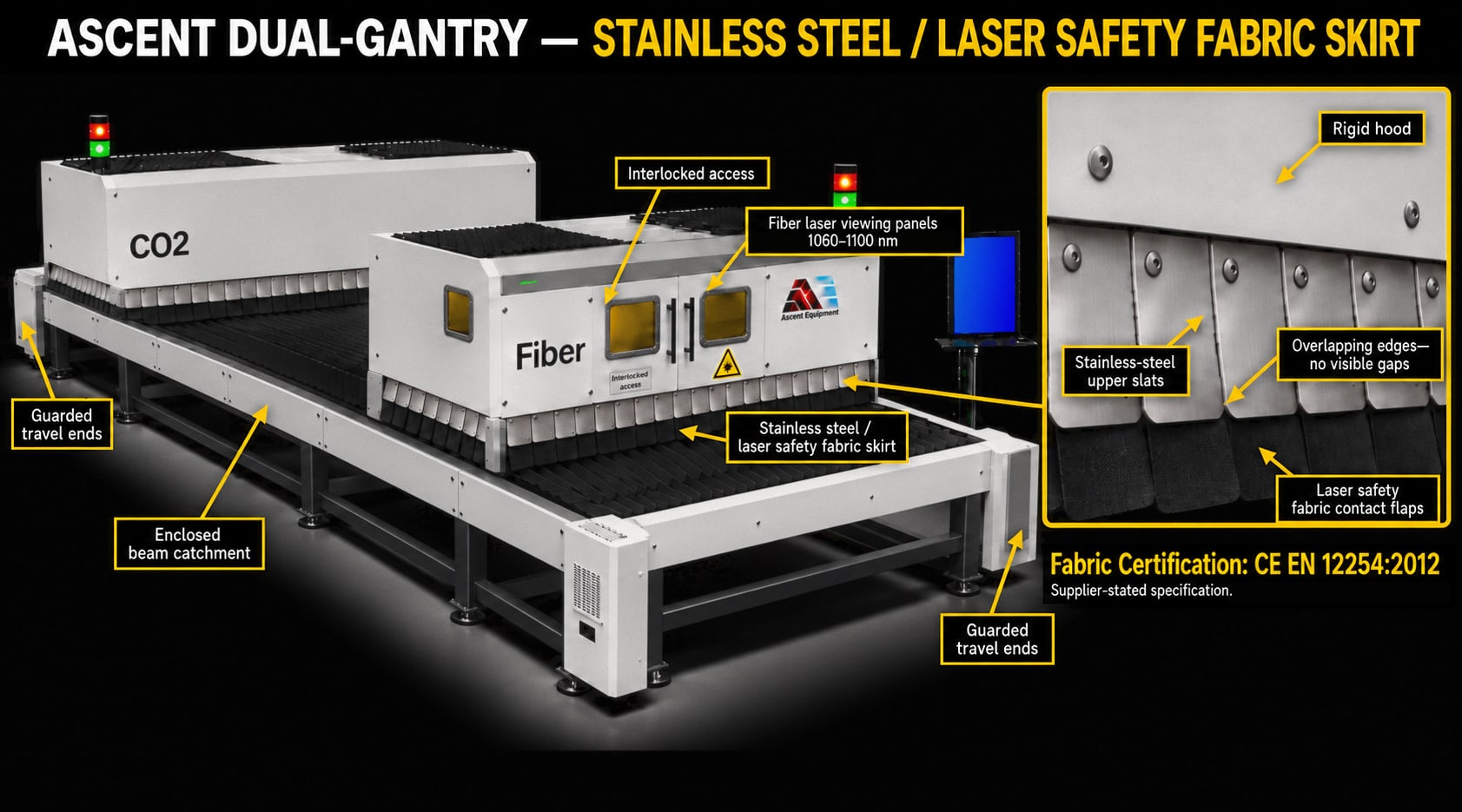
You can set up a cobot with the laser off, then let it weld inside an engineered laser enclosure. Laser welding cobot systems typically use interlocked access doors, suitable viewing windows and fume extraction. Ascent's cobot, for example, comes on a mobile cart with a built-in enclosure rated Class 1.
The protective design has to account for the laser's wavelength and power, every possible beam path and reflection, the access points and each operating mode. Teaching, production, troubleshooting and maintenance each need a defined procedure. Choose laser barriers and windows for the actual exposure, and don't count on an ordinary welding screen to stop a laser.
Motion hazards are different. A cobot may limit force or speed, but the welding head, sharp parts, clamps and nearby fixtures can still hit or trap a hand. A conventional robot usually runs behind dedicated guarding. With either one, loading stations and positioners need their own safeguards, and an emergency stop doesn't replace guarding.
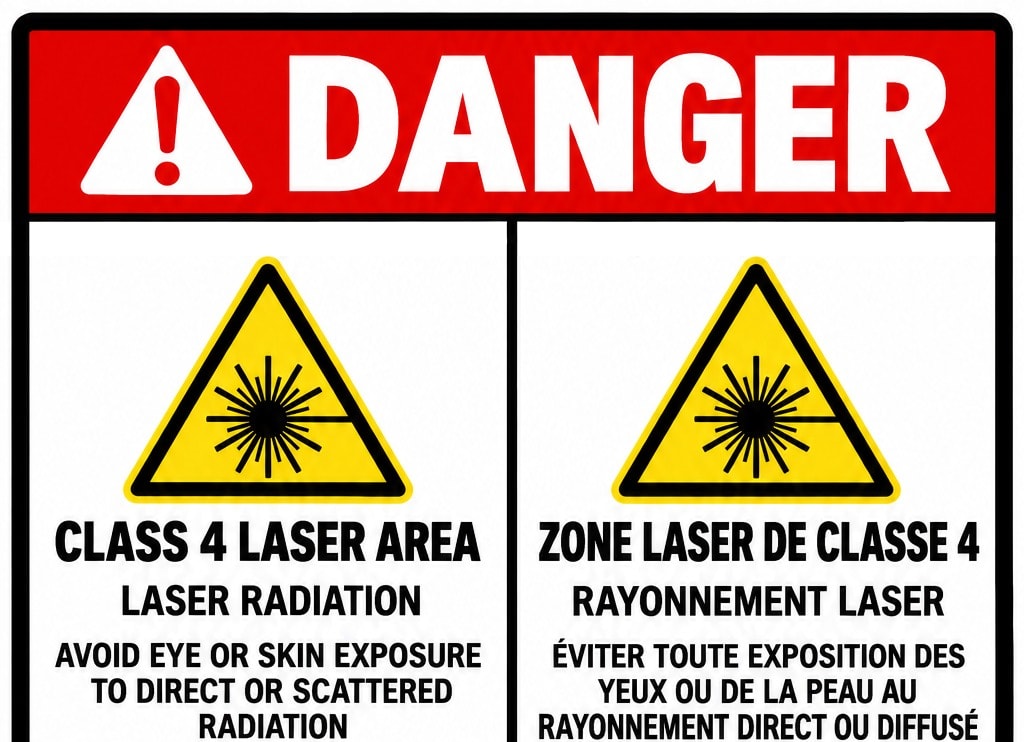
Class 4 laser hazards include serious eye and skin injuries from direct and reflected light, fire and airborne contaminants. Enclosures and interlocks should keep hazardous radiation out of reach during normal production. Verify the assembled system, though; a machine isn't Class 1 just because it's enclosed. A qualified laser safety specialist should set the controls for access and servicing, including laser eyewear wherever exposure is still possible: minimum OD 5; prefer OD 7 or 8. See our laser safety page for more.
Operators need training on both the robot and the laser process. Easier programming helps newer employees take on automated welding, while experienced fabricators stay valuable for setup, process development, troubleshooting and quality decisions. We look at that side in how laser technology empowers fabricators and entry-level workers.
Choosing the right approach
A cobot can be a practical place to start when a shop has repeat batches, changing designs and a need for programming anyone can learn. A conventional industrial robot suits jobs that need more reach, payload or speed, or deep integration into production. Compare specific models and complete cells; the labels alone won't tell you much.
Before you buy, run representative parts and record total cycle time, weld quality, changeover time, fixture repeatability and how much operator time it takes. Think about maintenance access, support, and how the cell will handle a misplaced part or an interrupted cycle.
The best automation projects start with a repeatable product and a proven welding process. The robot then repeats that process, and your people can spend more of their time on work that needs judgment and fabrication skill.
What Ascent provides
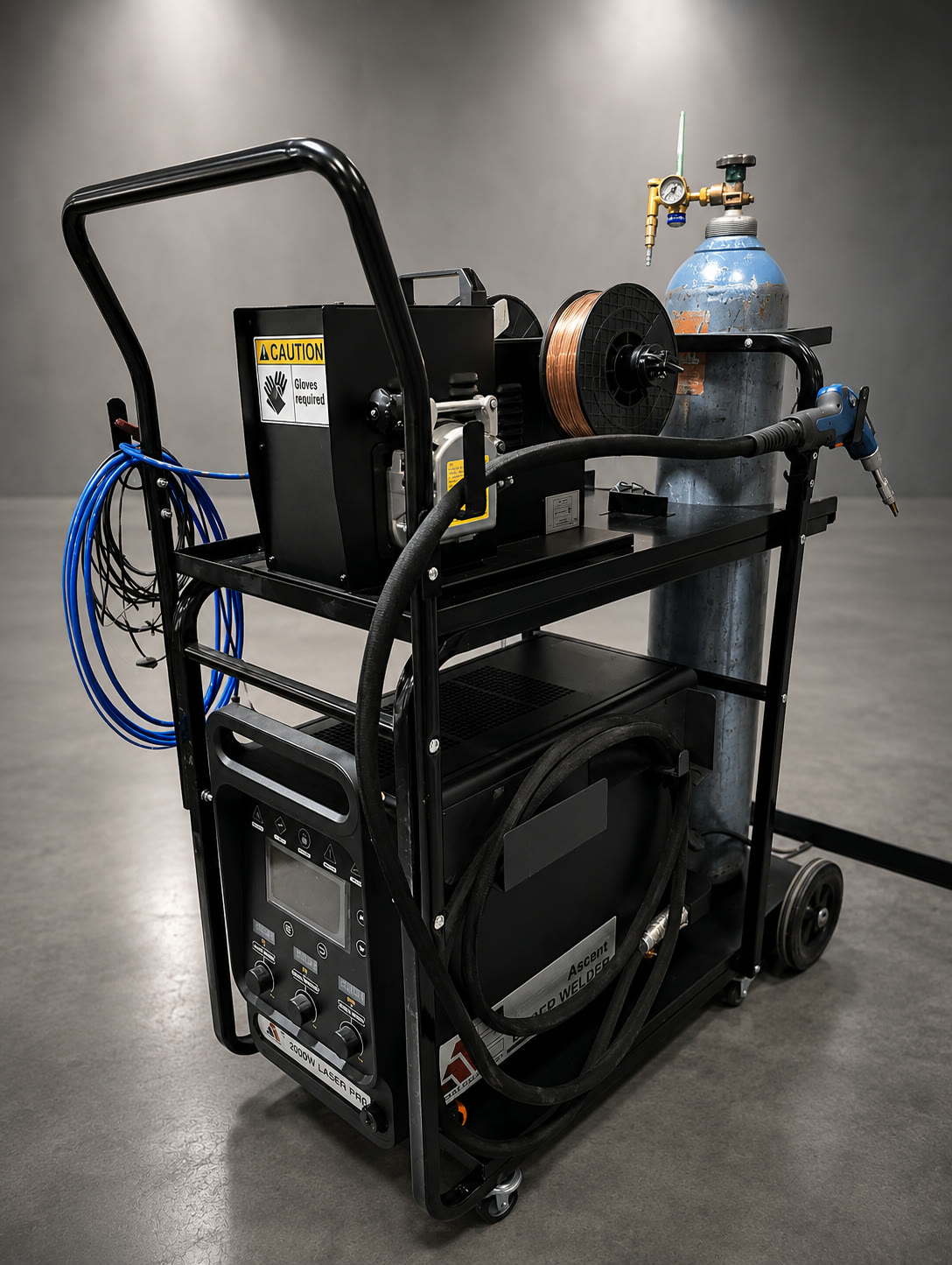
The Ascent laser welding cobot is one integrated system: a fiber laser welder, a collaborative robot arm, the controls and a light-tight enclosure rated Class 1, all on a mobile cart. Weld paths are taught by moving the arm by hand with no-code drag-and-drop software, and one teach pendant runs both the arm and the laser. The arm carries a 7 kg or 12 kg (15 or 26 lb) payload with a working radius of about 954 to 1,073 mm (37.6 to 42.2 in). The laser comes from the A-STR-AW series, with sources up to 3,000 W, refrigerant cooling and built-in process packages. A vision camera and laser seam tracking are optional.
The price includes installation and training at your facility, and freight is extra. The warranty is 2 years on the fiber laser source and 1 year on non-consumable parts and workmanship. Ascent tests customers' parts before a sale, so you can see how your own parts weld before you decide.
To talk through your parts and whether a cobot cell fits them, contact us.
Sources
[1] ISO 10218-1:2025, Robotics, Safety requirements, Part 1: Industrial robots: iso.org
[2] ISO 10218-2:2025, Robotics, Safety requirements, Part 2: Industrial robot applications and robot cells: iso.org
[3] ANSI/A3 R15.06-2025, Industrial Robots and Robot Systems, Safety Requirements, publication notice (September 9, 2025): automate.org
[4] OSHA Technical Manual, Section III, Chapter 6, Laser Hazards: osha.gov
[5] ANSI Z136 series of laser safety standards: lia.org
Ascent figures come from the laser welding cobot page and brochure. The budget ranges, the cobot estimates and the price example are planning estimates and aren't quotations. Sources reviewed October 11, 2026.