Call us: 1-800-927-5107 647-494-7800 ext. 1008
Laser Welders

Hand-held laser welder

2000W: USD $28,000 · 3000W: USD $34,000

Prices include shipping, installation and training. For other power levels, contact us for a quote. Prices are in U.S. dollars. For Canada, the price is calculated in Canadian dollars at the exchange rate when the order is placed. Shipping to Canada is from Toronto, Ontario, and within the USA from Buffalo, New York, or Mount Sterling, Kentucky.

Welds faster and cleaner than MIG, TIG or arc

Ascent handheld fiber laser welders join aluminum, stainless steel and carbon steel. They come with refrigeration cooling, a light torch, operator training and local service.

  • Accurate welds with very little heat distortion
  • Shorter weld times than MIG, TIG or arc welding
  • Works on aluminum, stainless steel, titanium and other metals
  • Non-contact process, so maintenance is minimal
  • Less wasted material and lower spending on consumables
  • Light, ergonomic torch that keeps operator fatigue down

With a handheld laser welder, a fabrication shop joins thin stainless steel, carbon steel and aluminum faster. Compared with many traditional welding processes, the part distorts less from heat and needs less cleanup. The practical question is fit. Check the machine against the materials you run, the design of your joints, the duty cycle you need and the safety controls your shop has in place.

Jobs that suit a handheld laser

MIG, TIG and arc welding are still the correct choice for plenty of jobs. A handheld laser welder pulls ahead on thin sheet and on joints you repeat often. On that work it can move along the joint faster, heat the part less and leave less to grind afterward. You still need good fit-up and a controlled process. The welder is a Class 4 laser system. Operate it as one.

Training by an Ascent technician takes 3-4 hours. This qualified training lets an operator who has never welded aluminum weld very thin aluminum material. The operator stays responsible for completing the required training, for working to approved process controls and for meeting every laser-safety requirement.

What a 100% duty cycle means here

The Ascent handheld fiber laser has a 100% duty cycle. It can work continuously, and it needs no scheduled breaks to cool down. The figure describes continuous running, not a timed on/off cycle. It applies at the rated power of the model you select, in ambient temperatures between -20°C and +60°C (-4°F and +140°F), which is the published range, and with the built-in dual-circuit refrigerant heat pump doing the cooling. The figure is the manufacturer's performance specification. No independent third-party test protocol for the duty cycle is published at present. Before you buy, confirm the exact configuration and the validation your application requires.

Main advantages of a handheld laser welder

Accurate welds

Welds come out clean and precise, and the heat barely distorts the part.

Shorter weld times

A laser shortens welding time sharply compared with traditional methods.

Many metals, one machine

It handles a range of metals and materials: aluminum, stainless steel, titanium and others.

Little maintenance

The laser never touches the workpiece. That prevents wear and gives the machine a longer life.

Less waste

A streamlined process scraps less material, and that saves money.

When the heat-affected zone decides the result

Shops turn to handheld laser welding when three things count most: fast travel, a narrow heat-affected zone and little cleanup. Thin-gauge aluminum sheet is a clear example. With too much heat it warps, or the weld burns through it. A good result still takes sound joint fit-up, correct settings, the right shielding gas, material in good condition and a trained operator.
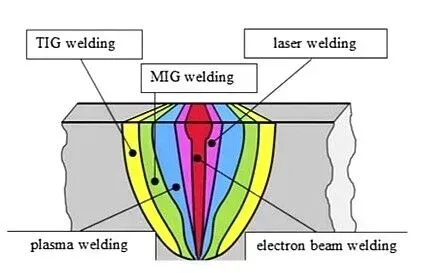
Cross-section drawing that compares how far the heat of TIG, MIG, plasma, laser and electron beam welding spreads into the metal

Safety and operator comfort

For anyone who welds, safety ranks at the top. Used together with a laser welding helmet, a handheld laser welder makes the workplace safer, because the operator is exposed to fewer harmful fumes and less intense heat. The torch is light and ergonomic. Operators tire less, so the machine suits long periods of use.

What it costs to own

Laser welding was once seen as an expensive investment. Advances in manufacturing and design have brought handheld fiber laser welders within reach of more companies. The savings add up over the life of the machine:

  • You buy fewer consumables such as electrodes and filler material.
  • Maintenance costs less, because the process is non-contact.
  • Energy efficiency is better than with traditional welding methods.

The welders come in several power and cooling configurations. Match the welder to the thicknesses you weld and the hours you run each day, and you avoid paying for capacity that goes unused.

Picking the right welder

Choose a machine for the materials and thicknesses you really run. Give weight to the torch as well: how heavy it is and how it sits in the hand over a full shift. Power output and build quality do not tell you, on their own, whether an operator can work with the machine comfortably all day.

What shielding gas does

Handheld laser welding depends on shielding gas. It is a critical part of the process, because it keeps contamination away from the weld area. Helium, argon and nitrogen are common choices. The gas surrounds the molten metal like a barrier, so oxidation is prevented and the weld stays clean.

The gas also makes welding more efficient in three ways:

  • It keeps the weld pool stable.
  • It cools the welding torch.
  • It stops plasma clouds from forming. Those clouds can get in the way of the laser beam.

How to compare models

Begin with the metals you weld most and how thick they are. Then compare the cooling method, daily run time, wire feeding, the weight of the torch, what the warranty covers and how close service is. See refrigeration laser welders for the specifications and penetration tables of the 1500W, 2000W and 3000W models. Contact Ascent Lasers Pro to set your requirements against the handheld welder models available.

Warranty and support
FAQ

Questions buyers ask about this machine

What does the quoted price cover, and is anything charged on top?
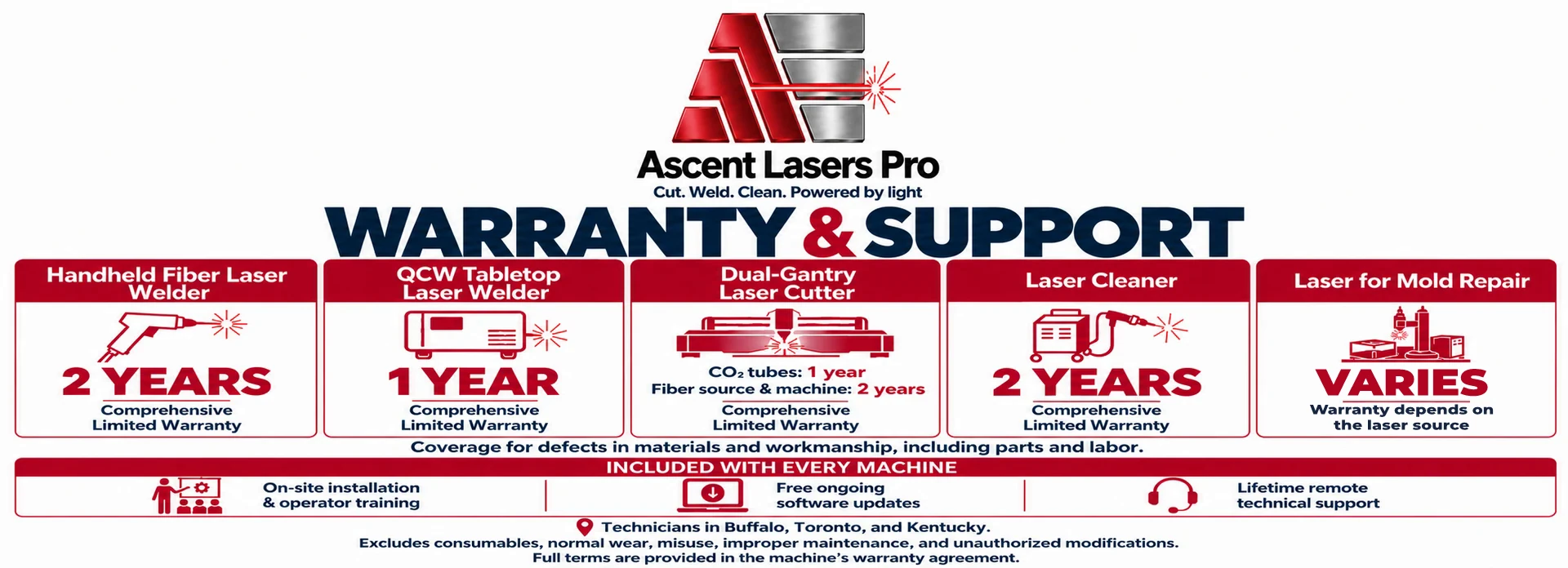
The quote from Ascent Lasers Pro covers everything the welder needs to run. Nothing is added later: no add-ons, no hidden fees, no extra charges. Shipping and on-site installation and training are included in the price. It also takes in a 2-year comprehensive warranty on parts and labor, ongoing software updates at no charge, and remote diagnostics and help for the life of the machine. AnyDesk remote desktop software is already on the machine when it arrives, so a technician can connect quickly to assist or retrain your operators. Our service team works from Buffalo, Toronto and Kentucky, so help is close.
How long is the warranty, and what does it cover?
Every Ascent handheld laser welder carries a 2-year warranty. It is comprehensive and covers both parts and labor.
What sets the Ascent handheld fiber laser welder apart from other welders?
Ascent reviewed comparable equipment available in North America as of August 2026 and reached these conclusions. In the whole industry, only the Ascent laser welder used a refrigeration heat pump, which lets it run continuously with no scheduled cooling breaks. Its torch was among the smallest found, and it works where there is room for only a 1.5-inch stroke. At 1.32 lb (600 g) the torch was also one of the lightest in the industry, which reduces operator fatigue. The Ascent was the only welder found to handle aluminum from 0.040 in. to 0.27 in. thick. A dual wire feeder takes care of larger gaps. Each welder is delivered complete with a trolley, one fiber laser helmet, one pair of OD 8 laser safety goggles and standard welding gloves.
What protective equipment does laser welding call for?
Protect your eyes with laser safety goggles rated for the laser's wavelength. Every Ascent handheld welder comes with one pair of OD 8 goggles and one fiber laser helmet; keep the goggles on under the helmet. Extra goggles and helmets can be bought from us. Minimum OD 5; prefer OD 7 or 8. For your hands, use the standard welding gloves that come with the welder; gloves and an apron rated for over 5,000 °F can be bought from us. Put laser partitions from us around the welder, or work in a complete laser room from us, with a door and an interlock that connects to the welder, and have a qualified person, such as a laser safety officer, check the setup. If you run a laser cutter, order it with a cover or screen it with our laser partitions, and send its fumes outdoors or through a special filter.
Is the welder for welding only, or can it also cut and clean?
Both the handheld welders and the refrigeration welders are able to cut a range of materials and to take off rust or oxidation. That ability is secondary. It is not what the machine is mainly for. A handheld laser welder can clean only a very narrow path. If you need professional laser cleaning, see our fiber laser cleaner page. For cutting as a job in itself, Ascent sells fiber laser cutters, among them a dual-gantry CO2 and fiber system. Those are separate machines made for that work.
In practice, how do the 1500W, 2000W and 3000W welders differ?
Power sets how deep and how fast the welder works in thicker material. On stainless steel, roughly 7 mm is the limit for the 1500W model, 9 mm for the 2000W model and 12 mm for the 3000W model. Penetration in aluminum, carbon steel and other metals goes up in proportion. For most jobs in aluminum and stainless steel of standard gauge, the 2000W model is enough. The 3000W model is for heavier fabrication. The refrigeration laser welders page has the full penetration tables.
Should I choose a 1500W, 2000W or 3000W laser welder?
Choose power based on the material, the joint design, the thickness range you weld most, and the production speed you need. Maximum penetration alone doesn't show how a welder performs on your parts, so compare sample welds at the thicknesses you use most often.
Is the welder air-cooled, or does it need a water chiller?
Neither, at least not in the usual meaning of those words. Ascent refrigeration welders are cooled by a heat pump. That is different from a traditional air-cooled setup with a fan, and different from a chiller loop filled with water or glycol. The heat pump allows a 100% duty cycle between -20°C and +60°C, and it spares you the maintenance that a water chiller needs.
What does wobble welding mean, and how does it help with thin sheet and fit-up gaps?
In wobble welding the beam does not follow one straight line. It oscillates in a controlled pattern. A high-speed servo drives the motion, and amplitude and frequency are set independently. The effective weld bead becomes wider, yet the head does not have to slow down. On thin sheet this pays off twice: the beam tolerates small gaps in the fit-up better, and the seam comes out more consistent along curves.
Which shielding gas does laser welding need?
Argon is the standard choice when you weld aluminum with an Ascent handheld or QCW system. It keeps the weld pool from oxidizing while you weld. Every Ascent laser ships with a gas regulator, so you can adjust the flow rate for the material you weld.
How long do nozzles, lenses and wire last, and what does replacing them cost?
A starter set of consumables ships with every Ascent laser welder. For the welder side it holds nozzle tips and wire. For the cutter side it holds nozzles, a protection lens and ceramic rings. How long consumables last depends on the materials you run. Replacement parts are inexpensive.
What electrical supply does the welder need?
The answer differs by model. The 2000W welder runs on 220V single-phase at 31A, which a standard 240V single-phase circuit should cover. The 3000W welder needs 380V three-phase at 17A. US plants usually have 208V or 480V three-phase and Canadian plants 600V, so the 3000W is normally fed through a transformer we can supply, UL/CSA-certified; tell us the three-phase voltage in your shop. Before installation, have an electrician confirm that the electrical service in your shop has the capacity. The refrigeration laser welders page lists the full specifications.
Can a laser weld two unlike metals, such as steel and aluminum?
Often, yes. Many pairs of different metals can be laser welded, depending on the metals and the joint. Send us your specification, and we'll tell you what works for your parts. Some pairs, such as steel and aluminum, form brittle compounds when they're fused directly, so those joints may need another approach, such as clips or rivets.
Is the handheld welder suitable for outdoor work or a job away from the shop, such as a mold repair?
Yes. The handheld welder is portable, and the Ascent welder for mold repair is built on the same platform. The rated operating range of the refrigeration-cooled models is -20°C to +60°C. That takes in most outdoor work and most repairs on site. If the job is fully mobile or off the grid, the welder can run on a suitable generator that matches its supply: 220V single-phase for the 1500W and 2000W, 380V three-phase for the 3000W. The warranty covers generator use; email us the model you want to run, and we'll send you the generator details.
What daily maintenance does a fiber laser welder need?
Very little. Before the first weld of the day, inspect the lens and clean it if there is spatter on it. Check the wire feed. Then make sure the proximity sensor and the safety interlocks trigger correctly.
Can a handheld laser welder replace TIG or MIG?
It can replace selected TIG or MIG work, especially repetitive sheet-metal jobs. Whether it fits depends on access to the joint, fit-up, the material, and your weld acceptance requirements. Compare the complete process, including preparation and finishing, not just the welding time.
Can I test my parts before I buy, and what should I send?
Yes. Send representative parts, and we'll weld them and show you the results before you decide. Include the material grade and thickness, joint drawings, your production volume and how you judge an acceptable weld, plus your current welding and finishing times, so the test compares production cost as well as appearance.
What determines the payback period of a laser machine?
Payback depends on the savings you can measure in labor, finishing, scrap, outsourcing and consumables, minus operating and maintenance costs. Work it out from your own production data and the complete installed investment, not the machine price alone.
How long does laser welding training take?
Operators can learn basic operation and a repeatable task quickly. Working independently also takes laser-safety training, practice on your own parts, and demonstrated weld quality, so the total time depends on the application and the operator. Ascent's on-site training at installation covers the start.
Does a laser welder operator need a license or certification?
No license is needed to run a handheld laser welder in the US or Canada. The employer is responsible for training and a laser safety program, under ANSI Z136.1 in the US and provincial safety rules in Canada, usually with a laser safety officer for Class 4 lasers. Some states and provinces also register Class 4 lasers; our US and Canadian guides cover them. For work under a welding code, check how the code treats laser welding first.
Do you sell and support laser welders in Canada?
Yes. Ascent has technicians in Toronto. Welders ship from Toronto, and delivery, installation, and operator training anywhere in Canada are included in the price. The machines carry bilingual labels and meet Health Canada's requirements.
Are your prices in US or Canadian dollars?
Prices are listed in US dollars. For Canadian orders, we convert to Canadian dollars at the exchange rate on the day you order.
How are duty and GST/HST charged on Canadian orders?
All Canadian orders ship from Toronto, Ontario, so there is no duty. GST or HST is charged at the rate for the province the machine ships to.
Can a Canadian business write off the purchase right away?
Possibly. Canada's 2025 federal budget brings back immediate expensing for manufacturing and processing equipment (Class 53), and a laser welder used to make parts can fall in that class. The measures were put into a bill in November 2025, so ask your accountant how and when they apply to you.

Talk to a laser specialist about your welding or cutting job

Contact us