Laser System For Molds Repair
The price depends on the laser source
Contact us for a quote. Prices are in U.S. dollars. For Canada, the price is calculated in Canadian dollars at the exchange rate when the order is placed. Shipping to Canada is from Toronto, Ontario, and within the USA from Buffalo, New York, or Mount Sterling, Kentucky.
Ascent Lasers Pro offers the following laser sources for mold repair:
- 150W and 300W QCW fiber lasers, with peak power of 1500W and 3000W
- 200W and 400W pulsed Nd:YAG lasers
- 1500W and 3000W continuous fiber (CW) lasers
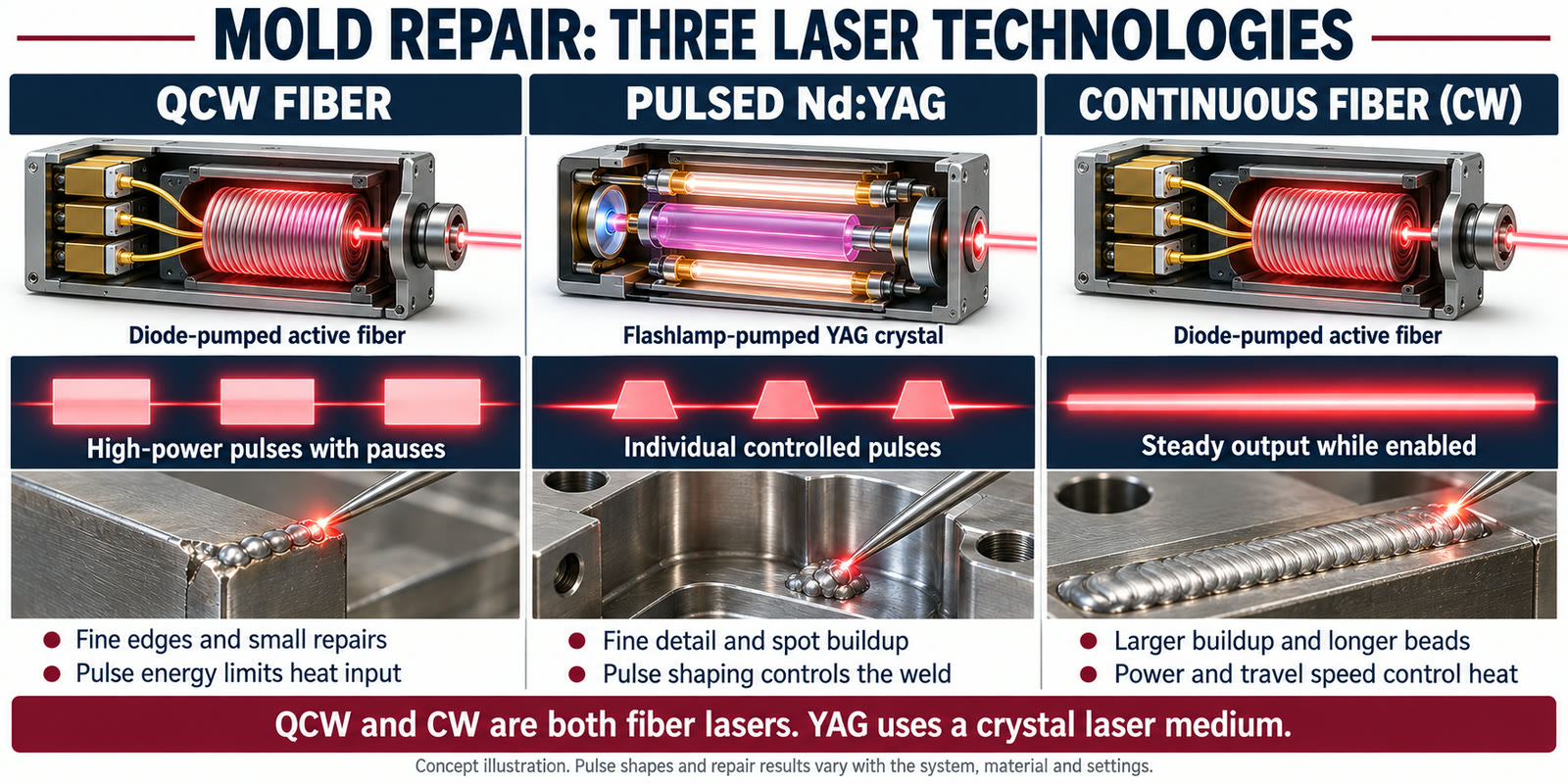
QCW fiber, pulsed Nd:YAG, and continuous fiber (CW)
QCW and CW are both fiber lasers, so the three types to compare are QCW fiber, pulsed Nd:YAG, and continuous fiber (CW).
QCW fiber: It produces powerful pulses with a lower average heat input. That suits precise repairs and controlled build-up of metal.
Pulsed Nd:YAG: It uses short laser pulses to rebuild worn edges, corners and small defects. It is a well-established choice for precise mold repairs.
Continuous fiber (CW): It delivers a continuous beam. It is often faster on larger repair areas, but you have to control the heat carefully around delicate details.
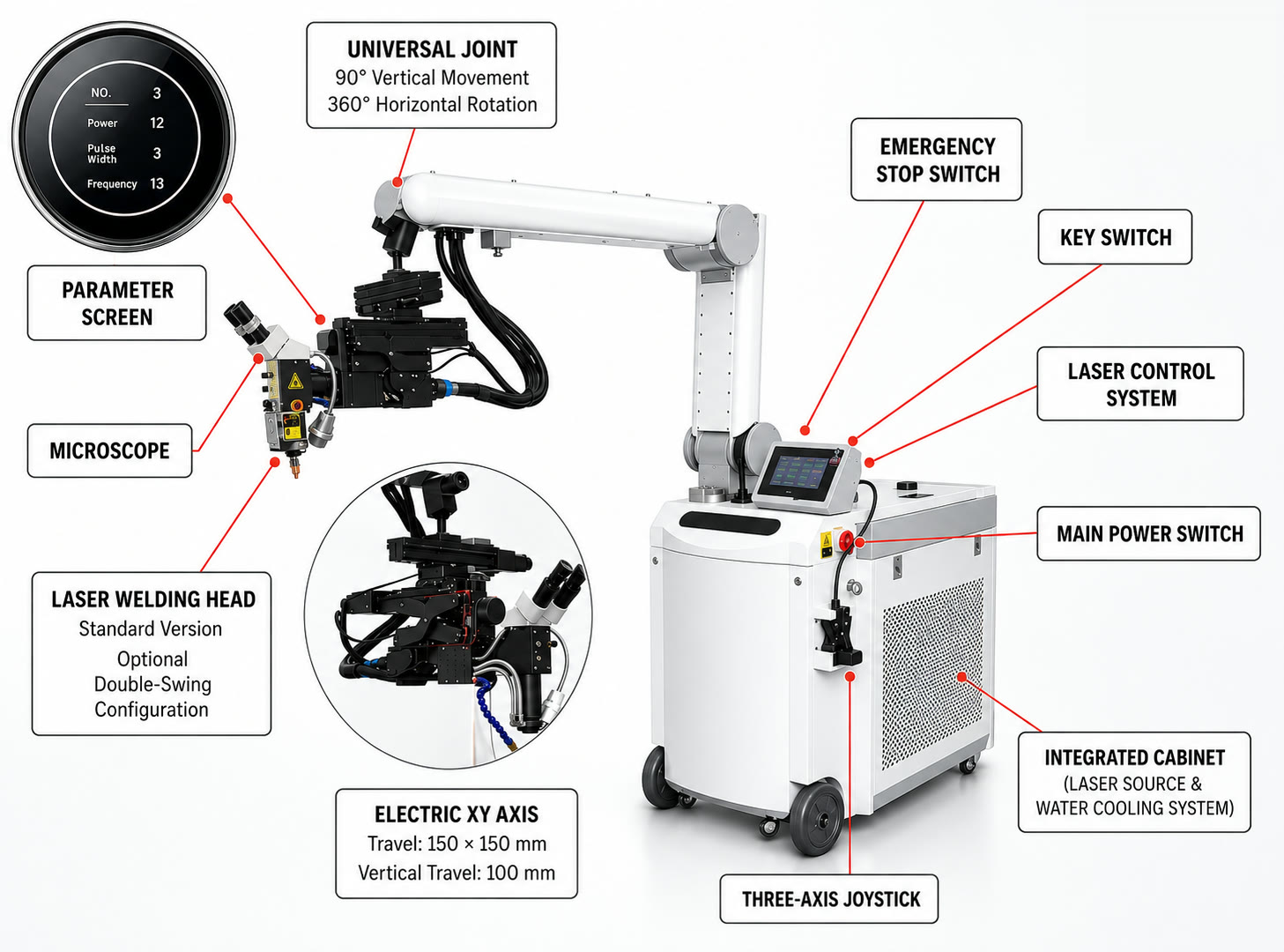
The QCW Mold Repair System is a precision laser welder built for one kind of work: repairs to molds, dies and tooling, and to precision metal parts. It adds weld metal to the worn or damaged spot and causes very little heat distortion. It replaces TIG and MIG welding for mold repair.
See the system
What QCW means
QCW stands for quasi-continuous wave. A QCW laser is neither a traditional pulsed laser nor a continuous-wave (CW) fiber laser. It operates between the two. For repair work that brings:
- High peak power, and with it deep penetration
- A low average heat input
- Very little distortion and warping
- Excellent control when a repair has to be precise
- A good fit for tool steel, mold steel, stainless steel, aluminum and copper alloys
How a repair is made
The operator works with four things: a microscope or a camera system, a precision XY table, fine filler wire (0.2 to 0.8 mm) and the QCW laser beam. In one step, the beam melts a small spot on the mold and fuses filler material into it. Worn and damaged surfaces are rebuilt this way.
Repairs the system is used for
- Mold cavities that need restoring
- Corners that have chipped
- Mold edges that have worn
- Gates that need repair
- Flash lines
- Damage at ejector pins
- Engraving that needs correcting
- Defects in the surface
Specifications of a typical system
| Specification | QCW Mold Repair System |
|---|---|
| Laser type | QCW fiber laser |
| Laser power | 150W / 300W |
| Peak power | 1500W / 3000W |
| Wavelength | 1080 nm |
| Laser source cooling | Water-cooled |
| Work platform | Motorized XYZ |
| Viewing system | Microscope |
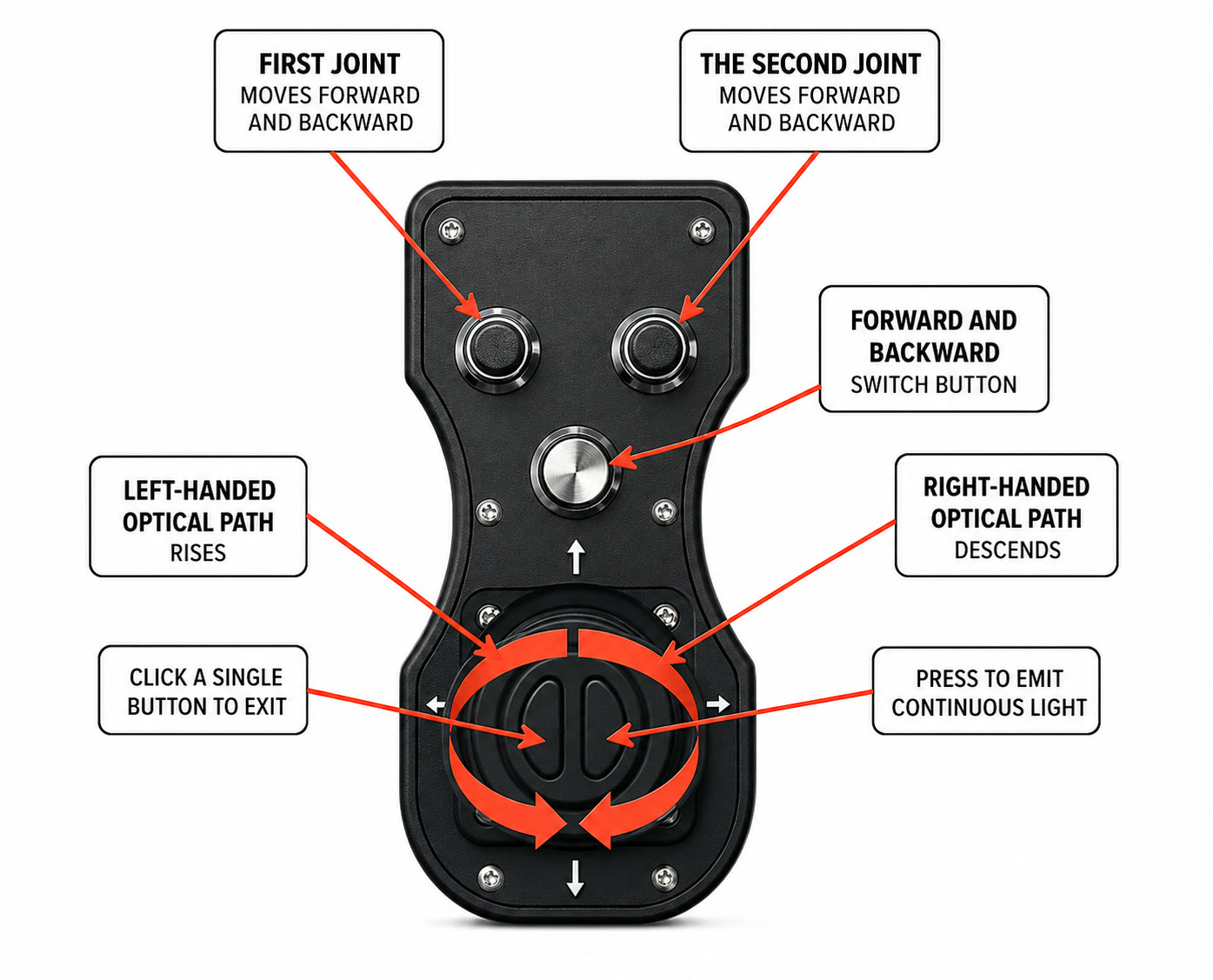
| Control | Joystick |
Where QCW mold repair lasers are used
- Die casting
- Plastic injection molding
- Stamping dies
- Automotive tooling
- Precision machining
- Medical device manufacturing
- Aerospace components
QCW mold repair laser or handheld fiber laser welder?
The two machines do different jobs. A handheld fiber laser welder is a production and fabrication welding machine. Shops use it on sheet-metal assemblies, stainless steel and aluminum. The QCW mold repair laser, by contrast, is a high-precision system for tool and mold repair. On mold repair, a QCW system offers:
- Precision at the microscopic level
- Very low heat input
- Stable control of the weld pool
- Repairs inside deep cavities
- A better cosmetic finish
- Less machining and polishing after the weld
YAG and QCW fiber mold repair lasers compared
Traditional mold repair systems use an Nd:YAG laser. QCW fiber technology is their modern replacement.
Technology
| Feature | YAG mold repair laser | QCW fiber laser |
|---|---|---|
| Laser medium | Nd:YAG crystal | Fiber laser |
| Wavelength | 1064 nm | 1080 nm |
| Beam delivery | Mirrors and optics | Fiber optic cable |
| Efficiency | 3-5% | 25-40% |
| Maintenance | High | Low |
| Lamp replacement | Required | None |
| Cooling | Large water chiller | Smaller chiller |
| Reliability | Moderate | Excellent |
| Electrical consumption | High | Lower |
How each one welds
YAG: This is the traditional choice for repairing plastic injection molds, dies and tool steel, and for precision build-up welding.
- Strengths: a very smooth weld appearance, excellent control under the microscope, and technology that is proven.
- Weaknesses: welding is slower, efficiency is lower, flash lamps need frequent replacement and operating costs are higher.
QCW fiber:
- Strengths: it welds faster and penetrates deeper, with higher peak power and a more stable output. Heat input is lower, energy efficiency is better and the service life is longer.
- Weakness: the initial investment is higher, although prices have dropped sharply.
Heat and distortion
A QCW system leaves a smaller heat-affected zone than a YAG system does. The repaired part distorts less, keeps its dimensions more accurately and needs less polishing.
Cost of upkeep
On a YAG machine, the flash lamps, reflectors and optical components have to be replaced regularly, and the cooling system needs maintenance too. A lamp typically lasts 500,000 to 2,000,000 pulses. A QCW fiber machine has no flash lamps to replace, and its fiber source typically lasts 50,000 to 100,000 hours.
Quality of the repair
Either system can give excellent results when the mold work is very fine, meaning welds of 0.1 to 0.3 mm. QCW generally wins when the repair is larger or calls for build-up welding. It has higher peak power, penetrates better and deposits metal faster.
How each machine is typically built
A traditional YAG mold welder has a large cabinet, a microscope and an X-Y-Z table. Its average power is 200W or 400W.
A modern QCW fiber mold welder is built around a fiber source. It is more efficient and more reliable, and it has a smaller footprint. Ours have an average power of 150W or 300W and a peak power of 1500W or 3000W.
Our recommendation for a new mold repair system
For a shop that is adding mold repair now, QCW fiber is the technology we recommend. The reasons:
- Maintenance costs less, because there are no flash lamps to replace
- Electrical efficiency is better
- Welding is faster and reliability is higher
- Service support is easier
- Most new mold shops prefer this technology
Older tool rooms still have YAG systems. Most new mold repair installations, though, are moving to QCW fiber-based machines. They perform better, and they cost less to own over the life of the machine.
Warranty, training and safety
The warranty depends on the laser source, and we give you the exact terms with your quote. Installation at your shop and training for your team are included in the price. For protective equipment and partitions, see laser safety. The questions below give the details.