Call us: 1-800-927-5107 647-494-7800 ext. 1008
Laser Welders

Refrigeration laser welders

Continuous welding at a 100% duty cycle

2000W: USD $28,000 · 3000W: USD $34,000

Prices include shipping, installation and training. For other power levels, contact us for a quote. Prices are in U.S. dollars. For Canada, the price is calculated in Canadian dollars at the exchange rate when the order is placed. Shipping to Canada is from Toronto, Ontario, and within the USA from Buffalo, New York, or Mount Sterling, Kentucky.

Handheld fiber laser cooled directly by a refrigerant heat pump

These handheld fiber laser welders are cooled by refrigeration in two circuits and carry a light torch. They are rated for continuous duty. Training takes place at your site, and support is local.

  • Deeper weld penetration than air-cooled or water-cooled systems
  • Steadier operation anywhere between -20°C and +60°C
  • Very high-speed wobble head for faster welding
  • 100% duty cycle: continuous welding with no scheduled cooling breaks
  • Energy use 60% lower than with other cooling systems
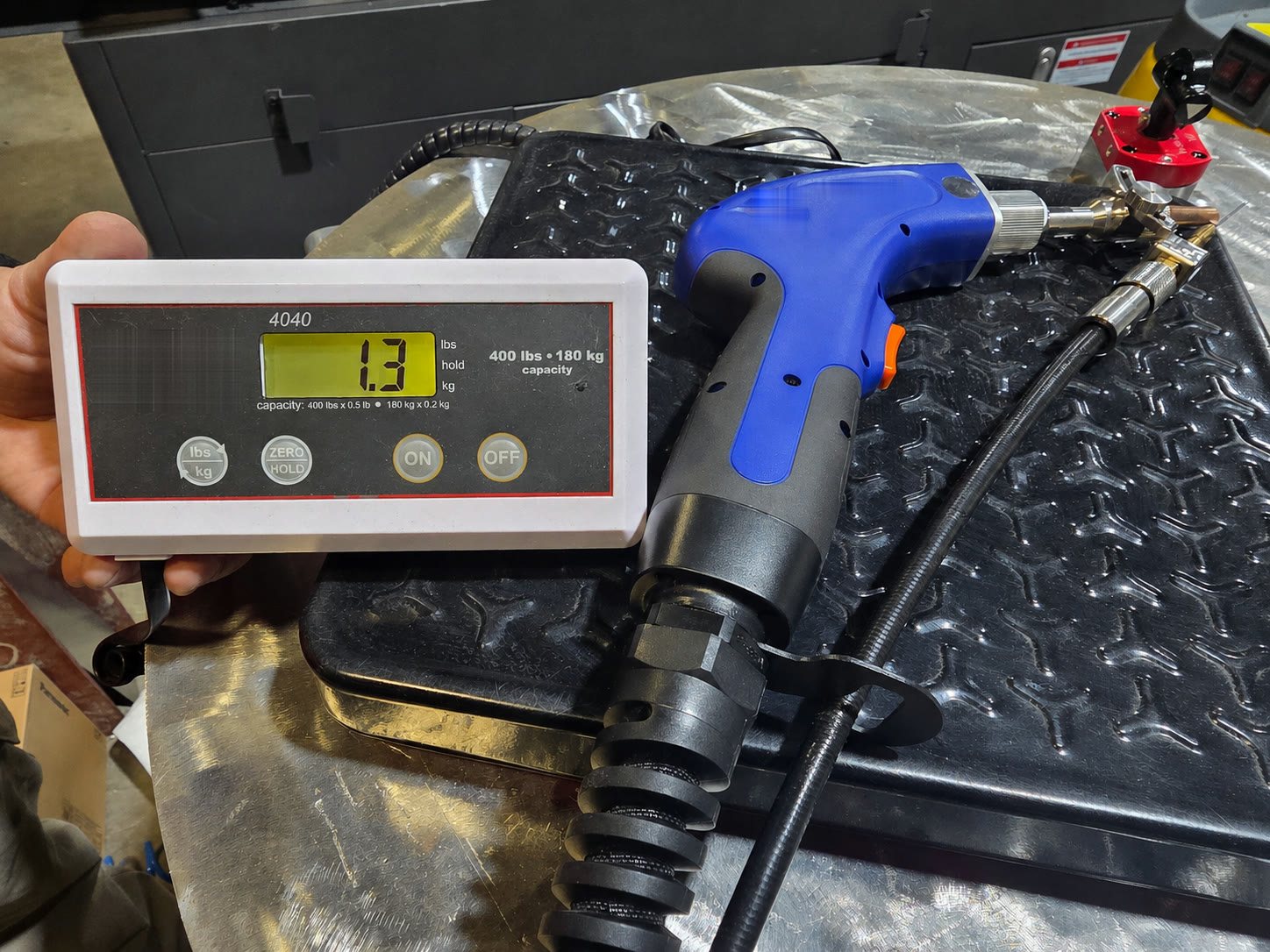
  • Torch weight: 1.32 lb (600 g)
  • Optional 15 m (49 ft) torch cable for longer reach
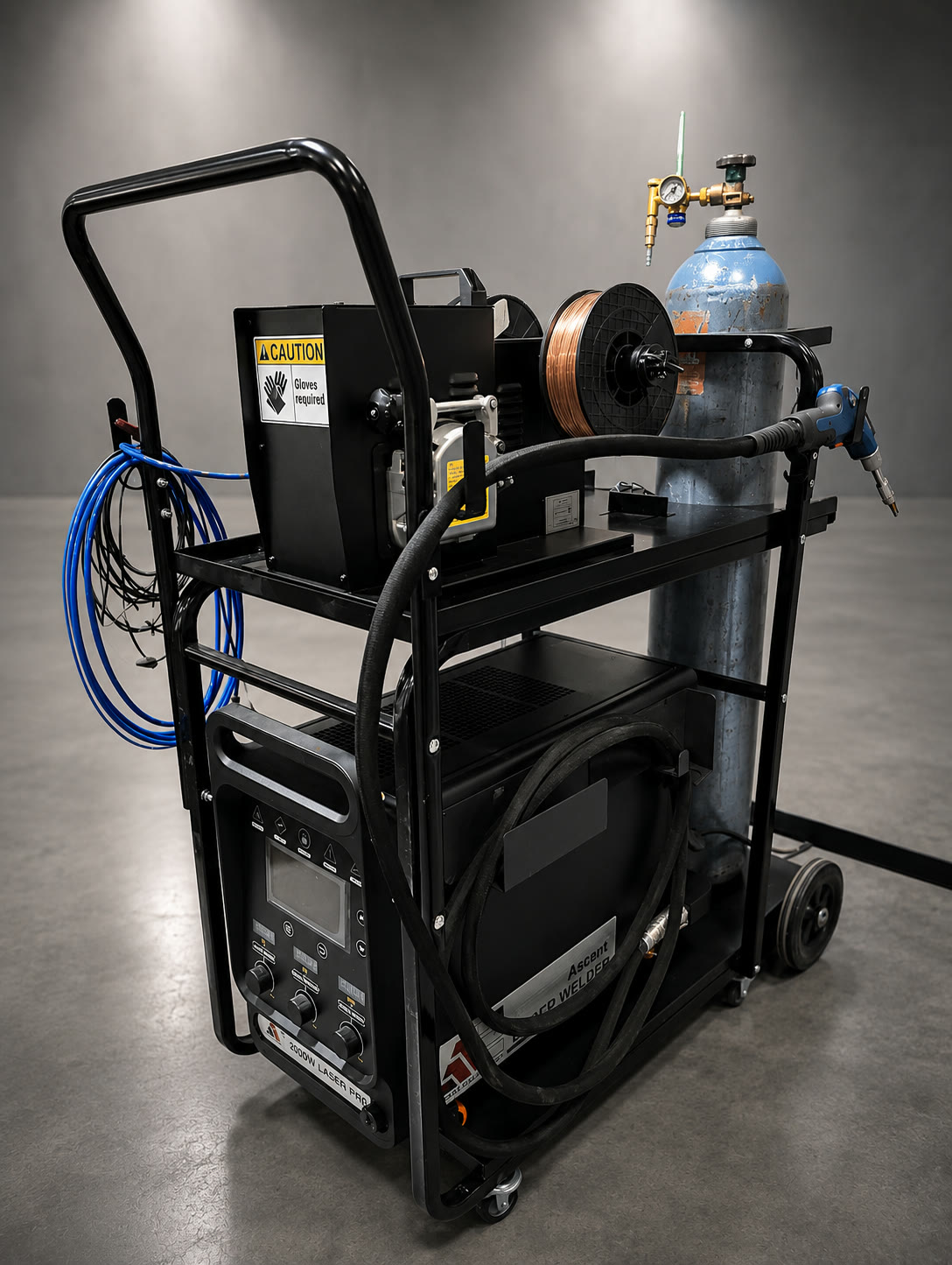
The Ascent 2000W refrigeration laser welder on its trolley with the wire feeder, a wire spool, a gas cylinder and the handheld torch

What comes in the package

Each laser welder package contains:

  • An automatic wire feeder that runs a single wire or two wires
  • Aluminum welding wire, 1.2mm, on a spool
  • A trolley for the laser welder and the argon gas tank
  • One fiber laser helmet
  • One pair of OD 8 laser safety goggles
  • Standard welding gloves
  • An assortment of laser nozzles
  • Protective lenses for the laser torch

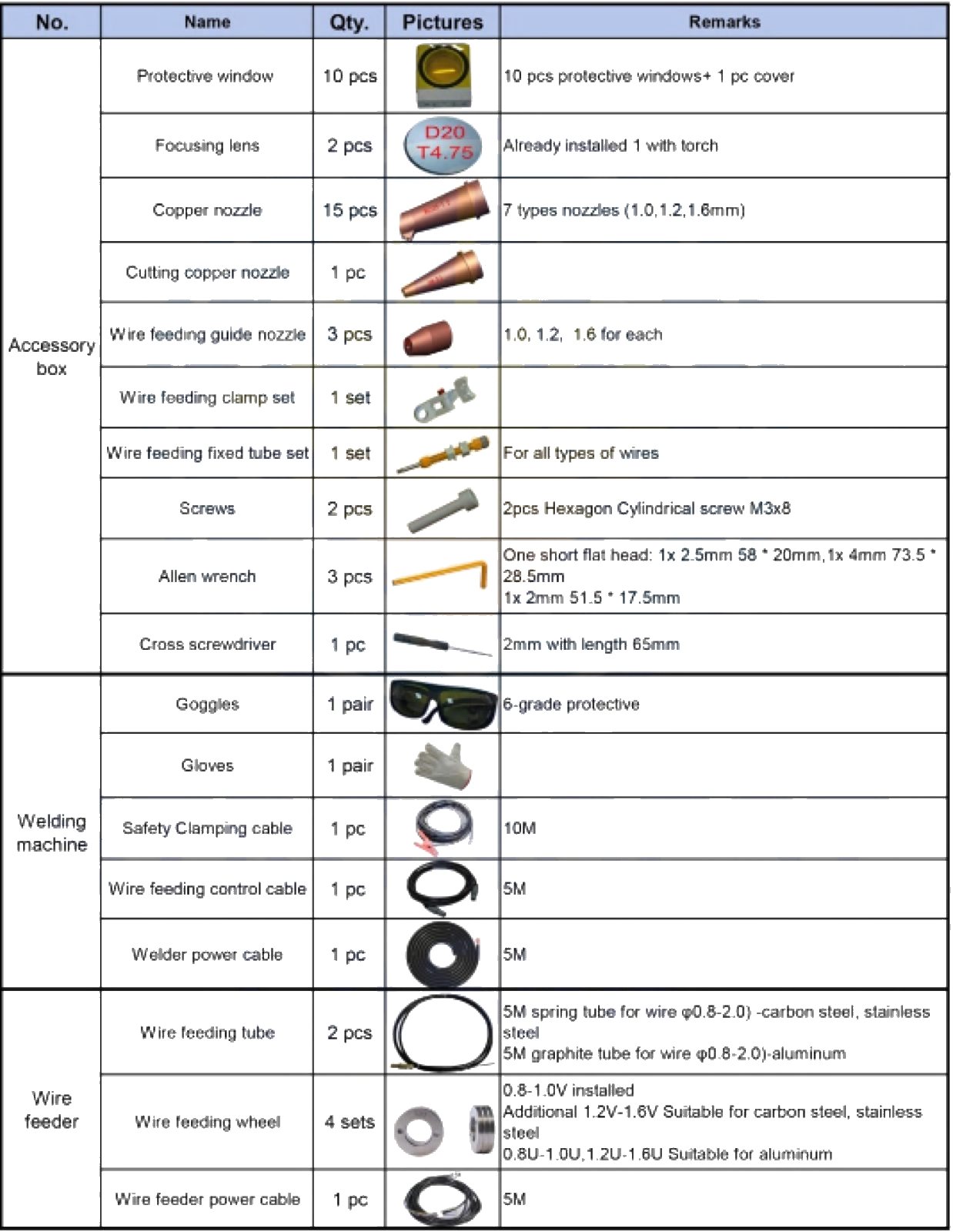
Accessory list for the laser welder with a photo of each part: protective windows, focusing lenses, copper nozzles, wire feeding parts, tools, goggles, gloves and cables

The 2000W model in brief

The 2000W handheld laser welder from Ascent is made for work in aluminum and stainless steel.

  • Fiber laser welders have replaced TIG, MIG and other traditional welding methods.
  • The refrigeration heat pump has two circuits and is designed to run continuously, with no scheduled breaks for cooling.
  • The welder is well suited to aluminum, steel, stainless steel and other metals.
  • No lighter laser welding torch is available.
  • Ascent technicians give 3-4 hours of qualified training. With it, operators who have no earlier experience of welding aluminum can weld very thin aluminum. Operators are still responsible for completing the required training, keeping to approved process controls and observing every laser-safety requirement.

See the welder at work

A demonstration of the refrigeration laser welder.

Direct refrigerant cooling in two circuits

This design removes the weak points of air-cooled welders and of water-cooled welders. The machine combines refrigeration cooling with a dual wire feeder and is made for continuous production.

An adaptive repair process package keeps the welder reliable over its life cycle. The machine checks its own status and calibrates itself automatically.

  • A highly efficient refrigeration heat pump with inverter drive does the cooling, so no water is needed
  • 100% duty cycle: the welder runs continuously and has no scheduled cooling breaks
  • At present the only welder on the market designed to work from -20°C up to +60°C (-4°F up to +140°F)
  • The heat pump has a double circuit, which makes cooling more efficient
  • Light and portable
  • Light welding torch: 1.32 lb (600 g), measuring 270 × 230 mm (10.6" × 9")
  • Uses less energy than other laser welders
  • 3-button control that is simple and easy to use
  • A new control concept that keeps the welding experience familiar
  • Very high-speed wobble head. The beam moves dynamically, and a high-speed servo controls oscillation amplitude and frequency independently
  • The torch works from a single trigger
  • A range of nozzle tips, so each joint type gets the right one
  • Dual safety light
  • For large welding projects, a fiber optic cable with triple protection, 10 m or 15 m long (33' or 49')
  • Wire is fed and retracted automatically
  • An app on your cell phone controls the welder
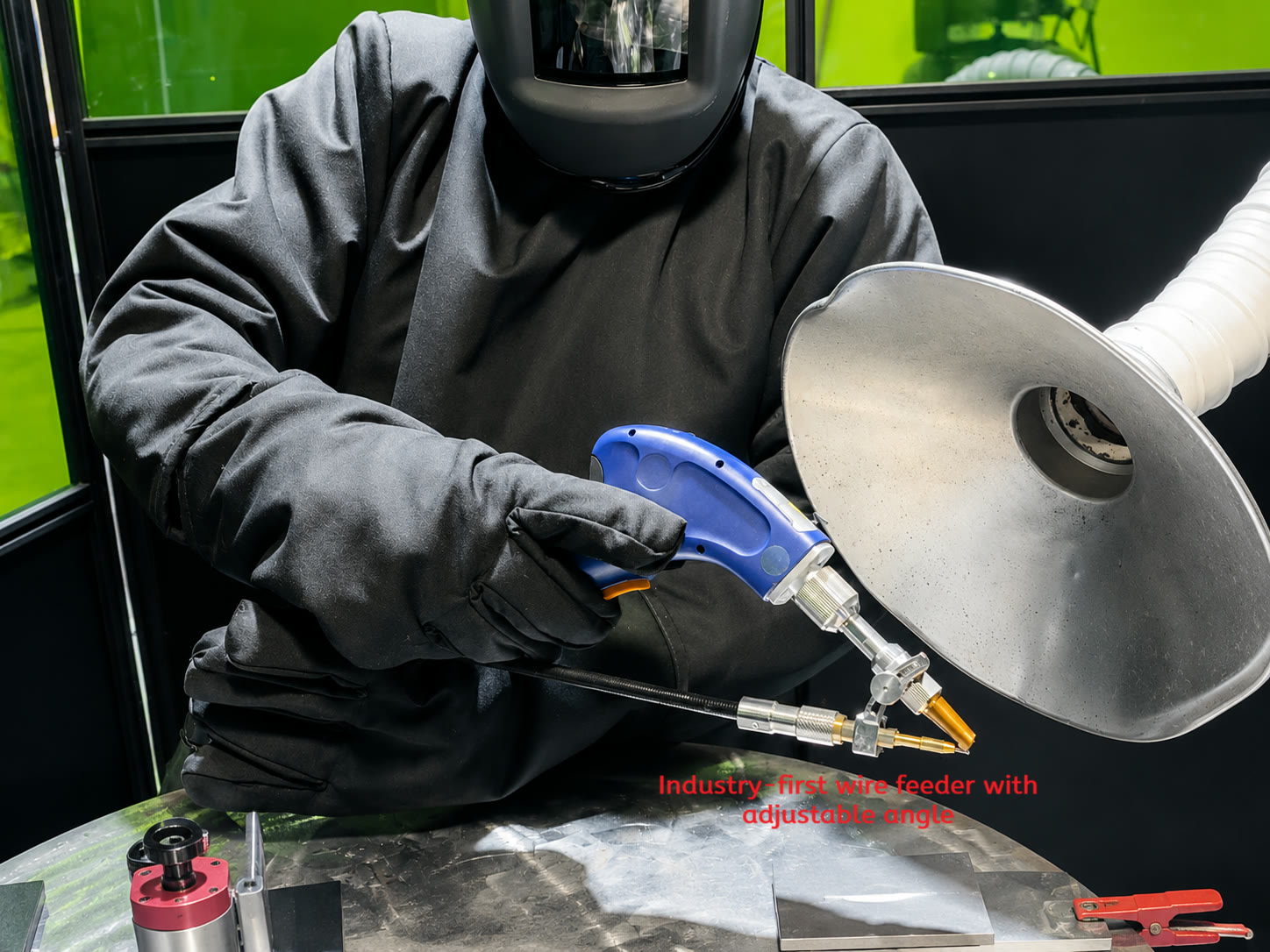
  • Dual wire feeder

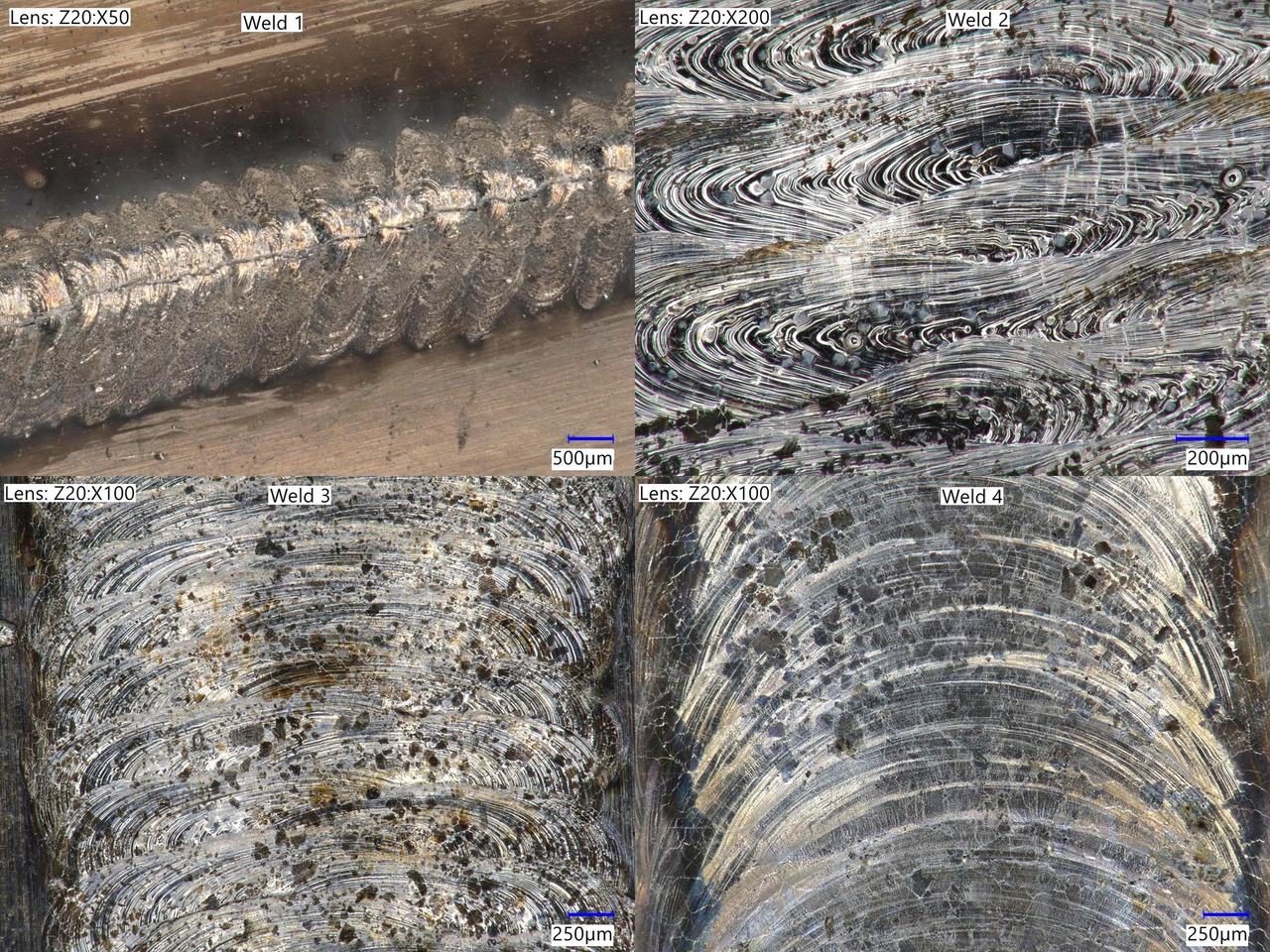
Microscope test of aluminum welds from the 2000W welder

The laser welds aluminum without distorting it. Heat input is minimal, so thin material stays flat and keeps its true size.
Android phone app for setup and control

  • Create welding parameters and adjust them with little effort
  • Select welding settings easily
  • Pick the optimal process conditions with the remote controller
  • Use the app to set welding conditions
  • Save, select and adjust welding conditions in the app, and keep an eye on interlocks, warnings and alarms
  • The app is supplied with the machine and is also available as a download from the App Store

Control panel and cooling system
Hand holding a smartphone whose screen shows the logo of the welder control app
The Android app. Set, store and watch your welding parameters on the phone.
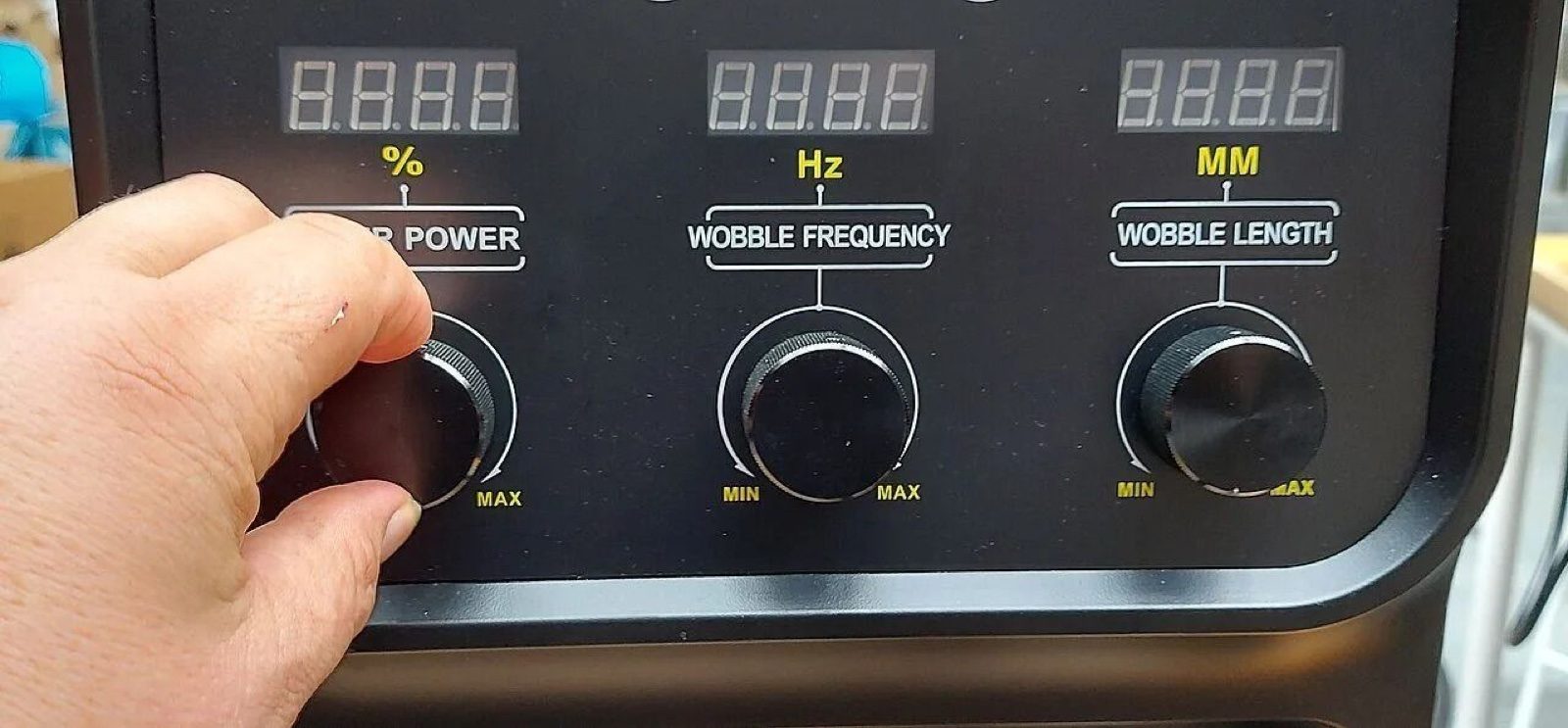
Three rotary knobs on the front panel of the welder, labeled laser power, wobble frequency, wobble length, each under a digital display
The 3-button control is simple and easy to work with.

What each knob does, and where to start: our guide Laser Welder Settings Explained: Power, Speed and Wobble covers the three controls and the starting settings from the 2000W manual.

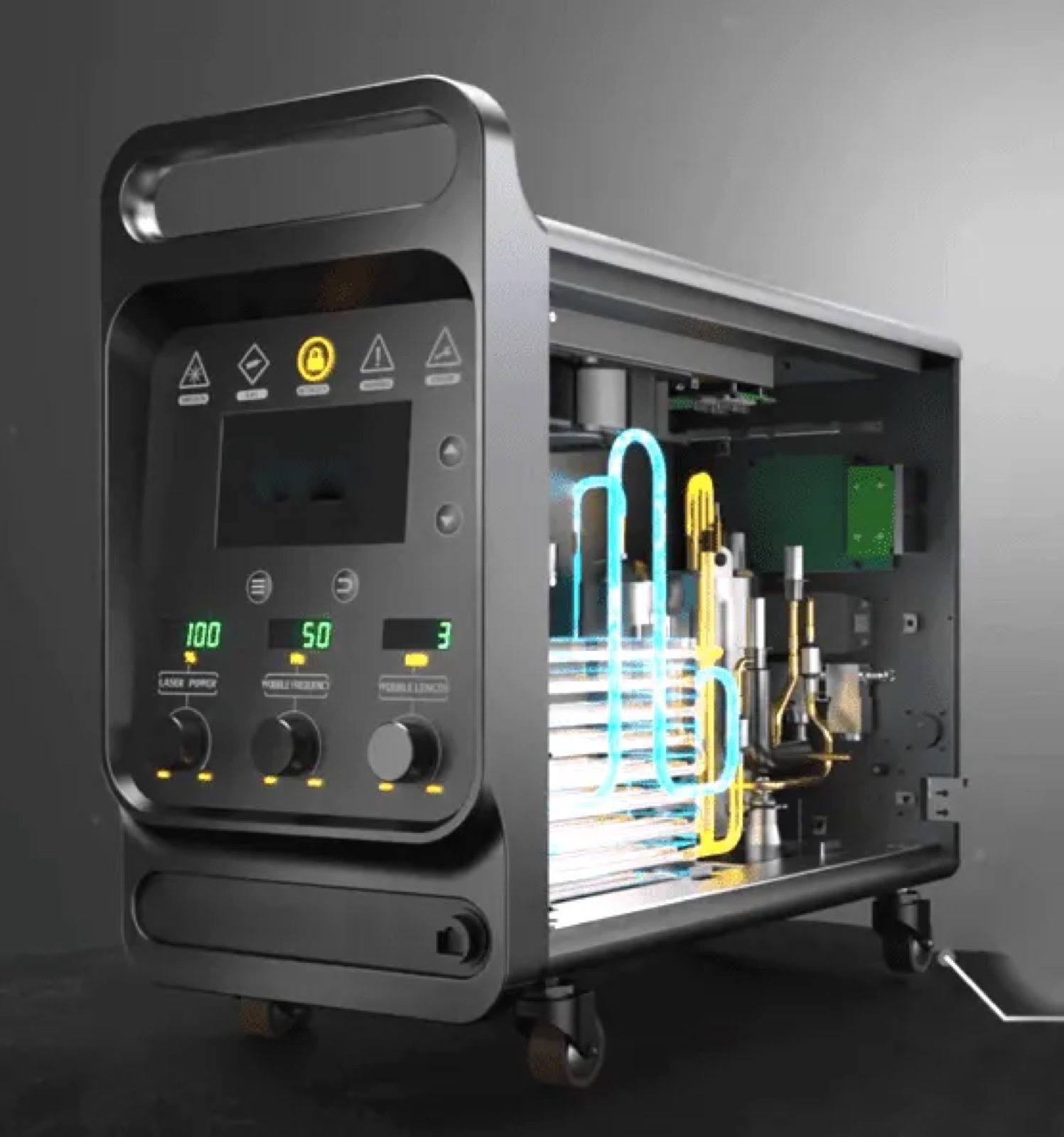
The heat pump runs on a compressor and is very economical and efficient. It is designed to run continuously with no scheduled cooling breaks, and its energy use is 60% lower than that of other cooling systems.
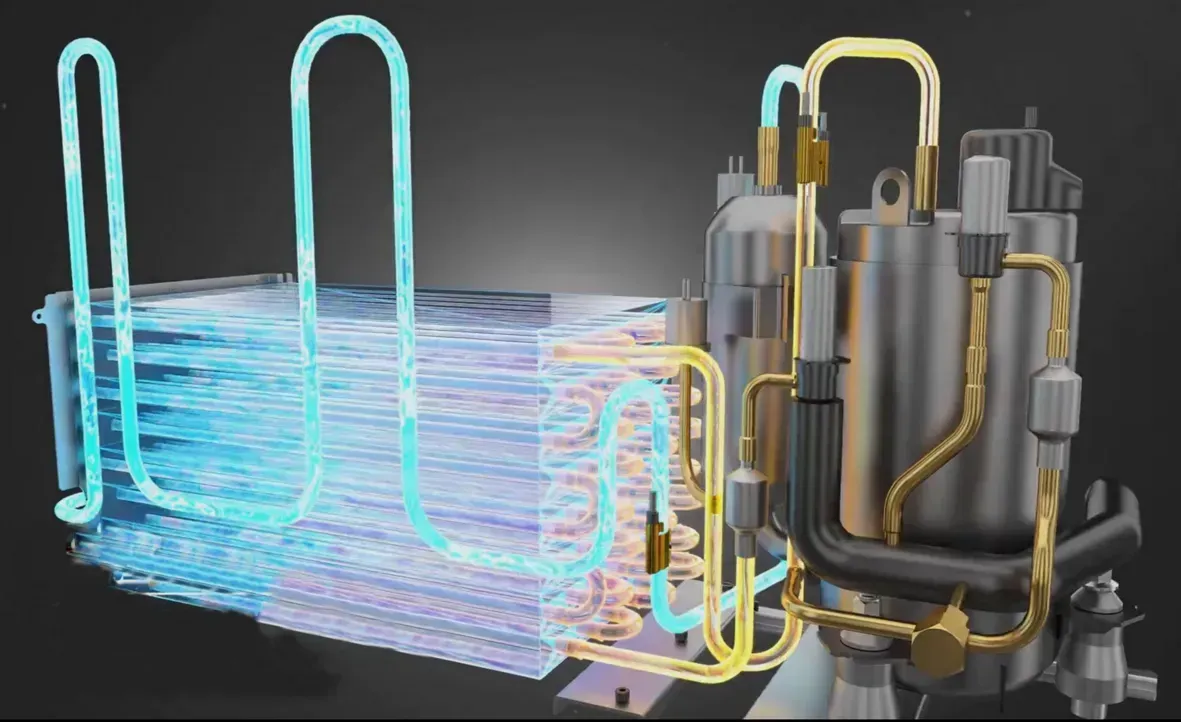
Rendering of the compressor-driven heat pump with its coil block, compressors and refrigerant lines
The compressor-driven heat pump cuts energy use by 60% against other cooling systems.
Cutaway rendering of the welder cabinet with the heat pump coils and refrigerant lines visible behind the control panel
The refrigeration heat pump has an inverter drive and is highly efficient.

No lighter torch in the industry

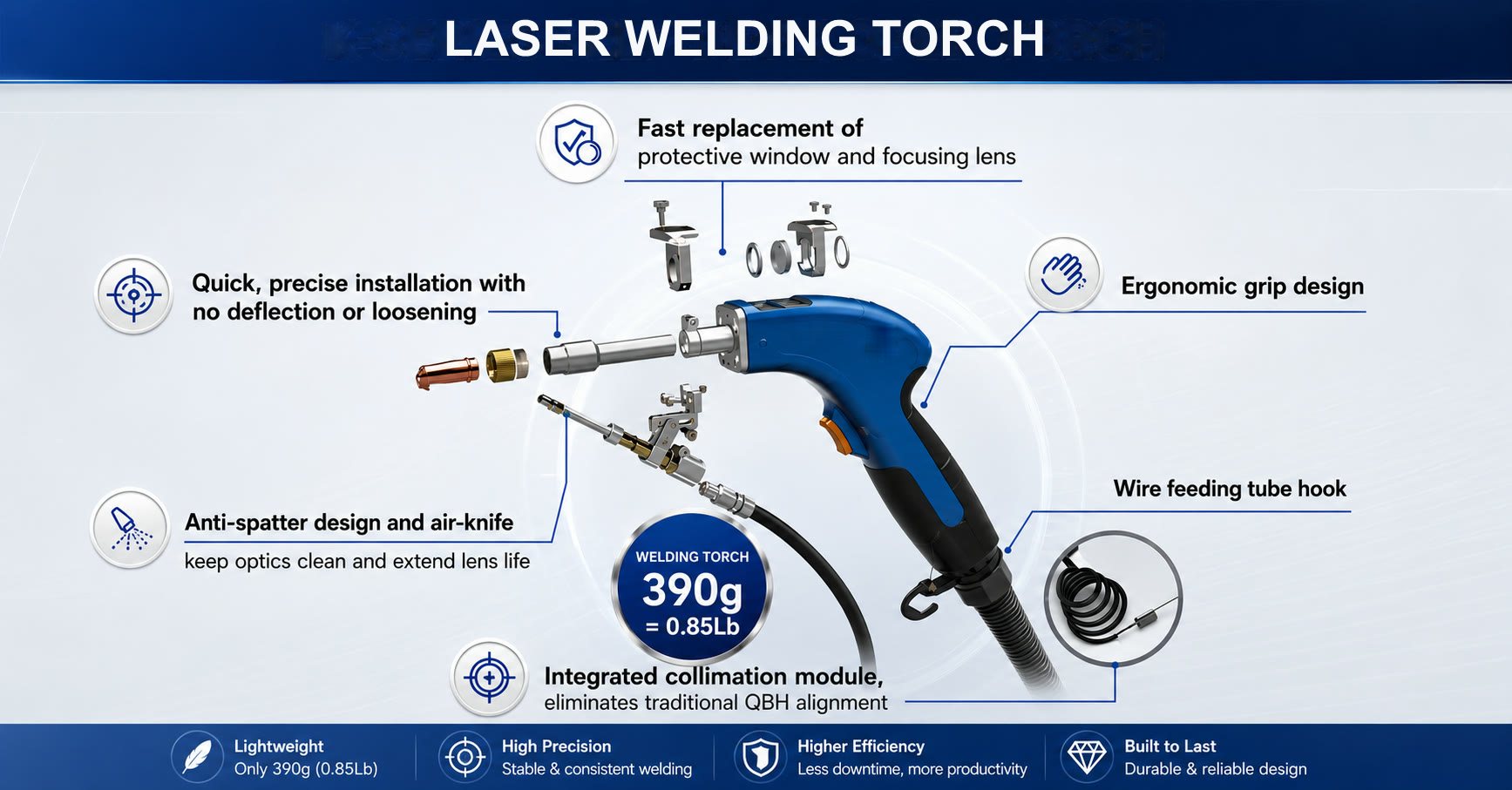
At 1.32 lb (600 g), the laser welding torch helps reduce operator fatigue. It measures 270 mm × 230 mm (10.6" × 9").

How to read the 100% duty cycle rating

The Ascent handheld fiber laser is rated for a 100% duty cycle. In practice it operates continuously and takes no scheduled breaks to cool down. In this model family the claim holds at the rated power of the selected model, inside the published ambient range, which runs from -20°C through +60°C (-4°F through +140°F), and with cooling by the integrated refrigerant heat pump and its two circuits. The duration meant is continuous operation, as opposed to a timed on/off cycle. It is a performance specification from the manufacturer, and no independent third-party protocol for testing the duty cycle is published at this time. Before you order, confirm the exact model, the power setting, the ambient conditions and the validation requirements that apply to your application.
What the dual wire feeder offers

It is made for shops that have to change from one material to another quickly:

  • Closes significant gaps
  • Can weld in multiple layers
  • Fills wide gaps: 2 x 1.6 mm wire fills a gap of 2.5 to 3.0 mm
  • Welds at extremely high speed
  • Deposits filler metal at a high rate
  • Works on thin and thick material alike, from thin sheet metal to heavier gauge
  • Simple to run
  • The two wire feeders are separate, and each wire is controlled independently. When the welder is not in dual welding mode, you can prepare the two feeders for different materials, for example stainless steel in one and aluminum in the other. The changeover from one material to the other is then very short.
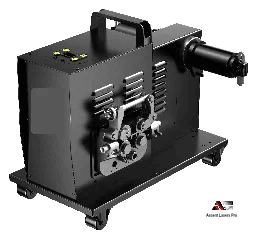
The dual wire feeder, a black unit with a carrying handle and a wire spool holder
The dual wire feeder. Each wire has its own control, so a change of material is quick.
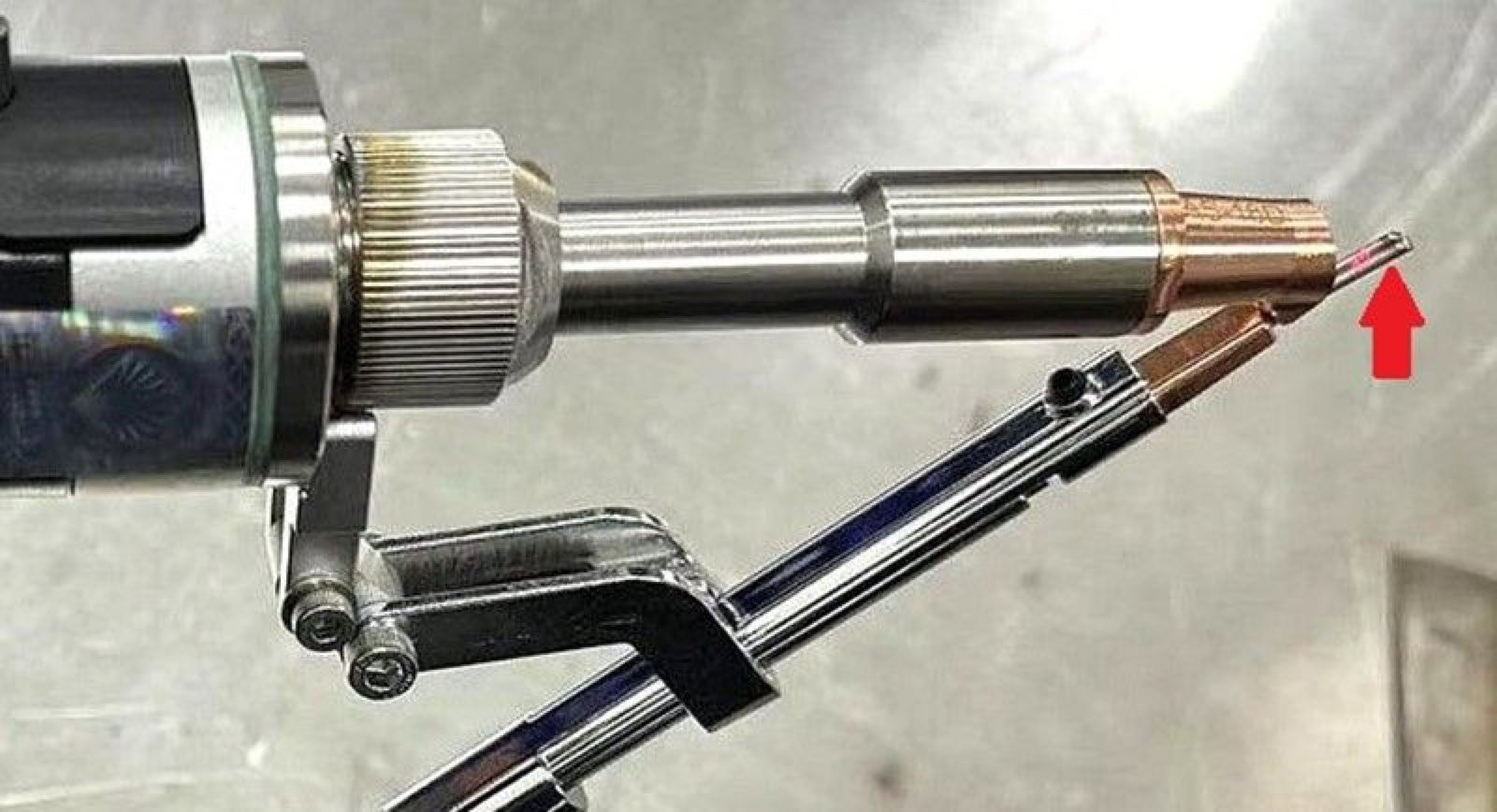
Close-up of the torch nozzle with the wire guide bringing filler wire to the tip
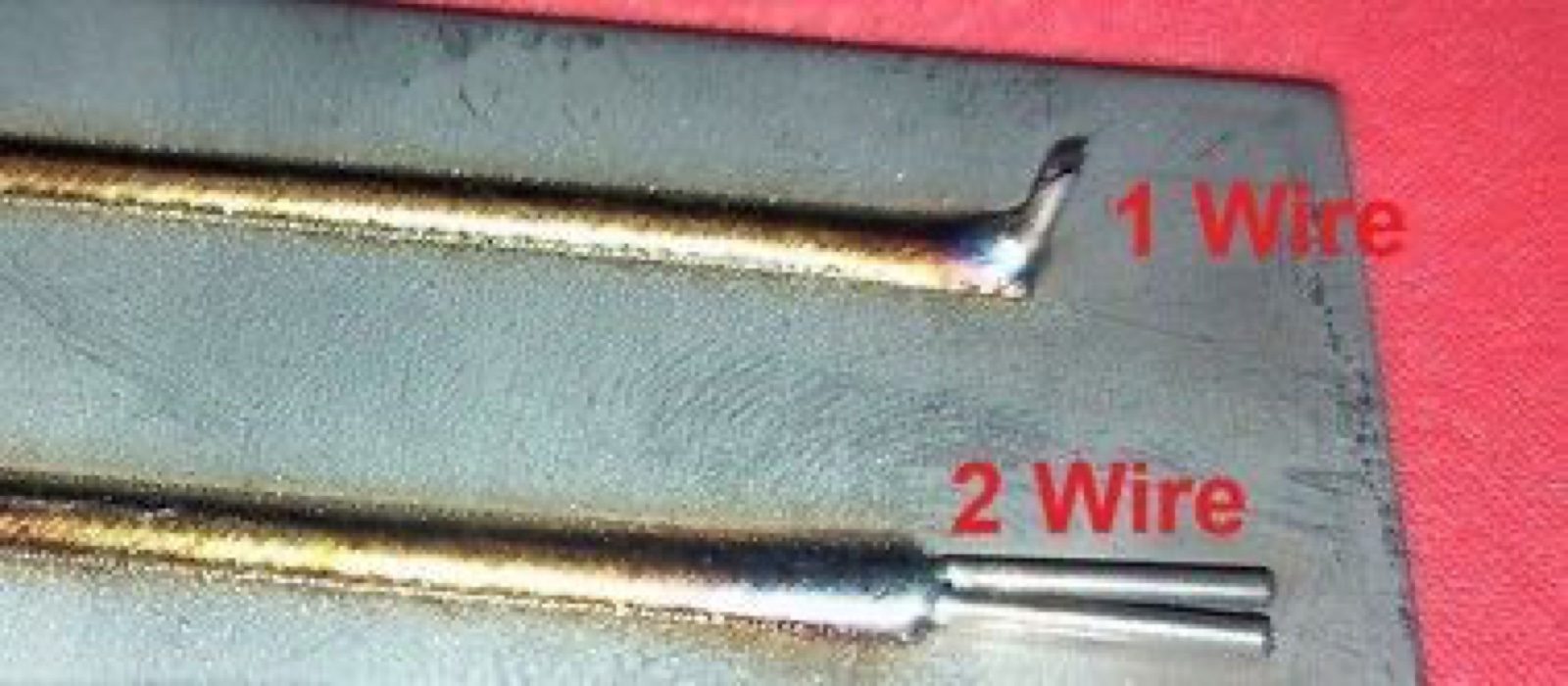
Two test beads on a metal plate, labeled 1 Wire and 2 Wire

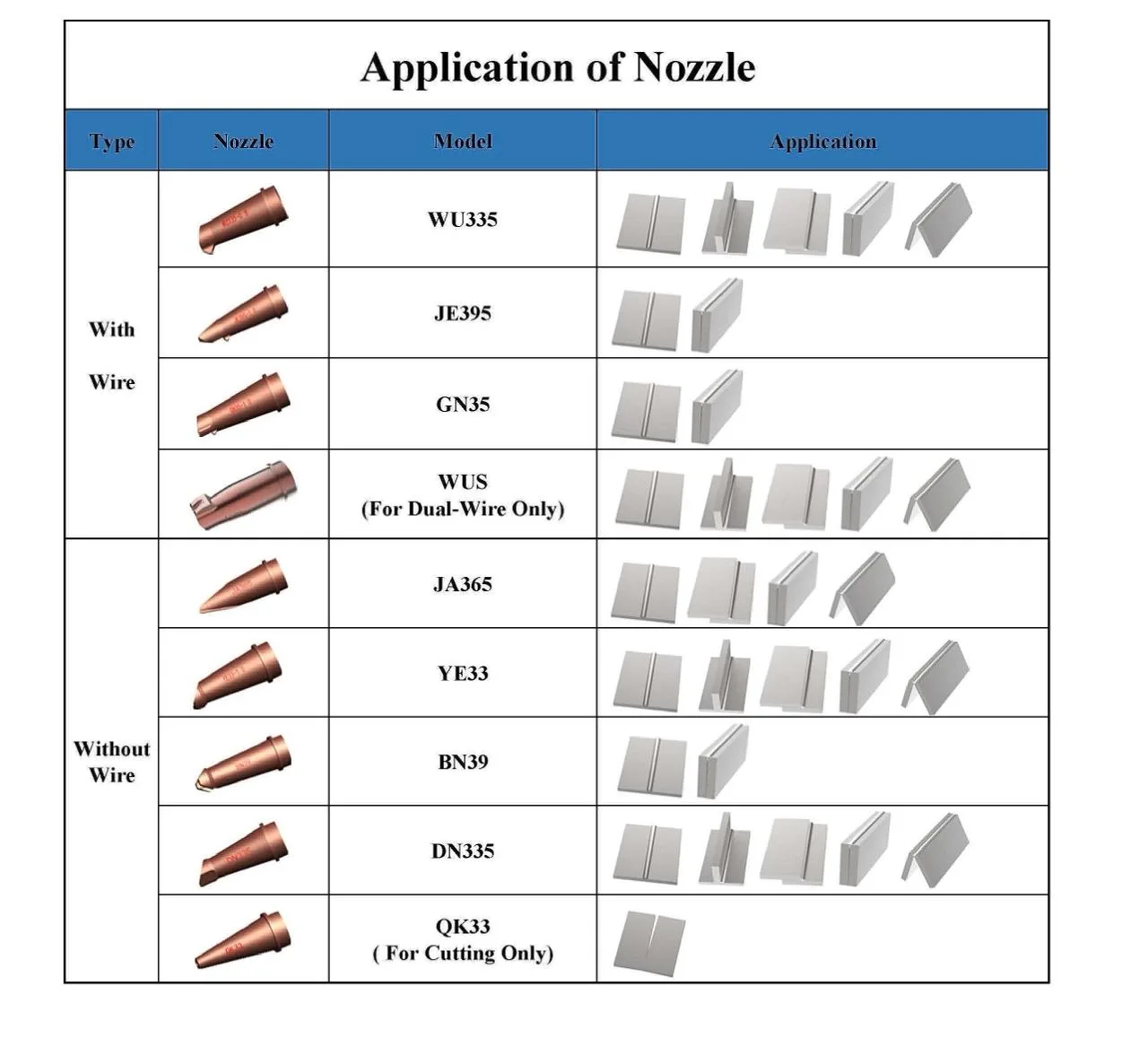
Which nozzle for which joint

For help choosing a tip for your joint, read Handheld Laser Welding Nozzles: Which Tip for Which Joint.

Specifications

Deepest weld penetration when welding from one side

Material A-PRO-HW-550
1500W
A-PRO-HW-550P
2000W
A-PRO-HW-850
3000W
Minimum material thickness0.020"0.020"0.040"
Stainless steel7.0 mm (0.28")9.0 mm (0.35")12.0 mm (0.472")
Carbon steel7.0 mm (0.28")9.0 mm (0.35")11.0 mm (0.43")
Corten steel5.0 mm (0.197")6.0 mm (0.24")8.5 mm (0.33")
Galvanized steel6.0 mm (0.24")7.0 mm (0.28")9.0 mm (0.35")
Aluminum 3000 / 50006.0 mm (0.24")7.0 mm (0.28")9.0 mm (0.35")
Aluminum 6000 alloy5.0 mm (0.197")6.0 mm (0.24")7.5 mm (0.295")
Brass3.5 mm (0.138")4.5 mm (0.177")6.0 mm (0.24")
Copper3.0 mm (0.118")4.0 mm (0.157")5.0 mm (0.197")
Titanium4.5 mm (0.177")5.0 mm (0.197")6.0 mm (0.24")
Zinc > 98%3.5 mm (0.138")4.0 mm (0.157")5.0 mm (0.197")

Machine data by model

Specification A-PRO-HW-550
1500W
A-PRO-HW-550P
2000W
A-PRO-HW-850
3000W
Fiber cable length5 / 10 / 15 m (16 / 33 / 49 ft)
Power supply cable10 m (33 ft)
Weight46 kg (101 lb)48 kg (106 lb)84 kg (185 lb)
Dimensions (L × H × W)673 × 505 × 310 mmNot listed
Operating temperature-20°C to +60°C (-4°F to 140°F)
Noise level< 58 dB< 50 dB< 58 dB
Power connection220V · 1-phase · 20A220V · 1-phase · 31A380V · 3-phase · 17A
Wire diameter0.8 / 1.0 / 1.2 / 1.6 mm0.8 / 1.0 / 1.2 / 1.6 / 2.0 mm
Predefined parameters40
Programmable parameters20

* Cooling is active: the compressors are inverter-driven and the ventilators are servo-driven.
* The greatest thickness you can weld depends on the quality of the material.
* 220V models accept 190V to 240V.
* 380V models accept 360V to 420V. Tell us your shop's three-phase voltage, and we can supply the correct transformer.
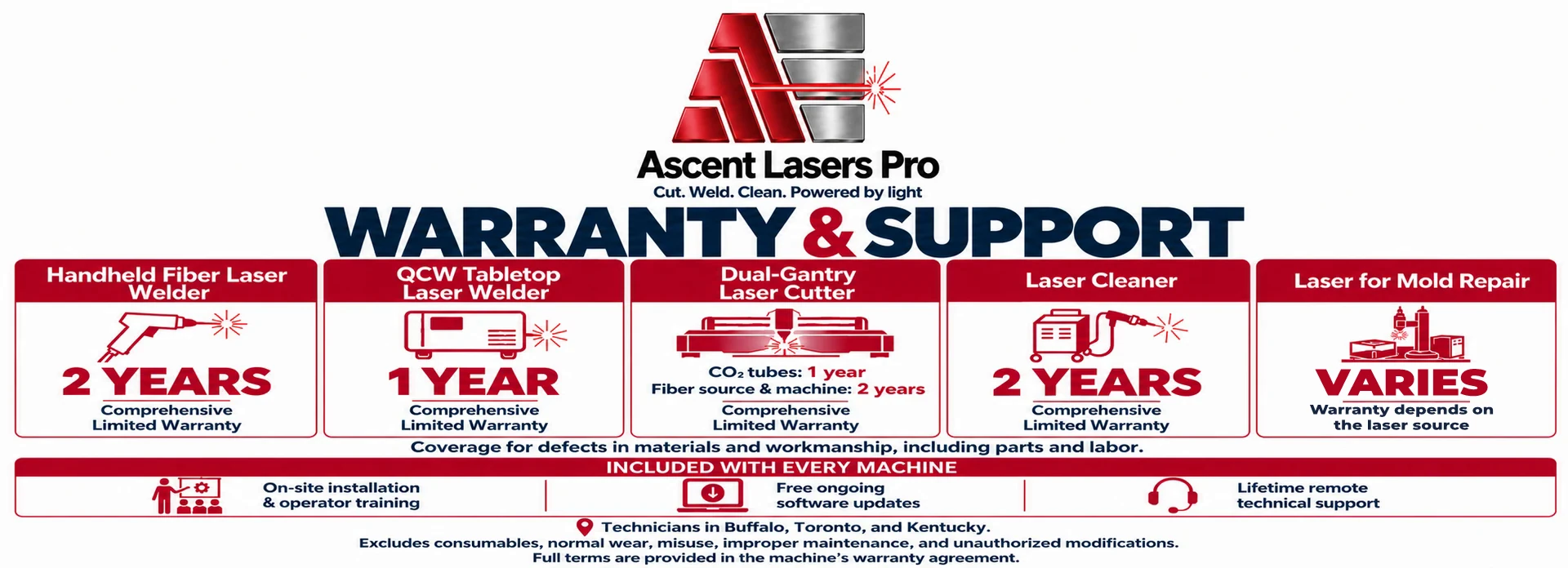
Warranty and support
For a quote on the 1500W, 2000W or 3000W model, contact Ascent Lasers Pro. The STR Series is a separate line of refrigerant-cooled welders with its own page: STR Series refrigeration laser welders.

FAQ

Questions buyers ask about this machine

What is included in the quoted price? Are there any hidden fees?
No hidden fees. Ascent Lasers Pro quotes one price, and it covers everything needed to operate the welder, with no add-ons or extra charges. Shipping and on-site installation and training are included in the price. Also included are ongoing software updates at no added cost, a 2-year comprehensive warranty covering parts and labor, and remote diagnostics and assistance for the lifetime of the machine. The service technicians are stationed in Buffalo, Toronto and Kentucky, which keeps help within reach.
What warranty comes with the welder?
A 2-year comprehensive warranty that covers parts and labor comes with each Ascent handheld laser welder.
What makes the Ascent handheld fiber laser welder different from others in the industry?
A refrigeration heat pump cools the Ascent laser welder, so it can operate continuously and takes no scheduled cooling breaks. The torch is compact and fits a working space with a stroke of 1.5 inches. It weighs 1.32 lb (600 g), which keeps operator fatigue down. The welder handles aluminum in thicknesses of 0.040 in. to 0.27 in., and its dual wire feeder deals with larger gaps. You receive a complete set: the machine, one fiber laser helmet, one pair of OD 8 laser safety goggles, standard welding gloves and a trolley.
How should we handle laser safety?
When you run a laser welder, wear laser safety goggles rated for its wavelength. We supply one pair of OD 8 goggles and one fiber laser helmet with every handheld welder, and the goggles stay on under the helmet. If more people need them, extra goggles and helmets are available from us. Minimum OD 5; prefer OD 7 or 8. Add the standard welding gloves that come with the welder, or buy gloves and an apron rated for over 5,000 °F from us. Work behind laser partitions from us, or in a complete laser room we supply with a door and an interlock connected to the welder, and have a qualified person, such as a laser safety officer, check the setup. A laser cutter needs a cover, so buy it with one, or put our partitions around it. Fumes from a laser cutter go outside through ventilation, or through a special filter that you purchase.
Can the welder cut metal too, or does it only weld?
It can do more than weld. The handheld welders and the refrigeration welders will cut various materials, and they will clean off rust or oxidation. Treat that as a secondary capability, since the main purpose of the machine is welding. A handheld laser welder can clean only a very narrow path, so for professional laser cleaning, see our fiber laser cleaner page. Dedicated cutting is the job of Ascent fiber laser cutters, which are separate machines built for it. The dual-gantry CO2 and fiber system is one example.
What separates the 1500W, 2000W and 3000W models in practical terms?
Mainly the maximum weld penetration and the speed on thicker material, both of which depend on power. In stainless steel, the 1500W model reaches roughly 7 mm, the 2000W model 9 mm and the 3000W model 12 mm. Aluminum, carbon steel and other metals gain depth in proportion. Most work in standard-gauge stainless steel and aluminum needs no more than the 2000W model, while the 3000W model serves heavier fabrication. The penetration tables are in the specifications section of this page.
Does this welder use air cooling or a water chiller?
It uses neither one, as those terms are normally understood. A heat pump cools Ascent refrigeration welders. It replaces both the traditional fan-driven air cooling and the water or glycol chiller loop. The result is a 100% duty cycle across the range of -20°C to +60°C, and none of the maintenance work that a water chiller brings.
What does wobble welding do for thin sheet and joints with gaps?
Wobble welding swings the beam in a controlled pattern, where an ordinary weld would trace one straight line. The motion comes from a high-speed servo, with amplitude and frequency adjusted separately. The weld bead gets effectively wider and the head keeps its speed. A wider bead forgives small gaps in the fit-up, and along a curved joint it leaves a more uniform seam.
What gas shields the weld?
Argon. Ascent handheld and QCW systems use it as the standard shielding gas when welding aluminum. During welding it prevents oxidation of the weld pool. A gas regulator ships with every Ascent laser, and you set the flow rate to suit the material.
How often do consumables need replacing, and are they expensive?
It depends on the materials you run. Each Ascent laser welder is delivered with a starter set: nozzles, a protection lens and ceramic rings for the cutter side, and wire and nozzle tips for the welder side. When they wear out, replacements are inexpensive.
Which electrical service is required for installation?
Each model has its own requirement. The 2000W welder takes 220V single-phase power at 31A, which a standard 240V single-phase circuit should cover, and the 3000W welder takes 380V three-phase power at 17A. US plants usually have 208V or 480V three-phase and Canadian plants 600V, so the 3000W is normally fed through a transformer we can supply, UL/CSA-certified; let us know your shop's three-phase voltage. Get an electrician to verify the service capacity of your shop before the machine is installed. The full specifications are in the tables on this page.
Is it possible to weld steel to aluminum, or other pairs of different metals?
In many cases, yes. Whether two different metals can be welded depends on the pair and the joint, so send us your specification, and we'll let you know what's possible for your application. Some pairs, steel and aluminum among them, form brittle compounds when fused directly, and shops often join those with clips or rivets instead.
Can you laser weld titanium?
Yes. Fiber laser welders, including suitable handheld systems, weld titanium well. The main requirement is excellent shielding from the air. Use high-purity argon, protect the weld pool and the hot weld as it cools, usually with a trailing shield, and add argon on the back side wherever the underside gets hot or the weld goes through. Keep the joint thoroughly clean and dry to reduce porosity. The penetration table on this page lists titanium for each model.
Will the welder work outdoors or at a remote job, such as repairing a mold on site?
Yes. It is a portable handheld platform, the same one the Ascent mold-repair welder is built on. Refrigeration-cooled models carry an operating rating of -20°C to +60°C, enough for most outdoor conditions and most on-site repairs. Off the grid or on a fully mobile job, power the welder from a suitable generator: 220V single-phase for the 1500W and 2000W models, or 380V three-phase for the 3000W. Running on a generator is covered by the warranty. Email us which model you plan to use, and we'll send the generator information.
What does day-to-day maintenance involve?
Not much. Before you make the first weld, look for spatter on the lens and clean the lens if you find any. Check that the wire feeds. Confirm that the proximity sensor and the safety interlocks fire as they should.
Air cooling or refrigerant cooling: which is the better system for a laser welder?
Refrigerant cooling is the better choice for high-power laser welders, from 1,500 W to 3,000 W, that run continuously. It holds the temperature steadier. It gives the laser source and the welding head the best protection. And it delivers a dependable 100% duty cycle, so performance stays consistent.
What is the thickest steel these welders can join?
The answer changes with the model and with the type of steel. These are the limits for single-side welding. The 1500W model welds stainless or carbon steel up to 7 mm thick. The 2000W model welds the same two steels up to 9 mm. The 3000W model welds stainless steel up to 12 mm and carbon steel up to 11 mm. At every power level, penetration is somewhat lower in galvanized steel and in Corten steel. The penetration table on this page covers every material the welders are rated for.
Can the laser torch reach into narrow spaces that a MIG torch cannot enter?
Yes. The torch of the Ascent laser is compact and needs only a 1.5-inch stroke of working space. It gets into narrow recesses where the bulkier tip of a MIG torch often has no clean access. The wobble head takes care of contoured seams. Together they make the welder suitable for tight-clearance work, and not only for open, flat joints.

Talk to a laser specialist about your welding or cutting job

Contact us