Laser safety
Class 4 laser safety in the US: the rules, the gear and the paperwork
This page is general and educational information. It is not legal advice, and it does not replace a trained Laser Safety Officer (LSO), whose role is defined in the ANSI Z136 standards from the American National Standards Institute.
A Class 4 industrial laser in the United States is not covered by one rulebook. Three sets of rules meet at your machine: the FDA regulates how the laser product is built, workplace safety law protects the people who run it, and a handful of states add their own laser registration on top.
Only seven states run a registration program that plainly reaches industrial lasers: Arizona, Florida, Georgia, Illinois, Massachusetts, New York and Texas. For the rest, the official sources we checked showed no such program. That is not proof that nothing applies, and a few states are worth a phone call. Registration is paperwork in any case. A safe shop comes from the controls and habits inside your own walls.
This guide is for private employers that weld, clean or cut metal with Class 4 lasers: handheld fiber welders, pulsed laser cleaners, enclosed laser cutters, and the demonstration, service and trailer work that goes with them. It starts with the rules that apply to every machine, then goes through cutters, welders and cleaners one at a time. Medical laser licensing and entertainment laser variances are separate systems and are not covered here.
Reviewed October 2026. State programs change, so check anything that affects your shop with the agency before you rely on it.
Class 4 lasers in brief
A Class 4 laser is the most hazardous laser class, and the class has no upper power limit. For visible beams it starts at 500 milliwatts of output. The fiber lasers in welders, cleaners and metal cutters are far above that.
- Eyes. The direct beam or a reflection of it can cause a serious eye injury in an instant. Even scattered light from the spot on a wall can be harmful at close range, so do not stare at it.
- Skin and materials. Up close, the beam burns skin and sets fire to materials, especially dark or light, thin ones.
- Know where the beam is. Keep it away from heads and eyes, and keep it off any skin or surface it is not meant to hit.
Who is responsible for what
Five different bodies have a say over a Class 4 laser. Their areas rarely overlap, so it pays to know which one a question belongs to.
| Body | Its area | What you need to know |
|---|---|---|
| FDA, Center for Devices and Radiological Health (CDRH) | The laser product itself: its design, performance, labels, manufacturer reports and imports, starting with 21 CFR 1040.10 and the reporting and certification rules around it. | This is mostly the manufacturer's duty. Importing, integrating or relabeling equipment can make some of it yours. |
| Federal OSHA, or a state OSHA plan | Hazards to employees on the job. | The PPE, respirator, lockout, chemical, machine guarding and electrical standards are enforceable. Serious laser hazards that are widely recognized fall under the General Duty Clause. |
| State radiation control program | In states with laser rules: registration, safety programs, safety officers, training, inspections and notices for temporary use. | Registering in your home state does not cover you anywhere else. |
| ANSI and the Laser Institute of America (LIA) | Consensus standards such as ANSI Z136.1 and ANSI Z136.9, the one for manufacturing settings. | Not law by themselves. They become binding when a state rule adopts a named edition. |
| Local fire and building officials | Occupancy, fire prevention, compressed gases, ventilation and installation. | Talk to them before you build a permanent laser booth or fit out a mobile rig. |
The OSHA rules that are enforced
There is no OSHA laser standard for general industry. OSHA has a laser chapter in its Technical Manual and an archived 1991 laser directive. Both describe hazards and controls, but they are guidance, and not everything they describe is a legal duty.
An OSHA inspector cites the standards that match your hazards, plus the General Duty Clause. To use that clause, OSHA has to show a recognized hazard that could seriously hurt someone and a practical way to fix it. Skipping a single ANSI recommendation does not meet that test by itself. These are the standards that come up most often around industrial lasers:
| Standard | Applies when | What it requires |
|---|---|---|
| General Duty Clause, OSH Act section 5(a)(1) | A recognized serious hazard exists and no more specific standard addresses it | A workplace free of recognized hazards likely to kill or seriously injure. Laser engineering controls and accepted industry practice can show that a hazard was known and could be fixed. |
| 29 CFR 1910.132(d) and (f) | There are eye, face, skin or other hazards that call for PPE | A written, certified hazard assessment naming the workplace, the person who did it and the date. PPE that fits, training, and proof that each worker understands the training before using the gear. |
| 29 CFR 1910.133 | Eyes and faces are exposed to hazards, harmful light included | Suitable eye and face protection that covers impact and process hazards as well as the laser wavelength. |
| 29 CFR 1910.134 | Respirators are needed for the work or required by the employer | Engineering controls come first. Then a written program, medical evaluations, training, and fit tests for tight-fitting respirators. |
| 29 CFR 1910.1000 and the standards for specific substances | The base metal or a coating gives off fumes, dust or gases | Exposures kept below the limits. If lead, hexavalent chromium or another listed substance is present, its own standard applies too. |
| 29 CFR 1910.1200 | Hazardous chemicals are used | A hazard communication program with labels, safety data sheets and training. |
| 29 CFR 1910.147 | Servicing could start a machine unexpectedly or release stored energy | An energy control (lockout) program covering isolation, verification and training. An emergency stop does not isolate energy. |
| 29 CFR 1910.212 and Subpart S | There are mechanical and electrical hazards | Guarding for moving parts and compliance with the electrical rules. Laser exposure gets its own assessment. |
| 29 CFR 1910.157 | Portable fire extinguishers are provided | Extinguishers chosen for the fire classes you expect, within the required travel distances (75 feet for combustible metals), and training for the employees expected to use them. |
| 29 CFR 1926.54 | Construction work, and only construction work | Only people who are qualified (and can prove it) may install or run the laser. It also calls for posted warnings, protective equipment, and beams kept away from workers. General industry falls outside it. |
Anything else is technical guidance, unless a state rule or the conditions of a registration make it compulsory. The older OSHA documents also contain outdated references, so check current requirements before you reuse their exposure tables or sign layouts.
Name a laser safety officer first
A laser program needs one accountable person: the laser safety officer (LSO). The LSO classifies the equipment, assesses the hazards, chooses the controls, writes the procedures, approves training and changes, and must have the authority to stop unsafe work. Some states make the LSO mandatory.
Legal responsibility stays with the employer. Appointing an LSO does not hand the employer's duties to an employee, and it does not make an unsafe setup acceptable. Make the appointment in writing. Say which machines, locations, mobile jobs and service work it covers, whom the LSO reports to, and who the trained backup is. A good LSO knows where their competence ends, and hands questions beyond it to the right expert: an industrial hygienist, a controls engineer or a specialist in laser safety. An LSO cannot waive a state requirement.
Federal OSHA sets no course length for LSOs, does not license them and does not fix a refresher interval, although states may set qualifications and training. A certificate shows knowledge, not the ability to manage every machine, so look for hands-on experience with your wavelengths, pulse modes and tasks. LSO training should cover hazard analysis and running a safety program, not just how to make a weld or operate a cleaner. Keep operator training and LSO qualification separate, with separate records.
Keeping the beam where it belongs
These practices come from OSHA's laser guidance. Pair them with the manufacturer's design information and, if your state names one, with that edition of ANSI Z136.
Work out the hazard instead of guessing a distance
The maximum permissible exposure (MPE) is the yardstick for eye and skin hazards. It is set at one tenth of the exposure that carries a 50% chance of injury, and its value depends on wavelength and exposure time. The nominal hazard zone (NHZ) is the space where direct, reflected or scattered radiation could go over the MPE. The nominal ocular hazard distance (NOHD) is how far along the beam the eye hazard reaches under stated conditions. None of these is a one-size-fits-all safe radius. A proper assessment takes in how the beam is delivered (optics, any scanning, beam diameter and how fast it spreads), how it is emitted (wavelength, continuous or pulsed, and for pulses their length and rate), how long someone could be exposed, and every reflection you can foresee.
Contain the beam and control the area
Use a validated enclosure or a contained beam path whenever you can. If the machine is an open handheld welder or cleaner, map out each way the torch might be aimed, each surface it might hit and each path a reflection could follow. Polished metal, curved rollers and edges can throw the beam somewhere new, and even a diffuse reflection from a Class 4 laser can be hazardous. Use proper beam stops, and make sure no radiation can leave through windows, doors, roof openings or ventilation openings.
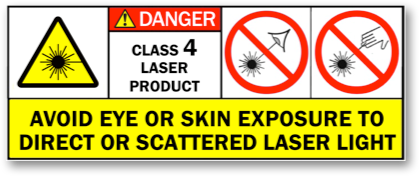
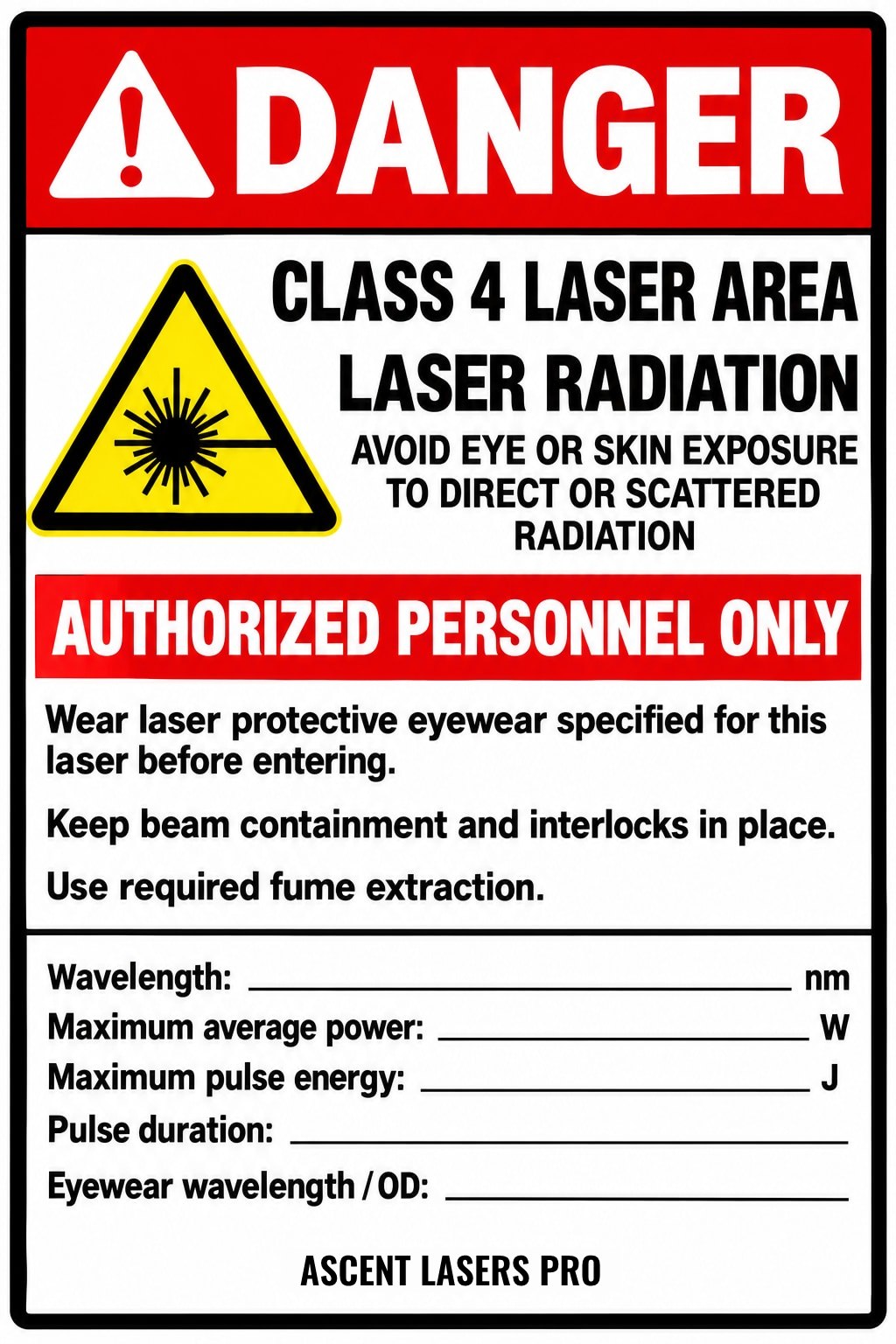
If hazardous emission can still be reached, the controlled area must take in the whole assessed hazard zone, and only trained, authorized people may enter it, including visitors and other trades. Tape on the floor, a traffic cone or a warning light does not contain a beam. Every entrance needs a warning that names the hazard and the protection needed before anyone walks in. On the label below, each machine's details go in the blank lines: its wavelength, average power, pulse energy and pulse duration, plus the wavelength and OD of the eyewear people must wear. Minimum OD 5; prefer OD 7 or 8.
Safety measures we recommend for every shop
- A laser safety officer, as described above.
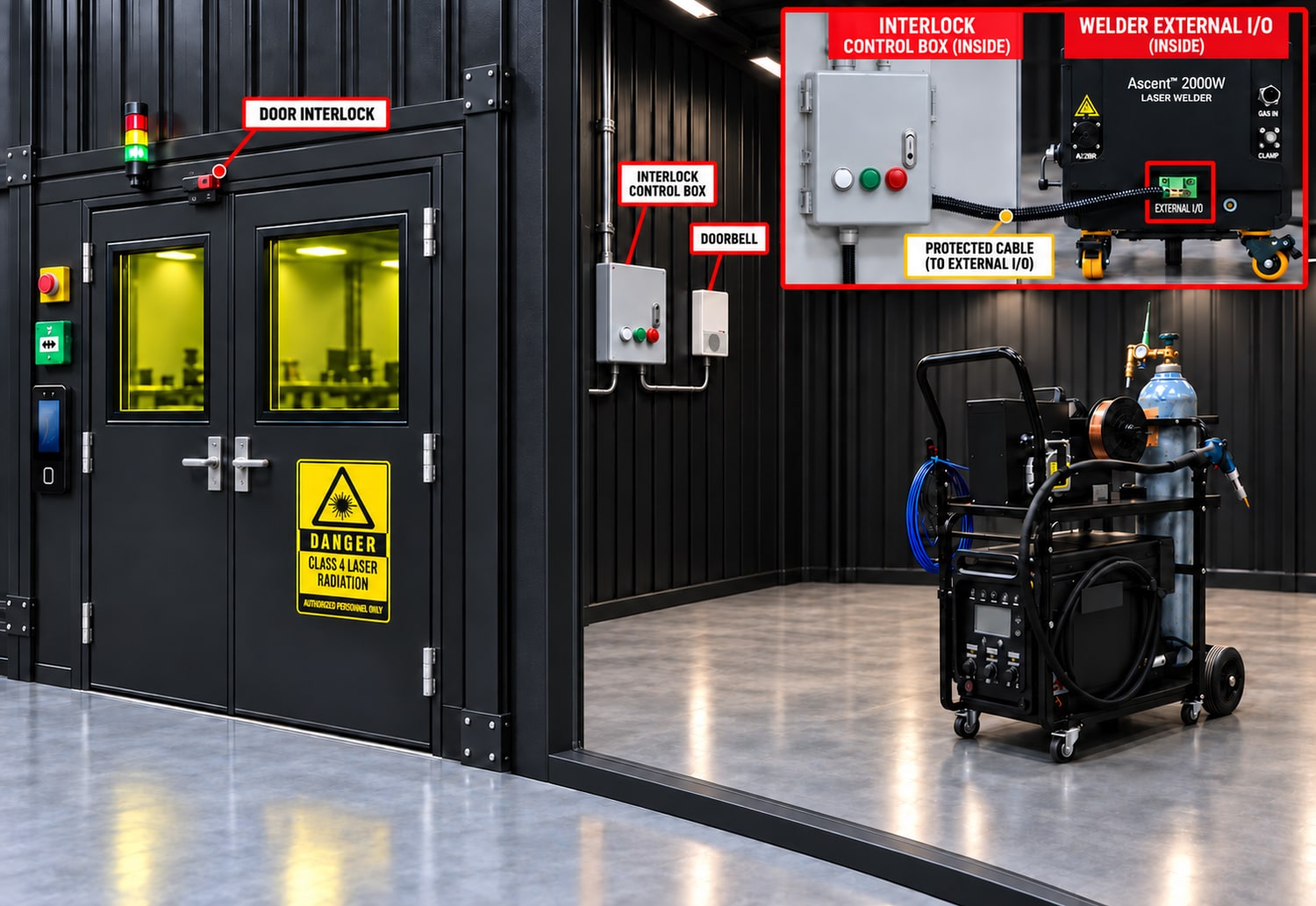
- A door interlock that shuts off the laser source when the door opens. Ascent Lasers Pro fiber laser welders can be connected to one, and we can supply a complete laser room with a door and an interlock that connects to the welder.
- Warning labels on the door, including a Class 4 laser label.
- Laser safety eyewear. One pair of OD 8 safety goggles comes with every Ascent handheld welder, QCW welder, laser cutter and laser cleaner, and the handheld welders also come with a fiber laser helmet. Extra goggles and helmets for the rest of your team can be bought from us.
- Skin protection: gloves, and covered arms and neck, as in regular welding. Standard welding gloves come with every Ascent laser welder, and gloves and an apron rated for over 5,000 °F can be bought from us.
- A dedicated work area: a room you already have, one built with mobile laser partitions from us, or a complete laser room from us, with a door and an interlock that connects to the welder.
- A laser safety audit. Ascent Lasers Pro does an informal one during installation, or you can hire an outside consultant.
- Standard operating procedures (SOP) for laser safety, which Ascent Lasers Pro supplies with the equipment.
How these controls look in practice depends on the machine. The next three sections cover laser cutters, laser welders and laser cleaners.
Laser cutters
On an enclosed laser cutter the beam stays inside the machine, so the enclosure is the main line of defense.
The answer for cutters: a complete, interlocked enclosure
A fully enclosed cutter can be rated Class 1 in normal operation even though a Class 4 laser sits inside it. The class depends on how much radiation a person can actually reach and on the design that keeps it in. Open the enclosure for service and Class 4 hazards may be within reach again. A cover on its own, or a claim in a brochure, does not make a machine safe.
That is why the enclosure has to stay intact and interlocked. In the picture below, the labels point to what a well-built cutter has: doors with interlocks, laser-rated windows, a closed catchment under the beam, guards where the gantry runs out, and a skirt of overlapping stainless steel slats and laser safety fabric flaps along the bottom edge. Look closely at every joint, gap and window, check how the panels stand up to fire, and confirm the enclosure survives long enough for the beam to be shut off.
Each window needs written proof that it protects against your machine's wavelength and power density for the time it could be exposed, including a stray direct hit. Tinted glass on its own proves nothing. Service work is where cutters are most exposed, since lifting a panel can put the Class 4 beam back within reach. Use the entry control and lockout steps from the welder section before any panel comes off.
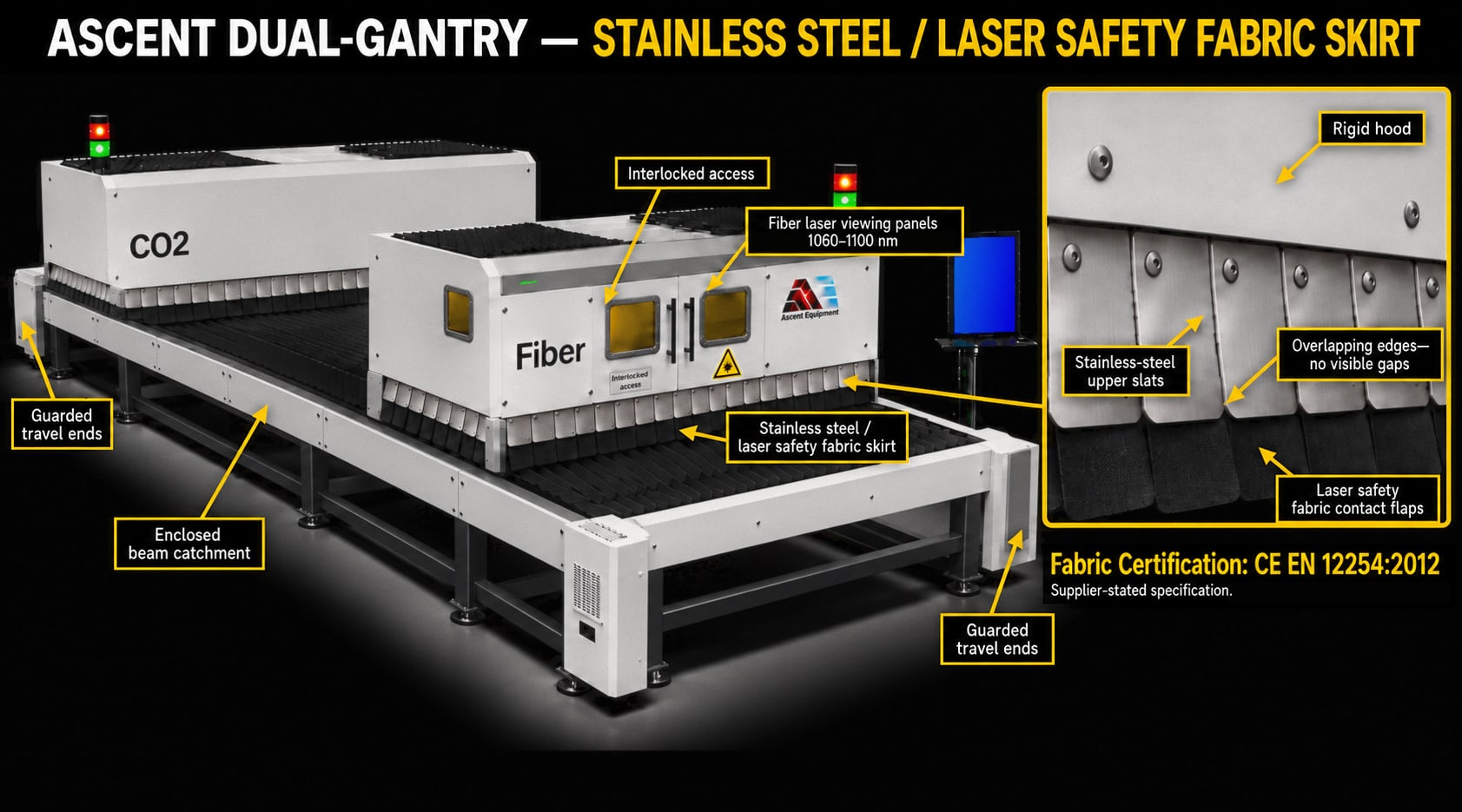
Where a cutter is not fully enclosed, it has to be set up behind laser safety partitions.
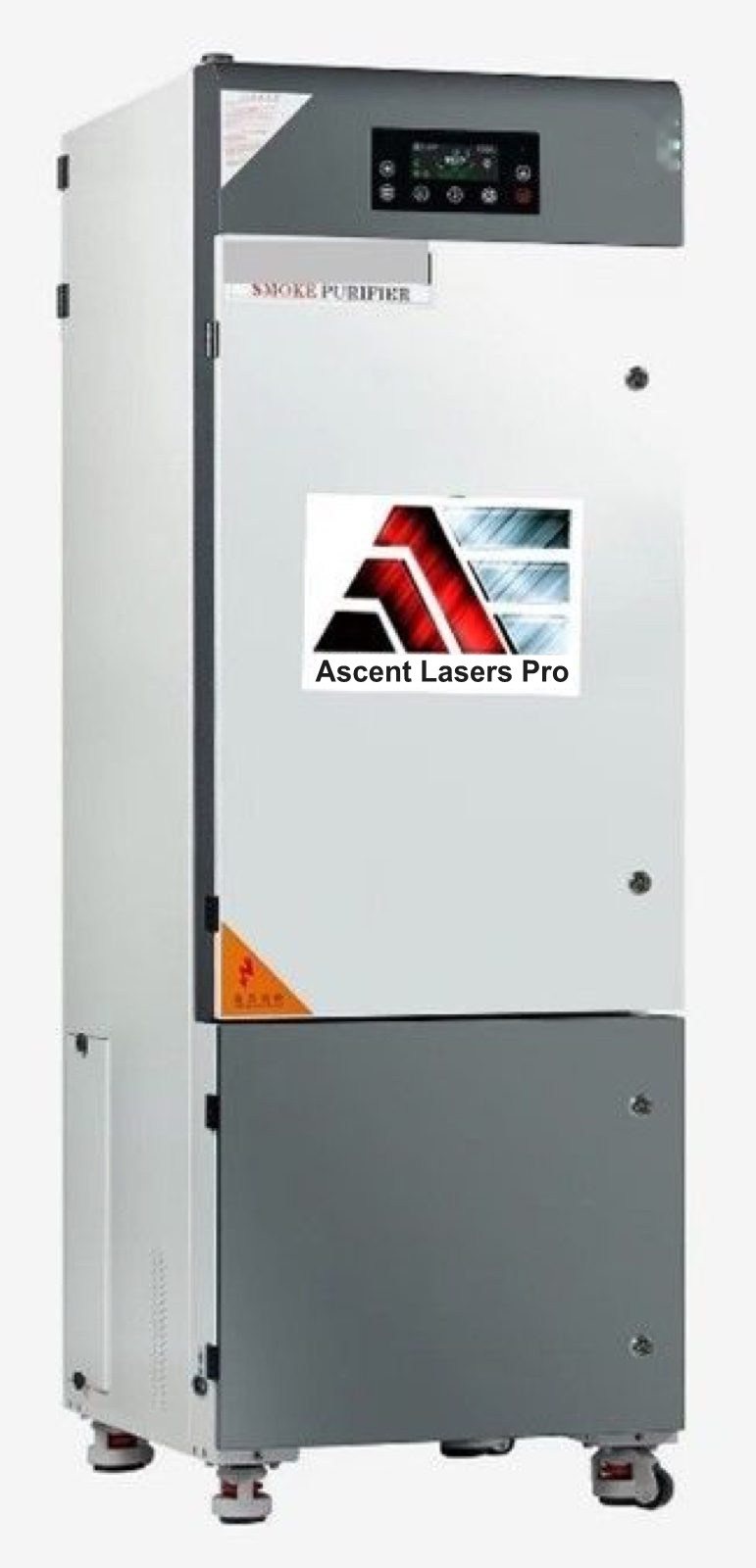
CO2 laser cutters give off odors and fumes. Vent them outdoors or pass them through a smoke purifier. Plan for fire as well: keep a CO₂ extinguisher close to the cutter (see the fire section below).
Laser welders
An open-beam handheld welder is a different situation. Nothing in the design contains the beam, so most of the protection has to come from the room, the procedures and the people. A torch that only fires when it touches the work helps, but it does not prove containment and it does not replace eye protection.
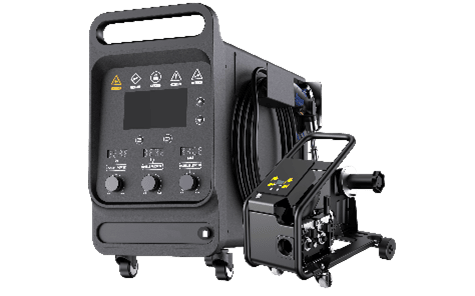
The answer for welders: protective gear, backed by controls
With a laser welder, protection rests on personal protective equipment (PPE), and on the room controls that stop anyone from wandering into the hazard zone. Think of it in four layers: who can get in and how the laser is stopped, the walls and windows around it, what each person in the room wears, and what happens to the fumes. Add fire protection to the list: a CO₂ extinguisher by the welder, and a Class D extinguisher as well when the work includes reactive metals.
Entry controls and emergency stops
OSHA's guidance describes three kinds of entry control: interlocked entry that cannot be defeated, controlled entry that can be defeated, and procedural entry backed by barriers and warnings. Which one fits depends on your layout and the rules that apply to you. Whatever you choose, keep a quick way out, put an emergency shutoff within reach, test the interlocks on doors and panels, and control how the laser restarts. Opening a protected door should put the laser into its safe state before anyone can reach the hazard, and resetting the interlock should not start emission. A warning light has to show whether the laser can actually emit, not just that the power is on. A single magnetic door switch that nobody has validated is not a safety system, and interlocks should never be bypassed to keep production moving.
Barriers and viewing windows
As with cutter windows, a barrier needs written proof that it holds up to your laser's wavelength and power density for the exposure time you expect, including a stray direct hit. Inspect joints, gaps under doors, windows and fire performance, and make sure the barrier is not burned through before the laser stops. A regular welding curtain is not a laser barrier, and neither the thickness of a sheet, its paint nor a tinted window shows that it will stop the beam. A booth with no ceiling needs a separate check for beams going upward, because tall walls alone do not prove containment.
Protecting everyone in the room
Eyewear is the LSO's call, and it follows from the numbers. The inputs are every wavelength the laser emits and how it emits: steady power, or the energy, length and rate of its pulses. From the exposure limit and the longest exposure that could realistically happen, the LSO works out how much optical density (OD) is needed to bring the beam under that limit. Minimum OD 5; prefer OD 7 or 8. The LSO sets the final figure for each machine and job, and a higher figure from the laser's manufacturer always takes priority. After that, inspect the eyewear for the points below:
| What to check | What to look for |
|---|---|
| Optical density (OD) | At a given wavelength, divide the light reaching the lens by the light passing through it and take the base-10 logarithm: that is the OD. Each step cuts the light that passes by a factor of ten: OD 5 lets through one part in 100,000, OD 7 one part in 10,000,000 and OD 8 one part in 100,000,000, which blocks 99.999999% of it. No filter stops everything, so the number tells you how much still passes. Minimum OD 5; prefer OD 7 or 8. |
| Wavelength range | Each OD rating applies to a stated band in nanometers, for example OD 5+ from 830 to 980 nm and OD 7+ from 1000 to 1095 nm, and it does not apply outside that band. Your laser's wavelength must fall inside it. Two machines described the same way may not share a wavelength, so look up the exact number for yours. A fiber laser around 1070 nm needs eyewear whose stated band includes 1070 nm. Rely on the guaranteed rating, not a typical curve. Minimum OD 5; prefer OD 7 or 8, at your laser's wavelength. |
| Lens material | Hard-coated, scratch-resistant polycarbonate, or absorbing glass with the protective dye throughout, so a scratch on the surface does not reduce protection. Reinforced or laminated glass lenses are made to withstand more beam energy. |
| Damage threshold | The power at which a direct beam starts to damage the lens and frame. Ask the maker for this figure and compare it with your laser's power. Retire eyewear that is damaged or has taken a high-energy hit. |
| Visible light transmission (VLT) | Set by the dye. It ranges from low values (around 23%, for example) to clear lenses well over 60%, and it decides how bright the work looks and how comfortable the eyewear is to wear. |
| Fit and coverage | Coverage at the sides and top, and a close fit. Some goggles fit over prescription glasses and some large frames do not, and some makers offer prescription inserts. |
| Markings and standards | The eyewear should be marked with its wavelength range, protection rating and VLT. ANSI Z136.1 is the US standard for safe laser use. In Europe, EN 207 and EN 208 covered laser protective filters and eyewear and have been replaced by ISO 19818. California goes further: under Title 8, section 3382 of its workplace safety rules, each pair of laser goggles must show the wavelengths it covers, its protection level at each of them and its VLT. |
Laser safety glasses are not welding eyewear. They do nothing about the bright light of the weld pool, which needs its own protection, and a welding shade or dark lens says nothing about protection at 1064 or 1070 nm. A CO₂ laser, at about 10.6 micrometers, needs its own assessment. Alignment eyewear that lets some visible light through, rated roughly OD 1 to 4, is only for low-power setup work. It falls below the minimum of OD 5 (OD 7 or 8 preferred), so it has no place at a production welder or cleaner. Leave eyewear on until the job is finished. Laser eyewear is not a license to look at the beam, and no one should ever aim a beam at someone's glasses.
A laser face shield or helmet must have laser filtering in every viewing area and must work with the eyewear underneath.
Gloves, sleeves and aprons are there for burns, sparks, cuts and chemical splashes. They never make it acceptable to put a hand or arm in the beam, and clothing only counts as laser protection if its maker documents the wavelengths and exposure it is rated for.
Protective gloves and front jacket for fiber lasers
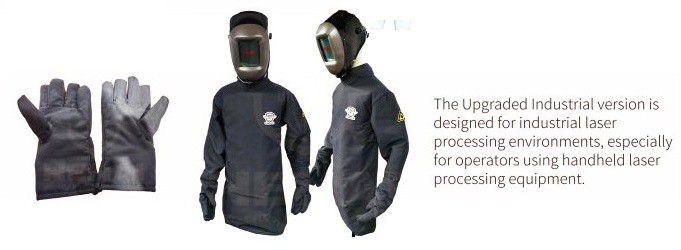
This gear is made from a special material for laser work rated to withstand 3000°C (5000°F). It is built for industrial laser processing, and the Upgraded Industrial version suits operators of handheld laser equipment in particular.
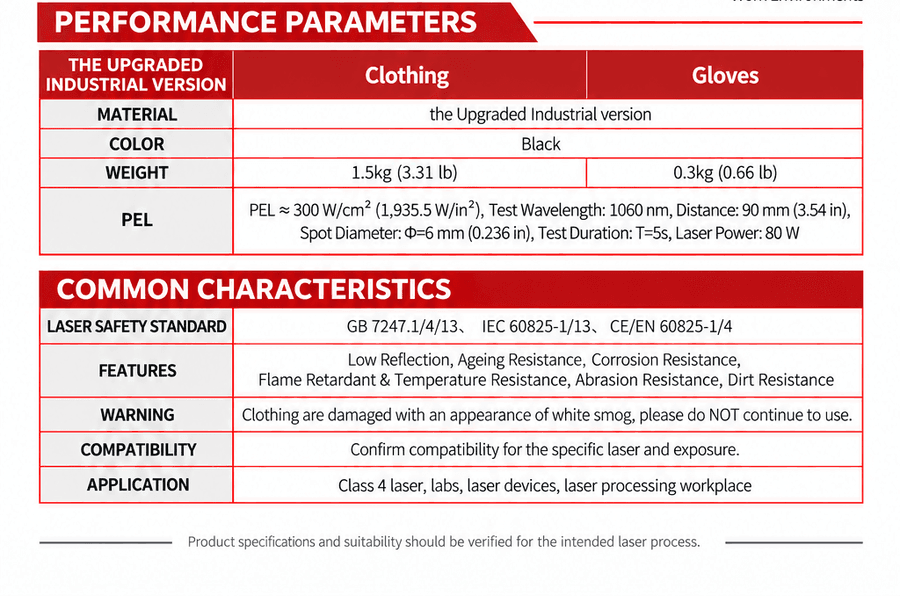
The Upgraded Industrial clothing is tested to a PEL of about 300 W/cm² at 1060 nm. The fabric is durable, dust-free and anti-static, with a flame-retardant outer layer, and it is intended for Class 4 laser work and handheld laser processing. Confirm that it suits your laser, your exposure and your process. If the clothing gives off white smoke, it is damaged: stop using it.
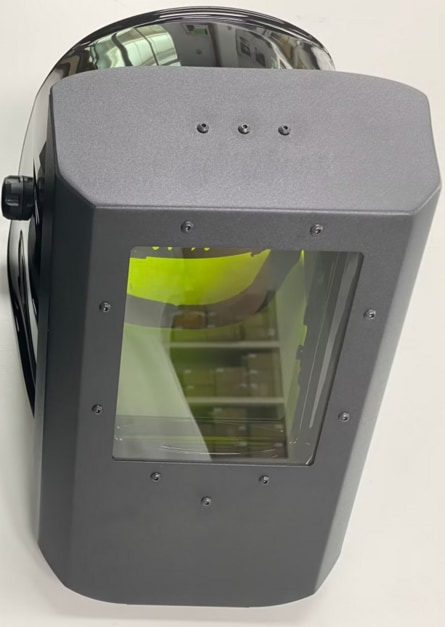
V1 laser welding helmet, available from Ascent Lasers Pro
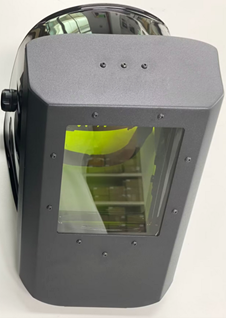
The V1 helmet has a steel protection shield and a dark green laser protection window made of a laser-resistant, PMMA-based plastic. The window absorbs laser radiation inside the material itself. It passes about 64% of daylight, so the view stays bright enough and colors stay recognizable. The window is certified to DIN EN 60825-4 and CE, so it can be used in machines or as shielding, even with large beam diameters.
Before you rely on it, work out the protection level your laser needs and compare it with the ratings on the window. The helmet is not designed for direct exposure to every laser beam, so check with your LSO that it suits your laser.
Complies with ANSI Z87.1-2020, ANSI Z136.1, IEC 60825-1, EN166, CSA Z94.3, AS/NZS 1337.1 and AS/NZS 1067.
| Specification | V1 helmet |
|---|---|
| Filter material | Plastic |
| Filter technology | Absorption filter |
| Visual brightness | Sufficient |
| Standards | EN 60825 |
| Filter thickness | Approximately 3 mm |
| Color vision | Sufficient |
| Color | Dark green |
| VLT (approx.) | 64% |
Fume extraction and respirators
Welding, cleaning and cutting can release hazardous particles and gases from the base metal and from anything coated on it. Old paint or adhesive can give off particles and breakdown gases even if it was water-based. Find out what is on the part before you start: read the safety data sheet (SDS), and check for lead, chromium, beryllium or anything else that might be there. Catch fumes with local exhaust placed close to the beam, and test how well it captures them under real working conditions. Keep in mind that a HEPA filter only traps particles; gases and vapors go straight through it.
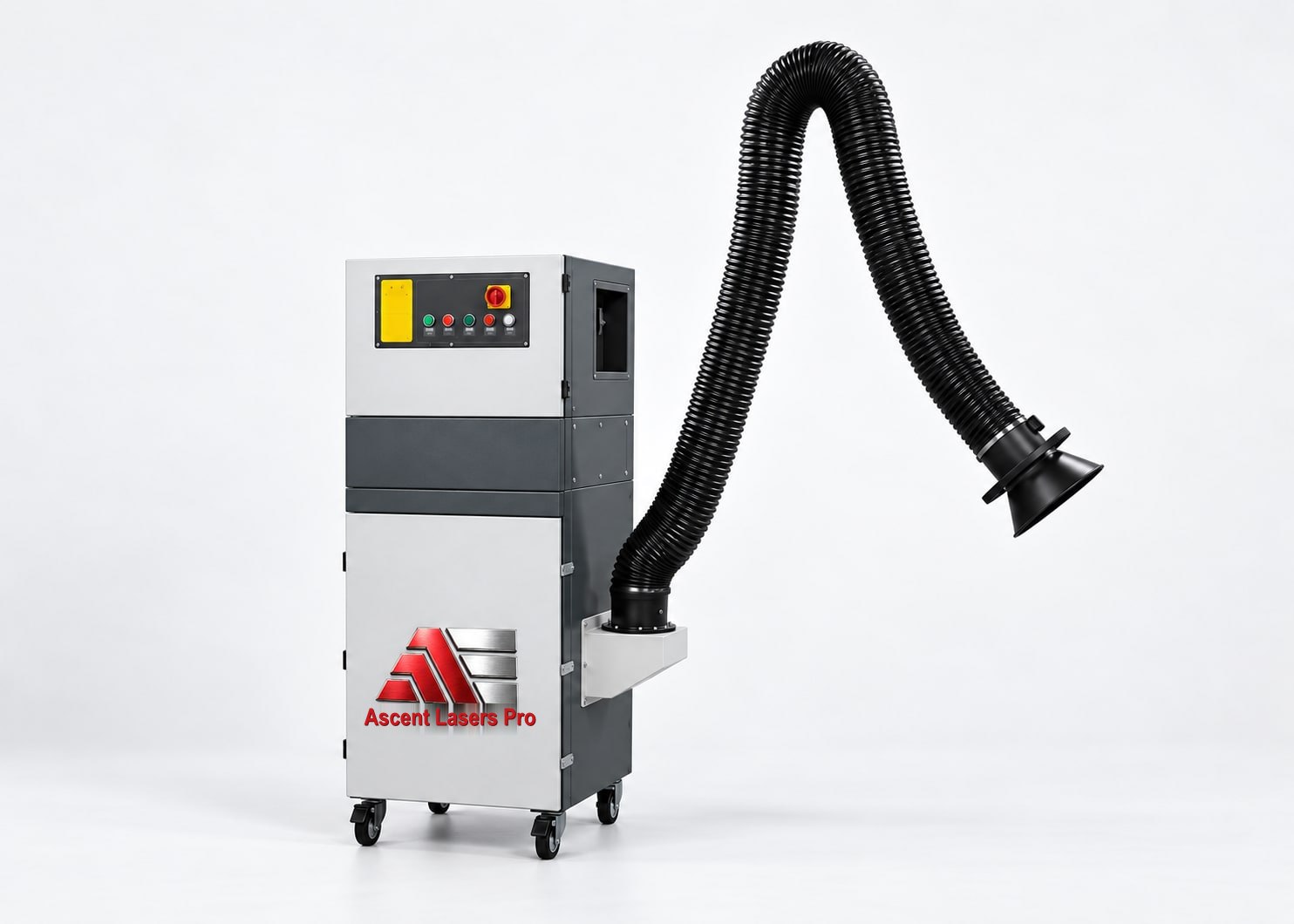
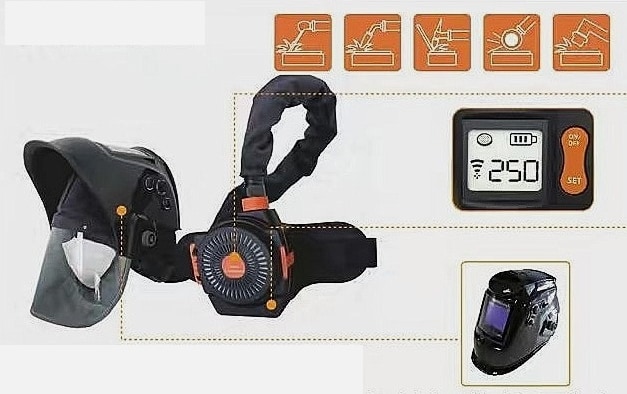
If respirators are needed, OSHA's respirator standard (29 CFR 1910.134) applies in full: a written program, medical evaluations, training, and fit tests for tight-fitting models. A P100 filter traps at least 99.97% of test particles in the lab, but that is the filter's efficiency, not the protection a worn respirator actually gives. A powered welding helmet with a respirator (a PAPR helmet) is not laser rated just because it filters air, and an air-purifying respirator must never be used where oxygen is low or conditions are immediately dangerous. A respirator is the last line of defense. OSHA wants workable engineering controls in place before respirators, and the welder's filtered helmet protects only the welder, not coworkers nearby.
Laser cleaners
A laser cleaner pairs an open, usually handheld, beam with a surface material nobody has tested: whatever happens to be on the part. Everything in the laser welder section (entry controls, barriers, eyewear, fume extraction and respirators) also applies to open-beam cleaners. What follows is what is different about cleaning.
Find out what is on the part
Cleaning strips off the surface layer, and that layer is what ends up in the air, so it deserves as much attention as the laser. Old paint and adhesive can release particles and breakdown gases even if they were water-based. If lead paint, a chromium-bearing alloy or a similar contaminant is involved, the OSHA standard written for that substance (lead, for example) applies on top of the general rules. Get the SDS and the process details first. When the job is coated steel rollers, find out exactly what the coating is, and get exposure data, before picking filters. When the part is magnesium, titanium or another reactive metal, have a Class D extinguisher close by.
Capture the fumes and protect the lungs
Do not tell anyone that laser cleaning gets rid of hazardous dust unless you have exposure data to prove it. Put the exhaust hood right where the beam hits the surface, prove it captures well during normal work, and do not count on a HEPA filter for gases or vapors. Base the choice of respirator on measured or expected exposure, under the same respirator rules as for welding.
Pulsed output and eyewear
Many cleaners are pulsed and steer the beam with a scan head, so average power does not tell you what a single pulse can do. Write down how each pulse behaves (energy, length, how often it repeats, peak power), plus average power, spot size and the scan pattern, and design for the scanner failing or the gun being aimed wrongly. A 1000 W average power rating alone cannot settle the choice of eyewear or barriers. Minimum OD 5; prefer OD 7 or 8. The LSO confirms the final rating from the real pulse conditions, using the eyewear maker's pulse performance and damage threshold data.
Cleaning on the road
Many cleaning jobs are done from a trailer at the customer's site. A trailer is not a safe enclosure just because it has walls. Your customer's laser registration probably does not extend to your crew either, so see "Working away from your own shop" below before the first job. At each site, check what you will clean and what is on it, where the beam will be aimed, whether the public can get close, what other work is going on, any openings in the trailer, and the way out. An LSO appointment can be limited, for example to routine contained cleaning, with specialist review required for new pulse settings or beams pointed outdoors.
Fire and other hazards
Look at what could burn: the target, sparks, collected dust, flammable chemicals and shielding gases. Make sure the extraction equipment is right for the material. Then add electric shock, energy stored in capacitors, compressed gas and oxygen displacement, and moving parts. Laser controls do not replace the usual fire, electrical, chemical and machine safety rules; both sets apply.
Fire extinguishers
For the electronics and optics inside any laser machine, CO₂ or fiber, cutter, welder or cleaner, reach for a carbon dioxide (CO₂) extinguisher first. Shops that weld or clean reactive metals that can burn need a Class D unit as well.
| Type | Use it for | Why | Size and location |
|---|---|---|---|
| Carbon dioxide (CO₂) | Fires on the laser machine itself. | It smothers and cools the fire and leaves no residue, so electronics, mirrors and lenses are not coated in corrosive chemicals. | For an industrial laser cutter, a 5 kg (11 lb) or larger unit no more than 10 m (33 ft) away is widely recommended. Desktop and hobby machines can use 2 to 5 kg (4.4 to 11 lb). |
| Class D (dry powder) | Laser welders and cleaners used on reactive metals. | Aluminum, titanium and magnesium work can leave chips and dust that burn. Water, CO₂ and ordinary ABC agents can make a metal fire worse, sometimes violently, so only a Class D unit should be used on one, and it must be close at hand. | OSHA requires Class D agent within 75 feet (22.9 m) of travel distance from the area where combustible metal is worked. |
CO₂ pushes out oxygen. If you discharge one inside a laser booth, a trailer or any other small enclosed room, leave and air it out. When employees are expected to use extinguishers, 29 CFR 1910.157 (OSHA's portable extinguisher standard) decides which types and how far away. NFPA 10 adds that any operation producing burnable metal chips, shavings, flakes or powder needs Class D protection. Treat the CO₂ size and distance in the table as a guideline and check them with your local fire department. Put extinguisher checks on the calendar, and make sure the people who work around the laser know where each one hangs and how to operate it.
Written procedures, training and incident response
Every machine and task needs written steps: start-up, shutdown, allowed settings, preparing the target, entry control, extraction, eyewear, what to do when something goes wrong, and emergencies. State who may align, repair or open the beam path, and align at reduced power when you can.
Operators need to understand laser hazards and to show real skill on their specific machine. Anyone else who comes near the laser, from service technicians to coworkers and visitors, should be taught the hazards and controls that concern them. Record who was trained and how they showed competence. No federal general industry rule fixes a number of training hours or how often to retrain, but some states do. Illinois wants laser users trained when they start and again every year, and Arizona spells out the subjects and competence expected of operators and LSOs.
On a written schedule, test the interlocks and emergency stops and inspect the barriers, windows, signs, eyewear and fume extraction. Repeat the hazard assessment whenever the enclosure, room layout, optics, power, target or machine changes. Auditing once a year is sensible; any mandatory interval will be set by your state's rule or your registration.
After a possible exposure, shut the laser off, secure the area, and have anyone with a possible eye injury examined by a doctor right away, even if it seems minor. OSHA's reporting rule (29 CFR 1904.39) generally gives you 8 hours to report a death on the job and 24 hours to report an in-patient hospital admission, an amputation or the loss of an eye. Some state laser programs also want their own report.
The seven states with laser registration
In these seven states, the rules name industrial lasers, or define laser installations so broadly that industrial machines are included. Find out which class, exemptions, fees and approvals fit your site and your work before the laser is first switched on. A filing deadline in the table is not permission to run the laser before a required approval comes through.
| State | Agency and rule | Main requirements | Temporary or out-of-state use |
|---|---|---|---|
| Arizona | Department of Health Services, Bureau of Radiation Control (Arizona Administrative Code Title 9, Chapter 7, Article 14) | The application is due within 30 days, and an unregistered laser may not be used. You need an LSO, operators who are competent, a written safety program and, where the rule says so, controlled areas. Separate provisions cover installers and service staff. | Check with the department which category your mobile or temporary work falls under; some older guidance predates the 2026 revision. |
| Florida | Department of Health, Bureau of Radiation Control (Rule 64E-4.001; DH Form 1605) | Each non-exempt laser is registered within 30 days of getting it, separately for every location, and an LSO is named on the form. There is a checkbox for mobile lasers, and registration is free. | Bringing a laser in from another state takes written notice 20 or more days ahead. |
| Georgia | Department of Community Health (Rule 111-8-91) | Registration is due 30 days after the laser is acquired. An injury must be reported within 15 days of being discovered, and closing down for good must be reported within 30 days. | Lasers in transit, or that cannot be switched on, are exempt from registration. |
| Illinois | IEMA Office of Homeland Security (32 Ill. Adm. Code Part 315, for Class 3B and Class 4) | The installation is registered and a qualified LSO appointed. Written operating and emergency procedures are required, and laser users get safety training when they start and every year after. | Temporary jobs need registration plus written notice 10 or more working days ahead, giving the type of work, how long it lasts, its scope and the exact sites. The state may inspect before you start. |
| Massachusetts | Department of Public Health, Radiation Control Program (105 CMR 121.000) | Class 3B and Class 4 lasers are registered, including those used in industry. The rule reaches every stage: having, using, transferring, running, maintaining, repairing and servicing a laser. | A laser brought into the state for temporary work needs written notice 10 or more working days ahead, along with registration and any fee. |
| New York | Department of Labor, not the health department (Industrial Code Rule 50; Form SH 280) | Covers laser installations and mobile lasers, within the rule's own definitions and exemptions. Operators doing mobile work may also need the certificate of competence the rule describes. | The rule's wording is older than the Class 4 label system, so for handheld or trailer work, get a written determination from the Department of Labor. |
| Texas | Department of State Health Services (25 TAC 289.301) | Covers industrial Class 3B and Class 4 lasers and companies that service lasers, with separate categories for using, aligning, calibrating, installing, repairing, demonstrating and selling them. LSO and safety duties are set, and service work must be logged. | A certificate is needed both to use lasers and to service them. Do not read the 30-day filing window as a grace period, and do not expect another state's registration to count. |
Before you contact an agency, gather the facts it will ask about: wavelength and Class 4 rating, power or pulse figures, the process, whether the laser stays put or travels, where and when it will be used, and whether you plan to demonstrate, sell, install or repair lasers. Ask the agency to put its answer on registration, notices and safety program duties in writing.
States worth a closer look
| State | Details |
|---|---|
| Alaska | The laser rules are in 18 AAC 85.670 to 85.730. The state proposed repealing them in August 2026, with comments closing September 11, 2026. A proposal is not a repeal, so ask the agency for the final status. Workplace safety rules apply in either case. |
| California | Cal/OSHA's marking rules for laser goggles (Title 8, section 3382) are described in the eyewear table above. Some published guidance claims California registers industrial lasers, but we could not confirm that on the state's own pages. The Radiologic Health Branch can tell you. |
| Kentucky and Wisconsin | Both radiation programs we located are about X-ray machines. Third-party guidance refers to a Class 4 laser notice in Kentucky and a voluntary courtesy notice in Wisconsin; neither appears on the official pages, so check with the agency. |
| Michigan | MIOSHA offers a compliance guide on industrial lasers and a model safety program. Both are advice and carry no legal force. |
| North Carolina | Laser safety guidance from the state's labor department strongly urges employers with Class 3B or Class 4 lasers to name an LSO. |
| Oregon | Oregon OSHA's position is that an LSO is expected wherever employees operate Class 3B or Class 4 lasers or could be exposed to them. |
We found no separate device registration in Michigan, North Carolina or Oregon, but their workplace safety programs still apply.
Working away from your own shop
Walls do not make a trailer a safe enclosure. Check the openings, windows, floor and roof penetrations, reflected beam paths, extraction and emergency exit. If emission could get out, plan how you will keep people away from the trailer. A machine used outside the trailer needs a controlled area of its own.
Who owns the laser, who runs it and who services it may each need their own answer. A registration held by your customer does not necessarily let your technician demonstrate, align or fix the machine. Texas treats laser services as a separate category, and Arizona has its own provisions for installers and service personnel, so register for the activity you actually perform.
Crossing a state line can start a countdown. Florida requires written notice at least 20 days before an out-of-state laser is used there, and Illinois and Massachusetts each require at least 10 working days. Start early, and if the scope is unclear, get the agency's answer in writing.
At every mobile job, go through the same list: the part and its coating, where the beam will point, how close the public can get, what else is happening nearby, openings, and exits. Have the containment up before the first shot, and look again each time you relocate or switch to a different part.
What FDA paperwork proves, and what it does not
When the FDA's Center for Devices and Radiological Health (CDRH) receives a laser product report, it assigns an accession number. That number shows the report was received and logged. It is not an FDA approval, a serial number or a permit to operate, and it says nothing about safety in your workplace. The FDA does not approve these reports or the products. The manufacturer certifies that the product complies and remains responsible for it.
The report also has to match the actual machine. The laser source inside a welder, cleaner or CNC cutter may have its own accession number, but that number does not carry over to the finished machine. What counts is a report on the whole product as sold: that model, with its housing and its controls. A properly documented report can cover a family of several models, but the FDA does not issue an accession number for each serial-numbered unit.
The FDA counts anyone who makes, assembles or imports electronic products as a manufacturer. If you import equipment, build it into something else or modify a certified product, you may take on duties that go beyond reselling an unmodified domestic machine.
| Document | What it shows | What to check |
|---|---|---|
| Laser product report (guided by FDA Form 3632) | Describes the product or model family: how its safety is designed and tested, its controls, labels and instructions. Model or design changes are added by supplement. | Confirm the report names your exact model and covers the finished machine, with its housing, interlocks and labels. |
| CDRH acknowledgment letter | Confirms the FDA logged the report, and gives the accession number. | Ask to see the actual letter; a number quoted in a brochure or email is not enough. |
| Annual report (guided by FDA Form 3636) | Yearly radiation safety reporting by manufacturers required to file. | Confirm it includes the model family. It is filed by September 1 and covers July 1 to June 30. |
| Certification and identification labels | The maker's declaration of compliance, and the details identifying the product. | Look for the maker's name, the model, a serial number or other identifier, the month and year made, and the laser warnings. Labels do not mean the FDA approved anything. |
| Import declaration (FDA Form 2877) | Filed when an electronic product is imported. | Compare the model on the declaration with the shipping paperwork. |
Whoever you buy a laser from, get copies of the acknowledgment letter for that exact model, the labels and the manuals, and file them. When an ad calls a machine "FDA approved," ask to see the paperwork. If the documents are in order, the correct claim is narrower: the radiation safety report for that documented model has been given an accession number by CDRH. The FDA does not approve or certify laser products.
A starting checklist
- Make an inventory of each laser: model and serial number, wavelength, power or pulse figures, and whether it stays in one place or travels.
- Get the paperwork from the manufacturer: the FDA acknowledgment letter that names your model, plus the labels and manuals.
- Contact your state's radiation program about registration, notices and safety program duties, in writing if the answer is not obvious.
- Appoint a laser safety officer, in writing.
- Complete the hazard assessment, and sign the written PPE certification that OSHA looks for.
- Install the controls and prove they work: enclosure or controlled area, barriers and windows, interlocks, emergency stops and fume extraction.
- Hang extinguishers: CO₂ beside the machine, and Class D too if you work with reactive metals.
- Write the procedures, train every person the laser can affect, and put inspections on a schedule.
File every record in one place, a physical binder or a digital folder: the list of lasers, FDA and manufacturer paperwork, state certificates and notices, the LSO appointment, the PPE assessment and hazard analysis, enclosure specifications, interlock and extraction test results, procedures, training records and the inspection schedule. Some states add forms of their own or say how long records must be kept.
State-by-state summary
Below is a summary of what each state's official radiation program pages showed when we reviewed them in October 2026. "Yes": we found registration that covers industrial lasers. "Not found": we found none, which does not prove there is no law, so check with the agency, particularly where the note mentions an X-ray program. "Unclear": the official pages do not answer the question, or published guidance contradicts them. "State plan": workplace safety for private employers is enforced by a state agency instead of federal OSHA.
| State | Workplace safety | Laser registration | Note |
|---|---|---|---|
| Alabama | Federal OSHA | Not found | X-ray program. |
| Alaska | State plan | Rules exist, repeal proposed | 18 AAC 85. Confirm the final status. |
| Arizona | State plan | Yes | Department of Health Services, Article 14. See above. |
| Arkansas | Federal OSHA | Not found | X-ray program. |
| California | State plan | Unclear | Goggle marking required by Cal/OSHA. Registration status: check with the Radiologic Health Branch. |
| Colorado | Federal OSHA | Not found | Confirm the scope with the agency. |
| Connecticut | Federal OSHA | Not found | X-ray program. |
| Delaware | Federal OSHA | Not found | X-ray program. |
| Florida | Federal OSHA | Yes | Rule 64E-4.001. Register within 30 days; notice ahead of out-of-state use. |
| Georgia | Federal OSHA | Yes | Rule 111-8-91. Covers registering and reporting injuries. |
| Hawaii | State plan | Not found | Program for ionizing radiation devices. |
| Idaho | Federal OSHA | Not found | X-ray program. |
| Illinois | Federal OSHA | Yes | Part 315. LSO, yearly training, notice for temporary use. |
| Indiana | State plan | Not found | X-ray program. |
| Iowa | State plan | Not found | X-ray program. |
| Kansas | Federal OSHA | Not found | X-ray program. |
| Kentucky | State plan | Unclear | 902 KAR 100:110 deals with X-ray. Check laser coverage with the Radiation Health Branch. |
| Louisiana | Federal OSHA | Not found | Broad radiation powers. Confirm whether lasers are covered. |
| Maine | Federal OSHA | Not found | X-ray program. |
| Maryland | State plan | Not found | X-ray program. |
| Massachusetts | Federal OSHA | Yes | 105 CMR 121. Notice for temporary use. |
| Michigan | State plan | Not found | MIOSHA laser guide and model program (advisory). |
| Minnesota | State plan | Not found | X-ray program. |
| Mississippi | Federal OSHA | Not found | X-ray program. |
| Missouri | Federal OSHA | Not found | Machine registration program. Confirm whether it includes lasers. |
| Montana | Federal OSHA | Not found | Registers radiation machines. Ask whether that includes lasers. |
| Nebraska | Federal OSHA | Not found | Broad radiation powers. Confirm whether lasers are covered. |
| Nevada | State plan | Not found | X-ray program. |
| New Hampshire | Federal OSHA | Not found | Rules for radiation machines and MRI. Confirm whether lasers are covered. |
| New Jersey | Federal OSHA | Not found | X-ray program. |
| New Mexico | State plan | Not found | X-ray program. |
| New York | Federal OSHA | Yes | Department of Labor, Industrial Code Rule 50. Covers both fixed and mobile lasers. |
| North Carolina | State plan | Not found | Laser safety guidance from the Department of Labor. |
| North Dakota | Federal OSHA | Not found | X-ray program. |
| Ohio | Federal OSHA | Not found | Its nonionizing rules apply to public employees, which is not the same as private-sector coverage. |
| Oklahoma | Federal OSHA | Not found | X-ray program. |
| Oregon | State plan | Not found | An LSO is expected by Oregon OSHA where Class 3B or 4 exposure exists. |
| Pennsylvania | Federal OSHA | Not found | X-ray program. |
| Rhode Island | Federal OSHA | Not found | X-ray program. |
| South Carolina | State plan | Not found | X-ray program. |
| South Dakota | Federal OSHA | Not found | X-ray program. |
| Tennessee | State plan | Not found | X-ray program. |
| Texas | Federal OSHA | Yes | 25 TAC 289.301. Covers industrial lasers and laser service work. |
| Utah | State plan | Not found | X-ray program. |
| Vermont | State plan | Not found | The registration page covers X-ray machines. |
| Virginia | State plan | Not found | Read how radiation is defined before assuming machine registration applies. |
| Washington | State plan | Not found | X-ray program. |
| West Virginia | Federal OSHA | Not found | General statutory powers alone do not create laser registration. |
| Wisconsin | Federal OSHA | Unclear | X-ray program. The Department of Health Services can say whether lasers need a notice. |
| Wyoming | State plan | Not found | Check directly. Wyoming OSHA covers private workplaces. |
Have a question about the rules for your own setup? Contact us. Installation and training come with every Ascent Lasers Pro machine, and we can go over your shop's situation with you before you order.
Ascent Lasers Pro provides this page for general information only; it is not legal advice. It is based on our October 2026 review, and agencies revise their forms, deadlines and requirements over time. Nothing here allows you to run a laser before an approval the law requires.