A Class 4 industrial laser in Canada falls under three separate sets of rules. Health Canada governs the product when it changes hands or crosses the border. The province or territory governs the workplace where it runs, unless the employer is federally regulated. And Alberta, alone among the provinces and territories we reviewed, requires the laser to be registered. Passing one of these tests tells you nothing about the other two.
This guide is for shops in Canada that weld, clean or cut with Class 4 lasers: handheld fiber welders, pulsed cleaners, enclosed cutters, and the demonstration, service and trailer work around them. It sticks to what is particular to Canada. The safety controls themselves, from the laser safety officer to eyewear, enclosures, fume extraction and fire protection, are on our laser safety page, and they apply here too.
Based on our review in October 2026. Laws and forms change, so check with the regulator before you rely on anything here. This is general information, not legal advice.
The bodies involved
- Health Canada. Its Consumer and Clinical Radiation Protection Bureau administers the Radiation Emitting Devices Act and the laser product rules made under it, and those rules reach industrial equipment. The duties fall mostly on manufacturers and importers, but you take them on if you alter a machine.
- Provincial and territorial regulators. They set the employer's duties: controlling exposure, training, protective equipment, ventilation, machine guarding and lockout. Several of their regulations adopt laser standards by name.
- The federal Labour Program (ESDC). It covers employers in federally regulated sectors under the Canada Labour Code. Where the work happens does not, by itself, decide whether a job is federal.
- Transport Canada. It protects aircraft from laser light, and it restricts having certain lasers in some public places, airports among them.
- CCOHS and the standards bodies. CCOHS publishes guidance, and ANSI, IEC and CSA publish standards. A standard only becomes binding at your site when a regulation adopts it.
- Local and electrical authorities. They deal with building, fire and electrical installation and with exhaust discharge. Laser documents do not count as electrical approval.
Three ways Canada is different from the US
First, Health Canada assigns no accession number and has no approval step before a laser goes on sale. Second, Canada has no single federal workplace regulator for general industry along the lines of OSHA, so the provinces write most of the workplace rules. Third, Alberta registers Class 3B and Class 4 lasers, which we found nowhere else as a general requirement.
The product side: Health Canada
Rules in force since October 2025
Health Canada's revised laser product rules, part of the Radiation Emitting Devices Regulations, started on October 9, 2025. From that date they apply whenever a laser product is sold, rented out or brought into the country, and that includes industrial machines, second-hand equipment and machines that have been modified. A business that imports a laser for its own use still has to check it against the import requirements.
The class belongs to the whole machine
Classification follows IEC 60825-1, the 2014 edition. The class that matters is the one for the complete machine, with all its built-in protection, across normal running, maintenance, servicing and fault conditions. A class assigned to the laser module by its maker does not decide the class of the welder, cleaner or cutter built around it.
Altering a machine can turn you into its manufacturer in Health Canada's eyes. A change to how it performs or what it is meant for puts the classification, the safety features, the labels and the instructions on you. So before you import or pass on a modified machine, review what changed: optics, scan head, emission controls, power, housing and operating modes.
Bilingual labeling
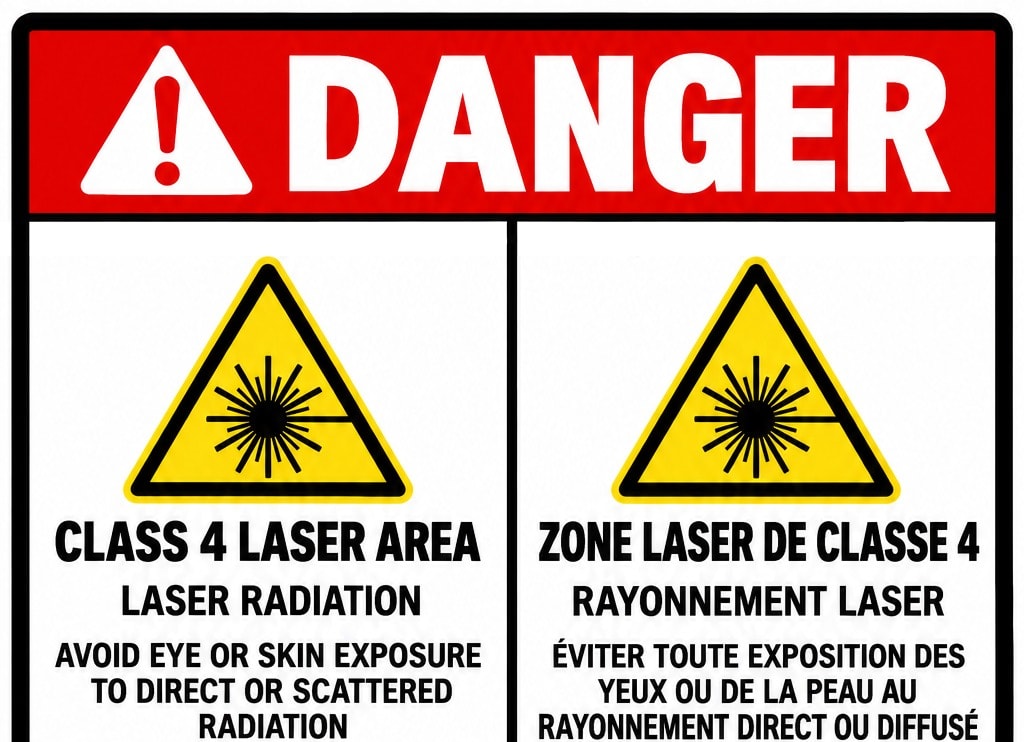
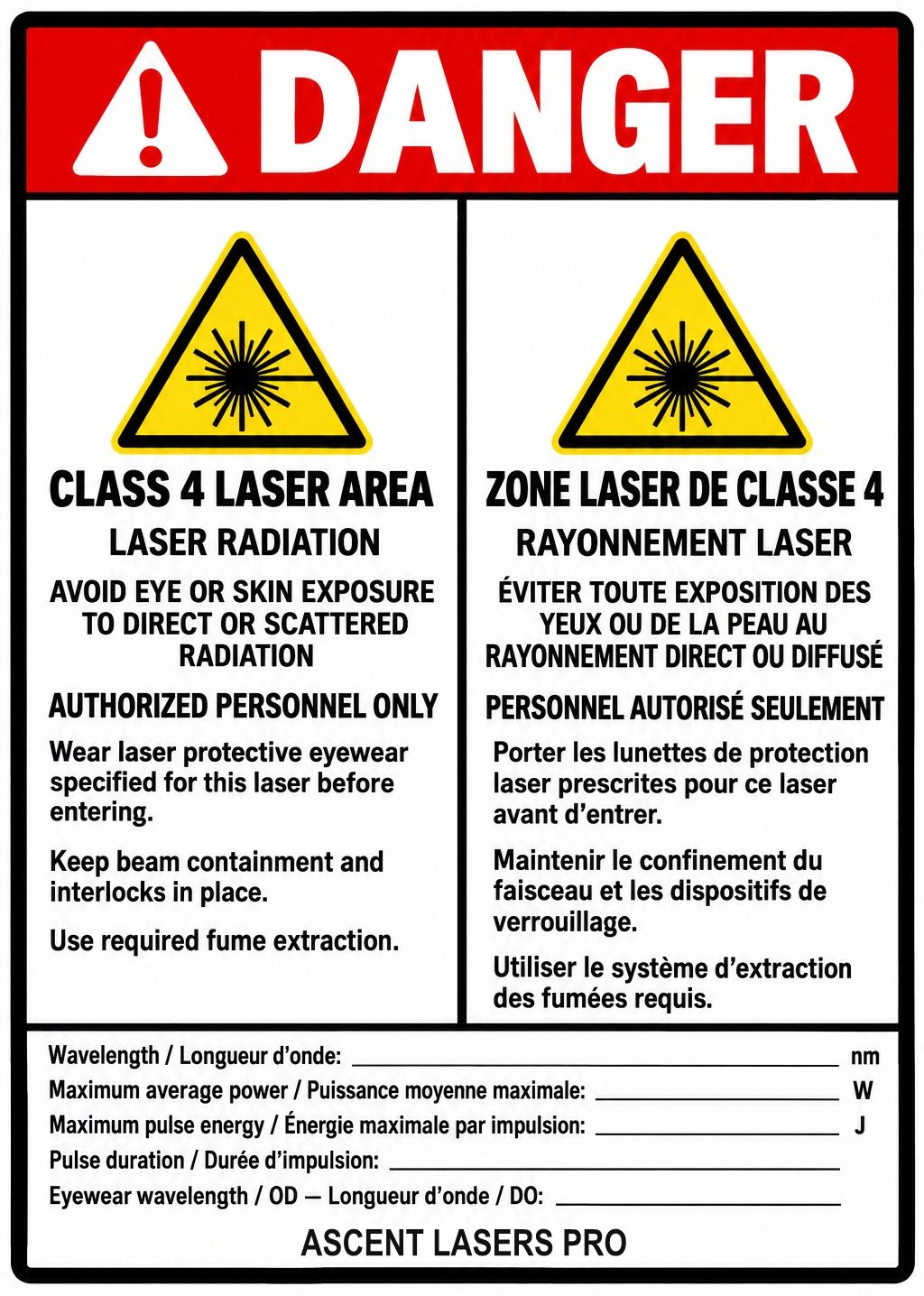
Warnings must be in English and French. That covers the laser class label, the hazard labels and the safety information in the manual. Labels that only identify the product and where it came from may be in one language. They name the manufacturer and its address, the model and when the unit was made, and, if a Canadian importer is involved, its name and Canadian address.
Paperwork to request before you buy
- Exactly what you are buying: brand, model, serial or batch number, intended use, and which head, optics, firmware and accessories are in the shipment.
- How it was classified: the test method and conditions, the measured accessible emission, the wavelength and pulse data, and the class of the finished machine.
- Proof of the safety features: the protective housing, interlocks and other required features, tested both working normally and with faults.
- The Canadian material: safety labels and user information in both official languages, with identification and origin markings.
- A change log showing whether any modification alters the class, the controls, the instructions or who carries the responsibility.
"Approved" is the wrong word
Nothing in the Radiation Emitting Devices Act certifies, registers, licenses or pre-approves a laser product, and the Act does not oblige anyone to keep records. Health Canada nonetheless recommends holding on to manufacturing, test and classification evidence, since an inspector may ask for it. That is why a laser should never be called "Health Canada approved" on the strength of IEC test papers, a customs clearance, a provincial registration or a reference number from another country. Each of those proves something different.
An Alberta registration certificate, for instance, allows the listed equipment to operate under stated conditions in Alberta. It says nothing about federal product compliance, and it does not travel to other provinces. Electrical approval is a further, separate question for your provincial electrical regulator.
US or EU compliance is not enough
According to Health Canada, a laser that satisfies the US rules (21 CFR 1040.10 and 1040.11) or the European rules is not automatically compliant in Canada. The class terminology differs, and so do the bilingual labeling rules. A model that already sells in the US still needs its own Canadian review.
Two more federal rules for handheld machines
The Canada Consumer Product Safety Act is one. Under it, Health Canada bans importing, making, advertising or selling handheld portable lasers of Class 3B or Class 4. Its published criteria are aimed at lasers that run on batteries and are carried by hand. Lasers that must plug into an outlet to work, or that are designed to be fixed in place, fall outside them. The second is Transport Canada's ban on possessing and using certain lasers in certain public places, such as airports. With a handheld welder or cleaner, ask Health Canada to confirm how these rules treat your machine instead of relying on your own reading.
The workplace side
Find out whose law applies
The employer's jurisdiction decides. A typical manufacturer follows its own province's or territory's safety law. A customer in a federally regulated industry may answer to federal labor law instead. When a supplier sends a technician to your plant, settle beforehand who handles which duty, because the supplier, the employer and the owner of the site all have some.
The federal rule
For federal employers, section 10.26 of the Canada Occupational Health and Safety Regulations ties laser work to ANSI Z136.1, and it cites the 1986 edition with all appendices except Appendix D. Do not treat that old date as permission to use exposure limits that are out of date. Check which edition governs, and any sector-specific rules, before you sign off on a federal site.
How the provinces bring in standards
There is no common formula. A regulation may freeze a particular edition, may say "as amended from time to time," or, as in New Brunswick, may accept other standards that protect at least as well. Note the regulation and the edition in your hazard assessment. Using a more recent standard is sensible, but you still have to meet the edition the law at your site names.
Canada has no national regulation written for industrial lasers. Ontario, for example, has no laser-specific regulation at all, yet its Occupational Health and Safety Act still obliges employers to take every precaution reasonable in the circumstances. American OSHA documents are useful for engineering decisions but carry no legal weight in Canada.
Two things are often confused. Safety Code 6 is about radiofrequency energy and does not set optical limits for a 1064 or 1070 nm laser. And rules for X-ray machines or ionizing radiation should not be pasted into a laser program unless you have checked that they apply.
Province by province
| Province or territory | Laser rule | What it asks of you |
|---|---|---|
| British Columbia (WorkSafeBC) | OHS Regulation, sections 7.19, 7.20 and 7.23 | Exposure limits and standards are adopted, including ANSI Z136.1-2000 as amended from time to time. You need an exposure control plan wherever a non-ionizing action level is, or may be, exceeded. |
| Alberta (Alberta OHS) | OHS Code, Part 20 | Class 3B and Class 4 lasers count as designated radiation equipment and must be registered. Part 20 also governs how they are run. More below. |
| Saskatchewan (OHS Branch) | OHS regulations and radiation rules | Look at both sets of rules. Since August 8, 2024, laser light shows no longer need registration, which is not an exemption for industrial lasers. |
| Manitoba (Workplace Safety and Health) | Regulation 217/2006, section 16.28 | Lasers have to be installed, used and maintained to ANSI Z136.1-2014, a fixed edition. |
| Ontario (MLITSD) | OHS Act; no laser regulation | General duties and the industrial, construction, chemical, protective equipment and lockout rules apply. Provincial guidance suggests a laser safety program with a competent person overseeing Class 3B and Class 4 lasers. |
| Quebec (CNESST) | RSST, sections 142 and 343 | Strong infrared sources must be shielded, and eye and face protection must meet CAN/CSA Z94.3 where workers face intense radiation. Rules on contaminants, ventilation, respirators and the French language also apply, so prepare French materials and training. |
| New Brunswick (WorkSafeNB) | General Regulation 91-191, section 34 | Industrial lasers follow ANSI Z136.1-2007, Z136.4-2005, Z136.5-2020, Z136.6-2005 and Z136.7-2008, or standards that protect at least as well. |
| Nova Scotia (OHS Division) | General regulations, section 112 | For welding, radiation has to be screened, or people kept clear unless it is shown their exposure is not excessive. A normal arc welding curtain is not proof of protection from near-infrared laser light. |
| Prince Edward Island (WCB OHS) | OHS Act and General Regulations, section 45.18 | General duties for precautions, machinery, training and protective equipment. Respirators are to CSA Z94.4-18. |
| Newfoundland and Labrador (OHS Division) | OHS Regulations, 2012, section 454 | Protective equipment, respirator programs, machinery, hot work and ventilation. A fixed welding station needs local exhaust that captures harmful contaminants. |
| Yukon (Workers' Safety and Compensation Board) | Radiation Protection Regulations, sections 21 to 25 | A written code of practice, a named responsible person, logs, restricted and screened areas, warning lights, beam termination and suitable eyewear. Laser workers need a medical exam with an ophthalmologist's report before starting, every six months and after any accidental exposure. |
| Northwest Territories (WSCC) | OHS Regulations, sections 361 and 363 | ANSI Z136.1-2000, as amended from time to time, governs installing, running, labeling and maintaining lasers. When a medical professional reports a known or suspected radiation injury, the Chief Safety Officer must be told right away. |
| Nunavut (WSCC) | OHS Regulations, sections 361 and 363 | The same approach as the Northwest Territories. Check the latest consolidation for your site. |
Mines, construction sites and some specialized facilities can have extra rules. Check them for the specific site and job before you demonstrate a machine or bring in a mobile unit.
Registering a laser in Alberta
In Alberta, Class 3B and Class 4 lasers are designated radiation equipment, and the OHS Act and Code make the employer register them. Registration certificates are issued through an authorized radiation health registration agency, a role some professional colleges, associations and academic institutions fill. You arrange the inspection with the agency. Under Part 20 of the OHS Code, covered equipment may not run without a certificate, except for limited installation and inspection work, and that exception does not cover routine sales demonstrations.
If the laser sits inside a system of a lower class, it falls outside the definition, so check the class of the system as a whole. Read the conditions on the certificate, and note that changes to the laser's output or to the site's protection can matter. Before a mobile cleaning job, a demonstration or a move to a new location, confirm the certificate still covers it. The industrial facility rules point to ANSI Z136.1-2014. Because the online text shows a currency date of March 2023, check for a newer consolidation, and for the agency's conditions, before a laser goes into service.
Canadian standards to build into your program
The controls on our laser safety page carry over to Canada. Add these Canadian points:
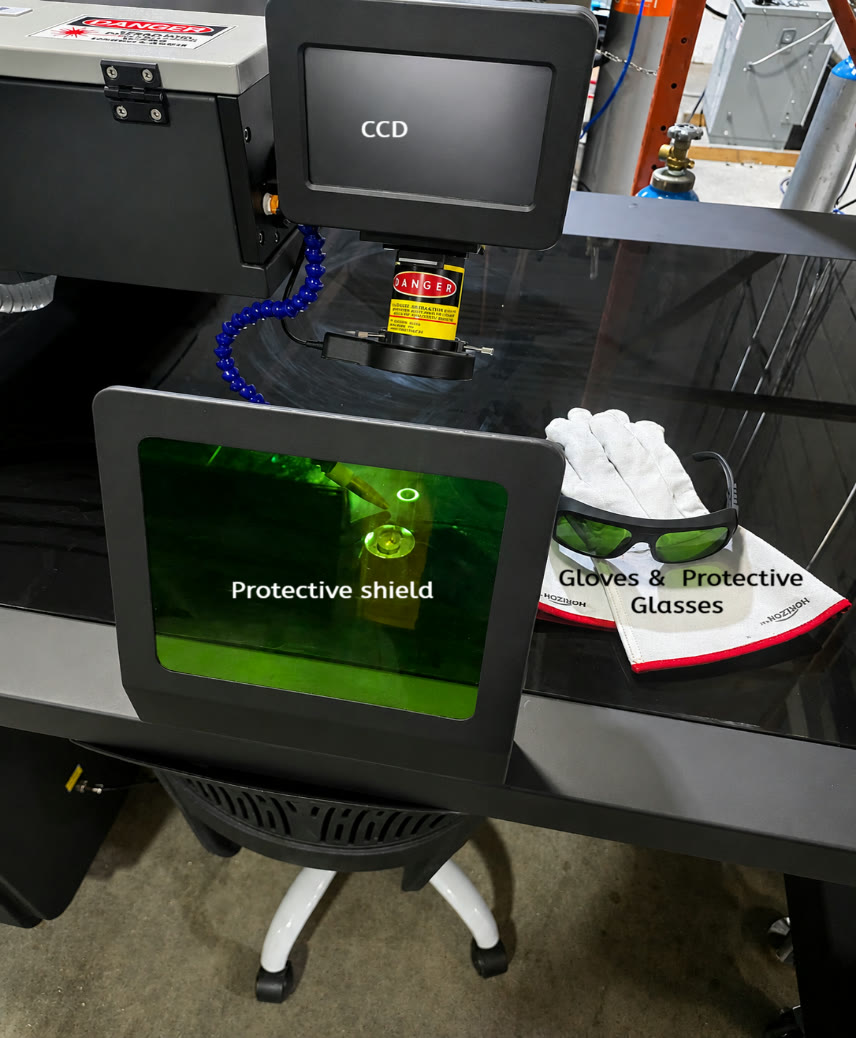
- Eye and face protection. Many jurisdictions call for protectors that meet CSA Z94.3, and Quebec names it for intense radiation. Laser eyewear also has to be rated for your wavelength. Minimum OD 5; prefer OD 7 or 8.
- Respirators. The provinces adopt CSA Z94.4, which covers hazard assessment, a program administrator, fitness evaluation, training, fit testing for tight-fitting masks and care of the equipment. How often to fit-test comes from your province's rules and that standard, not from US practice.
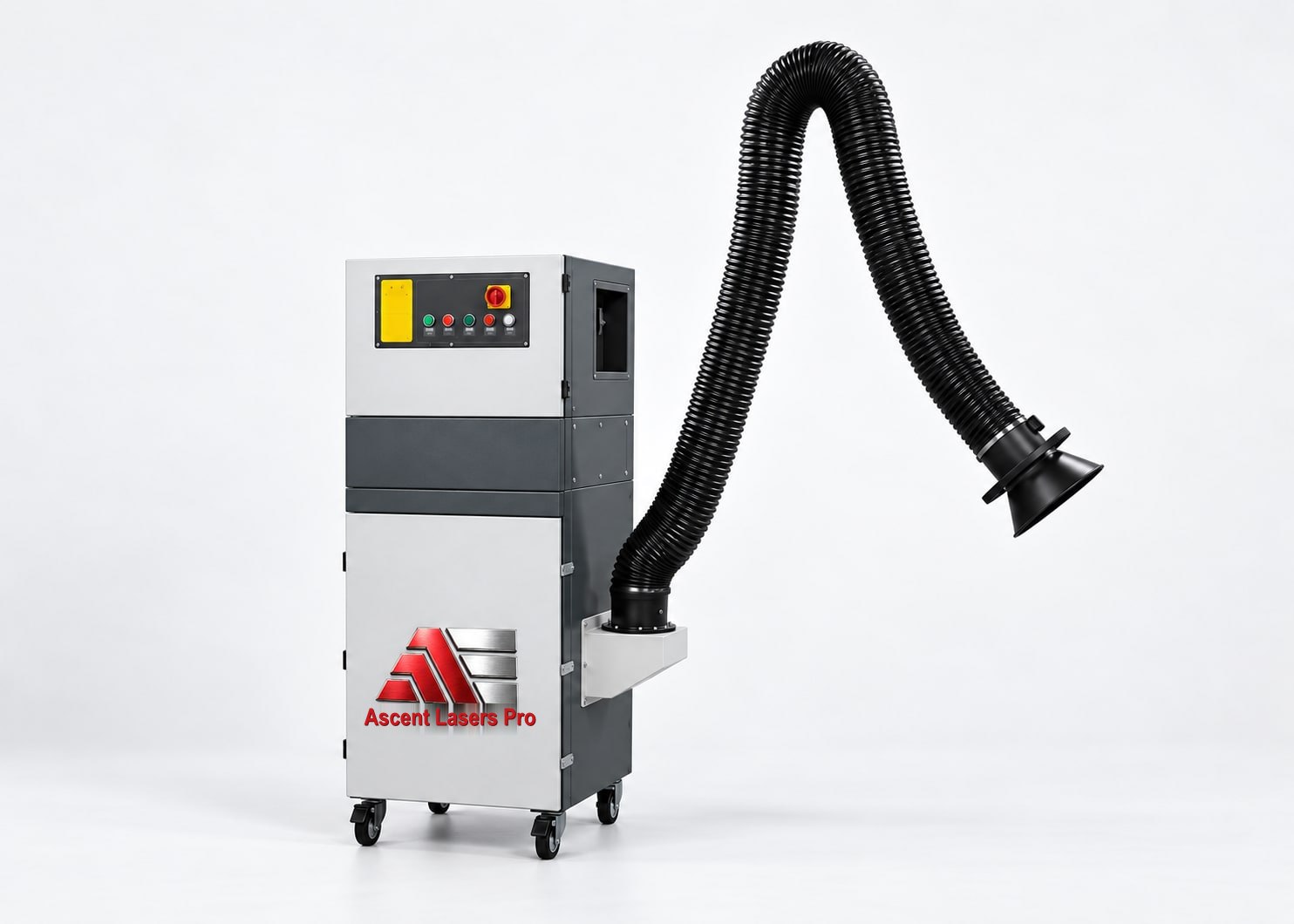
- Fumes. Judge fumes from welding and cleaning against your jurisdiction's exposure limits.
- Extinguishers. The National Fire Code of Canada and its provincial versions send you to NFPA 10 for portable extinguishers. NFPA 10 requires Class D protection where combustible metal dust, flakes, shavings or chips are produced, within 22.9 m (75 ft) of travel distance. For the laser machine itself, a CO₂ extinguisher is the usual choice. Confirm sizes and positions with your local fire department.
- Medical exams and training. Meet the stricter local rules where they exist, such as Yukon's.
- After an incident. Shut off the laser, secure the area and get anyone with a possible eye injury examined promptly. Keep the settings and the part as they were, and report under your province's or territory's injury and radiation rules. In Yukon, visual disturbances, afterimages and burns go to the person in charge.
Working at another site or in another province
Walls alone do not make a trailer safe. Look at its openings, windows, roof and floor penetrations, the paths reflections could take, the extraction and the way out, and plan to keep the public back if laser light could escape. If the machine is used outside the trailer, that area needs its own controls.
The law can change at a provincial border. Before a job elsewhere, pin down the employer's jurisdiction and industry, the site and dates, and whether Alberta registration applies. Send the regulator the laser's wavelength, the class of the whole system, its continuous or pulse figures, the task, who owns and who operates the machine, whether it is fixed or mobile, the dates and how the work area is enclosed. Ask what law, standard edition, registration, notice, exams and records they expect, and file the reply with the job. Learning that no registration is needed does not cancel any workplace duty.
Outside, make sure no laser light can head toward aircraft or the public, talk to Transport Canada where outdoor work is involved, and don't assume a trailer-mounted laser escapes every laser or vehicle rule.
At each mobile job, confirm the part and what is on it, which way the beam will point, who can get near, what other work is going on, the weather and the emergency plan. Get the containment up before the first shot, and look again whenever you move or change parts.
Registration across Canada at a glance
This summary comes from our October 2026 review of official federal, provincial and territorial laws and regulator guidance. "Yes" means we found registration that covers industrial lasers. "Not found" means we found no general registration for industrial Class 4 lasers. That is what our research showed, not an exemption, and workplace duties apply everywhere.
| Province or territory | Regulator | Registration | Main reference |
|---|---|---|---|
| British Columbia | WorkSafeBC | Not found | OHS Regulation 7.19, 7.20, 7.23 |
| Alberta | Alberta OHS | Yes | OHS Code Part 20 |
| Saskatchewan | OHS Branch | Not found | OHS and radiation rules |
| Manitoba | Workplace Safety and Health | Not found | Reg. 217/2006, s. 16.28 |
| Ontario | MLITSD | Not found | OHS Act (no laser regulation) |
| Quebec | CNESST | Not found | RSST s. 142 and 343 |
| New Brunswick | WorkSafeNB | Not found | Reg. 91-191, s. 34 |
| Nova Scotia | OHS Division | Not found | General regulations, s. 112 |
| Prince Edward Island | WCB OHS | Not found | General Regulations, s. 45.18 |
| Newfoundland and Labrador | OHS Division | Not found | OHS Regulations 2012, s. 454 |
| Yukon | Workers' Safety and Compensation Board | Not found | Radiation Protection Regulations, s. 21–25 |
| Northwest Territories | WSCC | Not found | OHS Regulations, s. 361 and 363 |
| Nunavut | WSCC | Not found | OHS Regulations, s. 361 and 363 |
What Ascent Lasers Pro includes in Canada
Every laser we sell in Canada comes with:
- Health Canada compliance. The machine is supplied to meet Health Canada's laser product rules under the Radiation Emitting Devices Regulations.
- Bilingual labels. The laser class label, the hazard warnings and the safety information are in English and French.
- Delivery and installation across the provinces. We deliver the machine and install it at your facility, wherever you are in Canada's provinces. Installation is included in the price of every machine. Shipping is included in the price of the 2000W and 3000W handheld laser welders and the QCW tabletop laser welder; for other machines, freight is quoted with the machine.
- Installation and support from Toronto technicians. Our technicians in Toronto install the machine, train your operators on site and support you after the sale.
Prices are listed in U.S. dollars. For Canadian orders, the price is calculated in Canadian dollars at the exchange rate when the order is placed.
Questions about the rules for your own shop? Contact us.