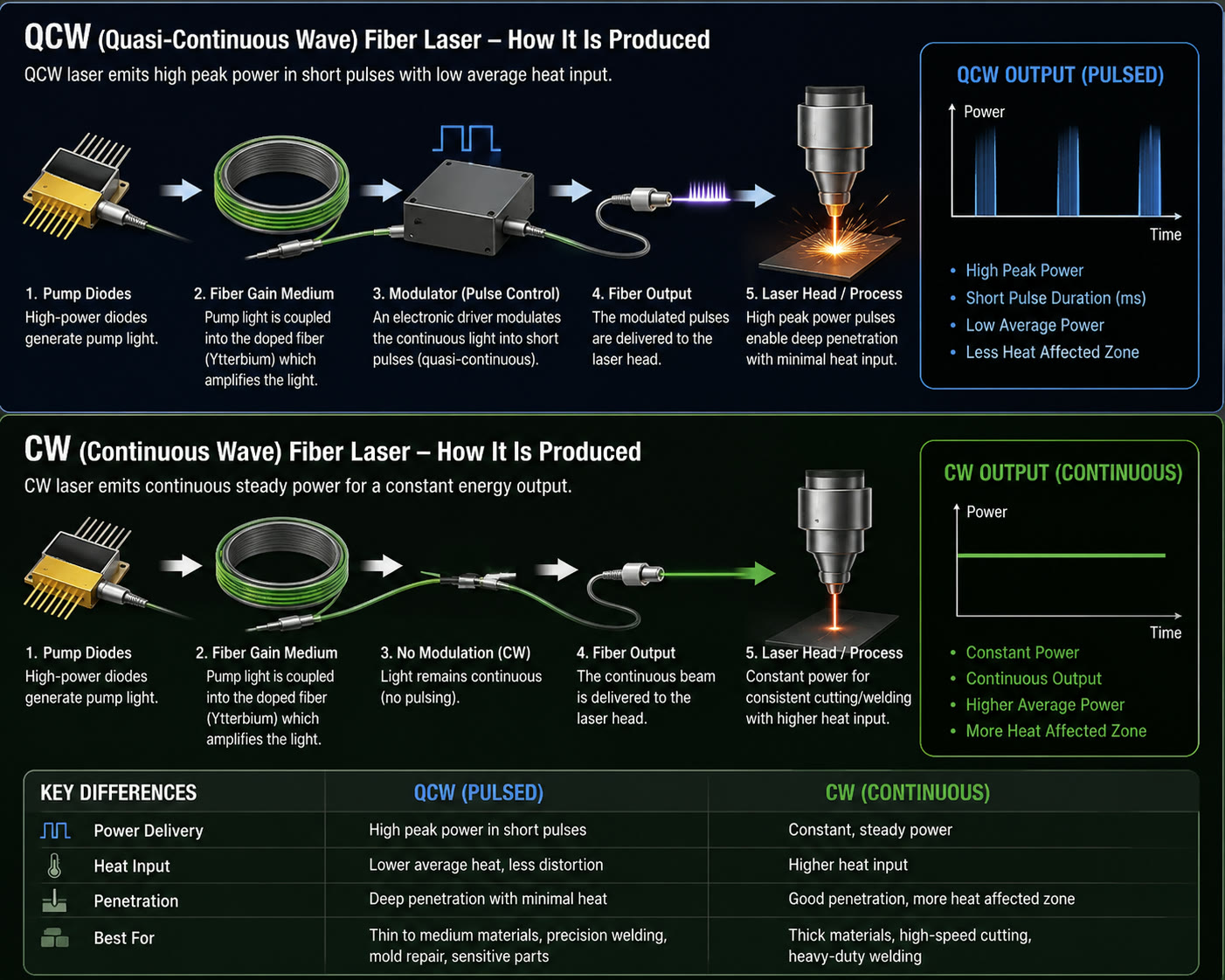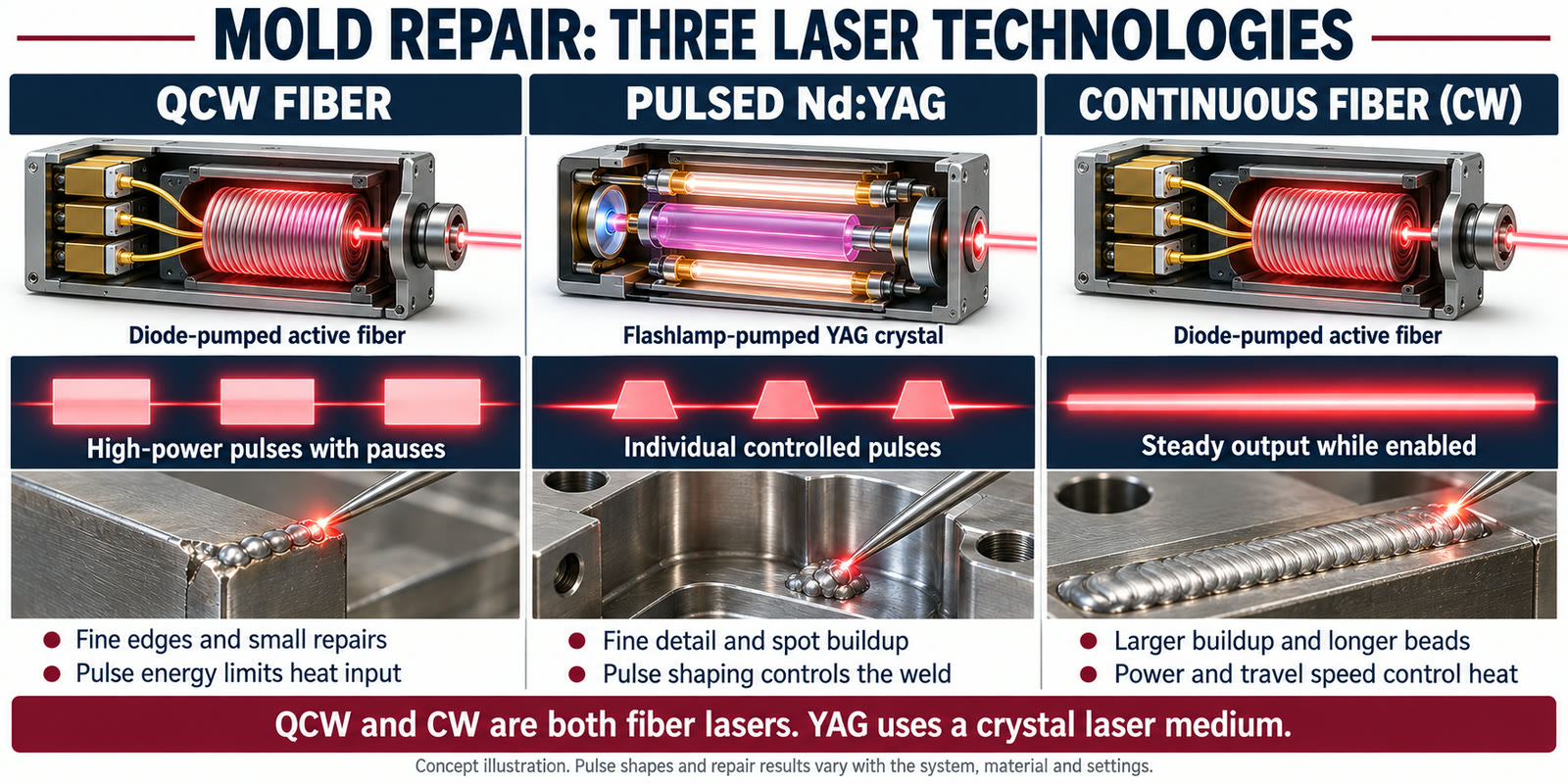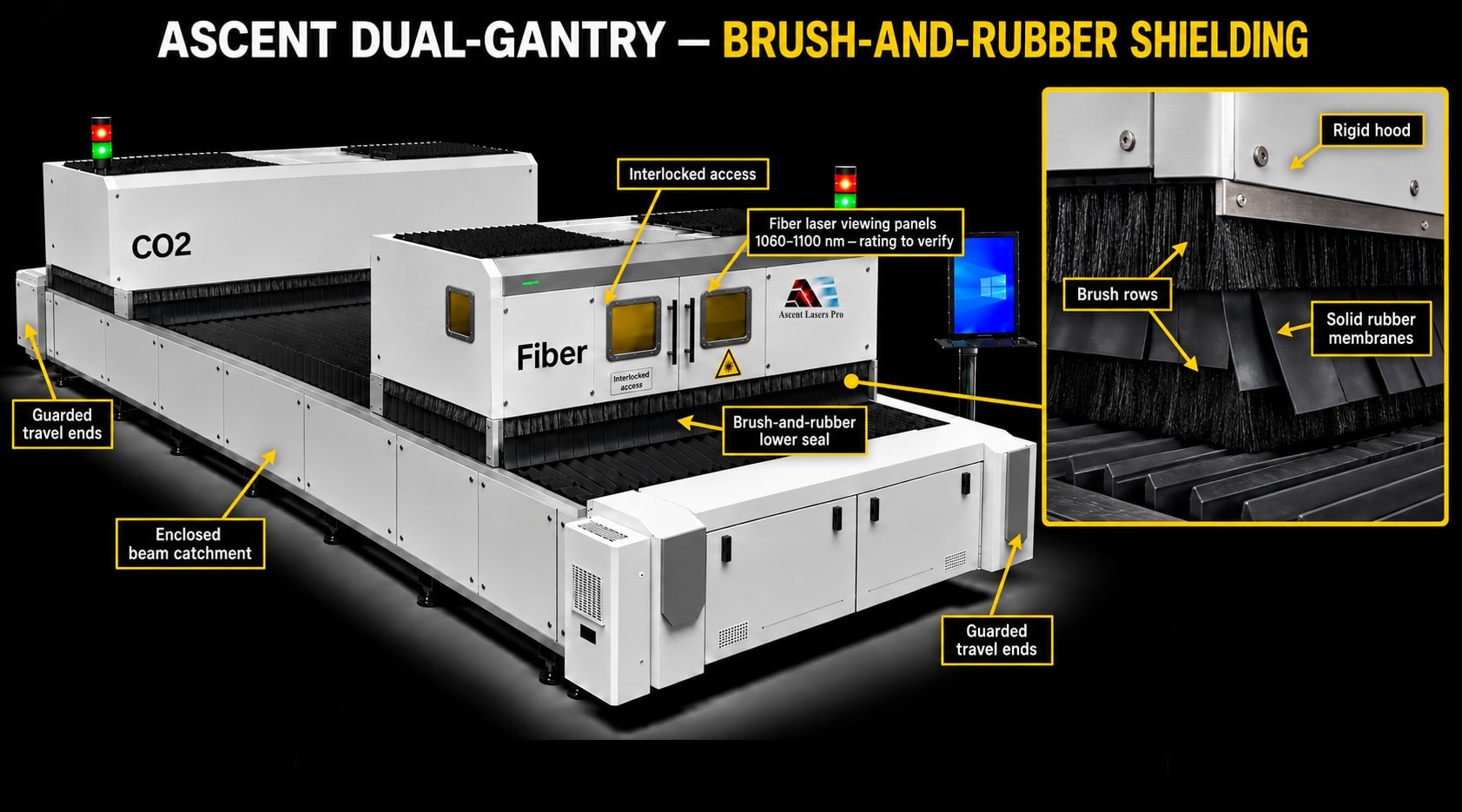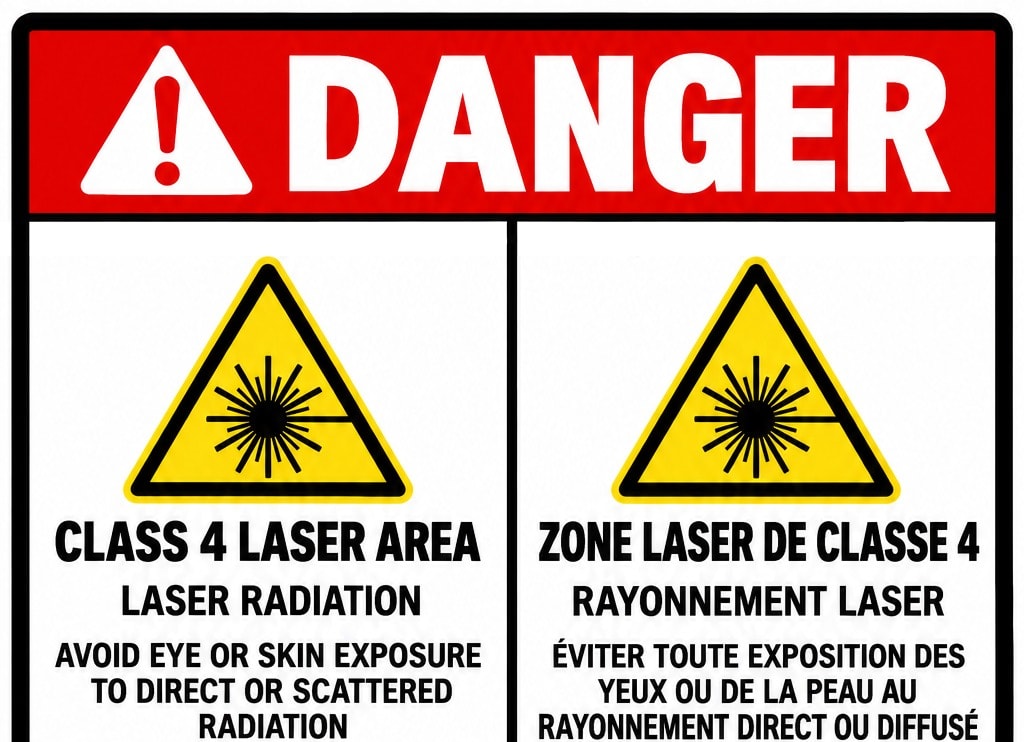
At 1070nm a fiber laser's beam sits in the near-infrared. You can't see it, and the barriers that stop visible light let it straight through. Ordinary welding curtains, standard rubber, white fabrics and most plastics do little or nothing to stop it. To build a safe welding area you need to know which materials really absorb or reflect 1070nm energy, and which only look the part.
We cover flexible materials, used to protect hands, back up joints and make portable barriers, and rigid ones, used for permanent enclosures and beam stops, along with how each holds up at welding power.
What decides whether a material stops the beam
Two things: how strongly the material absorbs light at 1070nm, and how much absorbed energy it can take before it ignites or burns through. The second is its thermal capacity.
Absorption at 1070nm depends on electronic structure. Metals have free electrons and either reflect or absorb strongly. Carbon absorbs broadly, 1070nm included. Many polymers, ceramics and pale materials let a good share of the light pass, and in some cases the beam goes through as though the material were glass.
Thermal capacity decides what happens to the energy that is absorbed: it's either dissipated safely, or the material burns, melts or ablates. High absorption doesn't help if the material is gone in seconds.
In welding, the case that usually matters isn't the focused spot at the joint, since nothing survives that for long. It is two other things: the beam that widens after it slips through a gap, still carrying its full power over a bigger spot, and the light that bounces or scatters off the joint. Both are hazardous, and both can be handled with the right materials.
Materials that work
Graphite felt
The best flexible all-rounder for welding. Graphite felt is a soft, fibrous carbon that tolerates very high temperatures. It absorbs most 1070nm energy, so little is reflected or transmitted. Industrial thermal suppliers and carbon fiber distributors sell it in sheets of various thicknesses.
It works as a pad behind a joint that catches whatever gets through a gap, as a movable beam stop taped or clamped behind small parts, and as a cover that protects the welding table.
At full weld power, a focused beam will slowly ablate the felt, leaving carbon dust and visible charring. That turns out to be a feature: charring shows the beam got through, so the joint had a gap. Treat charring as a prompt to inspect your fit-up.
A diverged beam coming through a gap is another matter. Its energy density is lower, the felt handles it well and doesn't normally ignite, so the protection lasts. A piece of felt between the workpiece and your hand behind a joint adds a meaningful second layer of protection for the hand.
Sources: industrial thermal suppliers, carbon fiber distributors and graphite machining suppliers. Look for graphite felt, carbon felt or, in some forms, RVC (reticulated vitreous carbon) foam.
Carbon-loaded silicone sheet
The best flexible option where stretch and conformability count. Silicone rubber loaded with carbon black absorbs 1070nm well: the carbon black does the absorbing and the silicone supplies the flexibility. It is softer and conforms more easily than graphite felt, so it works behind curved joints and uneven surfaces.
Silicone starts to degrade at about 250 to 300°C, which limits it under sustained direct exposure. It copes well with a widened beam or scattered light, where the energy is spread out, but don't rely on it as the main stop in the path of a direct, focused beam.
Typical uses are a gasket clamped behind curved joints, a pad on the table surface, and a second protective layer behind a copper backing bar.
Sources: laser safety equipment suppliers and industrial rubber suppliers, sold as "laser-absorbing silicone," "carbon-filled silicone sheet" or "NIR-absorbing elastomer."
Commercial laser safety blankets and curtains
The rated, documented option for a formal safety program. These products are made specifically to contain fiber laser energy. Makers differ, but most combine a woven fiberglass base (it resists heat and won't melt through), a carbon-based absorbing layer or coating, and, on some products, a reflective outer layer that redirects energy instead of absorbing it.
They come with ratings for particular wavelengths, power levels and exposure times. Check that a product is rated for 1070nm and for the power of your laser, and that the rating covers how long the barrier must hold before the laser is switched off. Laser safety suppliers offer roll goods to cut to size, ready-made curtains with grommets, and blankets for wrapping specific equipment.
Choose them when your formal laser safety plan calls for it (ANSI Z136.1; OSHA has no laser-specific rule for general industry but enforces through 29 CFR 1910.132/.133 and the General Duty Clause), when your insurer or facility management wants documented material specifications, or when the installation is permanent and has to meet specific OD requirements.
Sources: specialist laser safety suppliers. Specify a product rated for 1070nm, the fiber laser wavelength.
Copper (rigid: reflective, not absorptive)
The standard backing-bar material. Copper doesn't absorb much 1070nm energy; it reflects most of it. So instead of turning the beam into heat inside the material, as the absorbers above do, it throws the beam away from the joint.
For a backing bar, that's the behavior you want. Any beam that passes through a gap strikes the copper and bounces away at an angle set by the surface geometry. Because the copper isn't absorbing the energy, it doesn't heat quickly and it doesn't fuse to aluminum or stainless workpieces, so a bar can be reused indefinitely.
Typical bars are flat stock 6 to 12mm thick, placed directly behind the joint. The reflected beam leaves at an angle away from the joint instead of continuing along its original line. That is easier to predict and control than absorption, where energy collects in one spot and heats the material.
A caution: the beam reflected from copper is still dangerous. Think about where the reflection will go when you position the bar, and never let it head toward the operator or bystanders. Under a butt joint welded flat, lay the bar level so the reflection goes down into the table.
Flexible copper, in the form of mesh or woven fabric, can back curved joints. The gaps in the weave make it less reflective than solid copper, but it still beats having nothing.
Aluminum (rigid: partly reflective)
Aluminum also reflects most 1070nm energy, a little less than copper, and can stand in as a backing bar if you have no copper. Unlike copper, though, it can stick to the underside of the weld, especially on stainless steel, and then it is hard to get off. Prefer copper for backing bars, and keep aluminum for fixed backing fixtures that the weld won't reach.
Tungsten sheet (rigid: absorptive, very heat tolerant)
Tungsten melts at 3422°C and absorbs a moderate share of 1070nm energy, less than carbon but with extreme heat tolerance. Thin sheet turns up in some laser safety designs where space is tight and heat resistance is vital. It's expensive and seldom in stock, so for most fabrication shops, graphite felt or copper is the practical choice.
Materials that don't work
| Material | Why it fails at 1070nm |
|---|---|
| Standard welding curtains (orange or green vinyl) | Built to block UV and visible arc light, but largely transparent to 1070nm infrared. A fiber laser beam passes through them almost unchanged, so they give no laser protection. |
| Standard welding gloves (leather, wool) | Leather absorbs some 1070nm energy but chars fast at welding power, so it offers no real protection from the beam. Gloves rated for lasers are a separate kind of product. |
| White or light-colored fiberglass | Pale ceramic-fiber blankets and fiberglass insulation let most 1070nm light through. They are made to shield against heat from hot parts, not against a laser beam. |
| Standard rubber and neoprene (no carbon black) | Depending on the compound, much of the 1070nm light can pass through, so plain rubber is not a reliable barrier. |
| Cardboard and paper | Flammable, and they absorb next to nothing. Not suitable. |
| Clear polycarbonate | The usual choice for CO₂ laser enclosures, because polycarbonate blocks CO₂ light, but it is transparent to a fiber laser at 1070nm. An enclosure designed for a CO₂ cutter gives no protection at all against a fiber laser. |
A practical weld-station setup
For most light fabrication work, this combination covers the bases:
- Behind each joint: a copper backing bar (6 to 12mm flat bar, flush with the underside of the joint) as the main beam stop, with a layer of graphite felt behind it as backup protection and a built-in gap indicator.
- On the welding table: carbon-loaded silicone sheet or a graphite felt pad, to protect the table and absorb scattered energy at workpiece level.
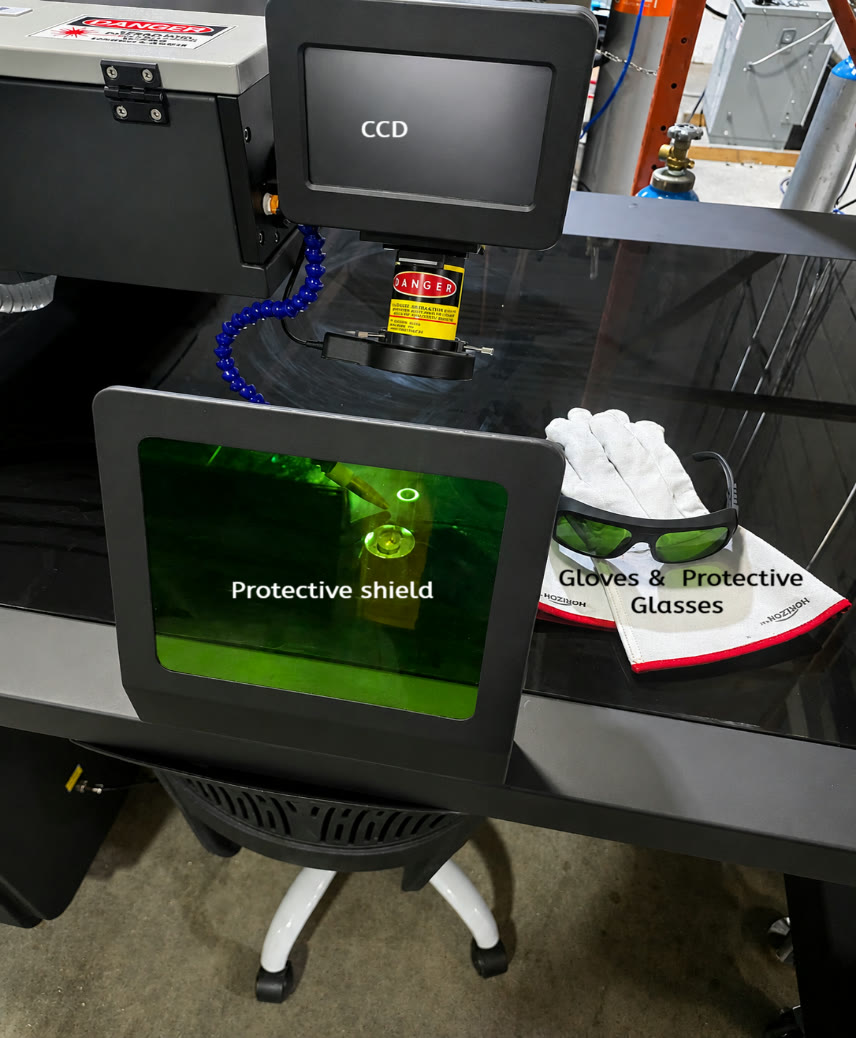
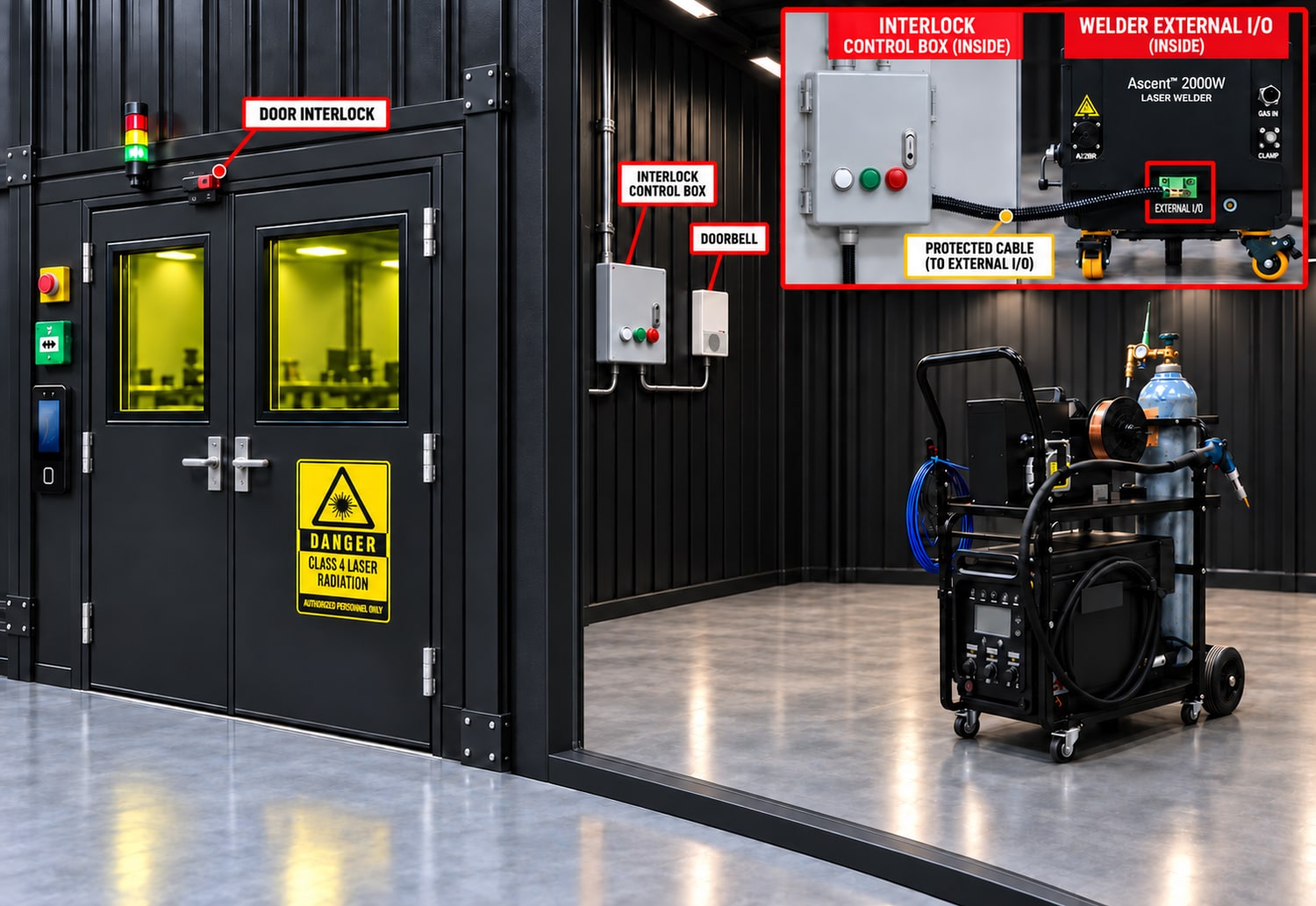
- Around the work area: commercial laser safety curtains rated for 1070nm and for your laser's power, hung on a plain pipe-and-hook frame to mark the controlled zone. Everyone inside wears laser safety glasses rated for 1070nm. Minimum OD 5; prefer OD 7 or 8.
- On the operator's hands, if the part can't be fixtured: laser-rated gloves made for fiber laser wavelengths, as an addition to good fixturing and backing-bar practice, never a replacement for them.
To learn how to set up a safe laser welding area, see our laser safety page and the workstation setup guide. If you have questions about your own configuration, our team can help.