
Seven ways to load 5 × 10 ft acrylic and aluminum sheets, and what each one costs
On a laser cutter, every minute spent maneuvering a sheet is a minute the beam isn't cutting. A full 5 × 10 ft sheet needs two people, a careful hand around the edges, and patience, and acrylic and polished aluminum mark easily. Mechanical help brings back the lost minutes and protects the stock.
You don't have to start with a robot. For a flat sheet, a vacuum lifter or a simple overhead gantry frequently does the work at a small fraction of the price. Five things decide the answer: sheet thickness, sheets per day, floor space around the machine, the way jobs vary, and whether finished parts also need to come off the bed.
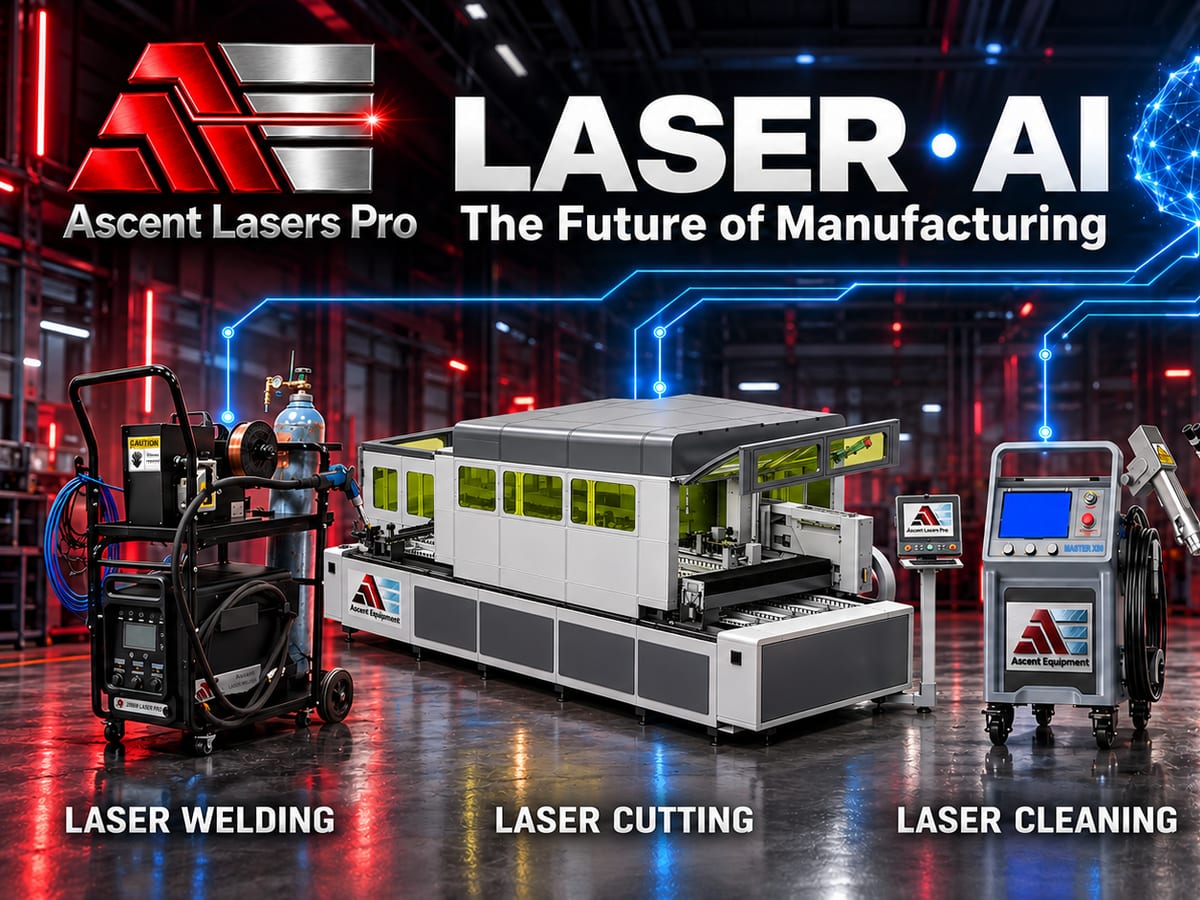
Ascent Lasers Pro can integrate a loading system with its laser cutters, so the machine and the loader can be planned as one project. Every cost below is a rough planning figure, not a quotation.
How the machine shapes the choice
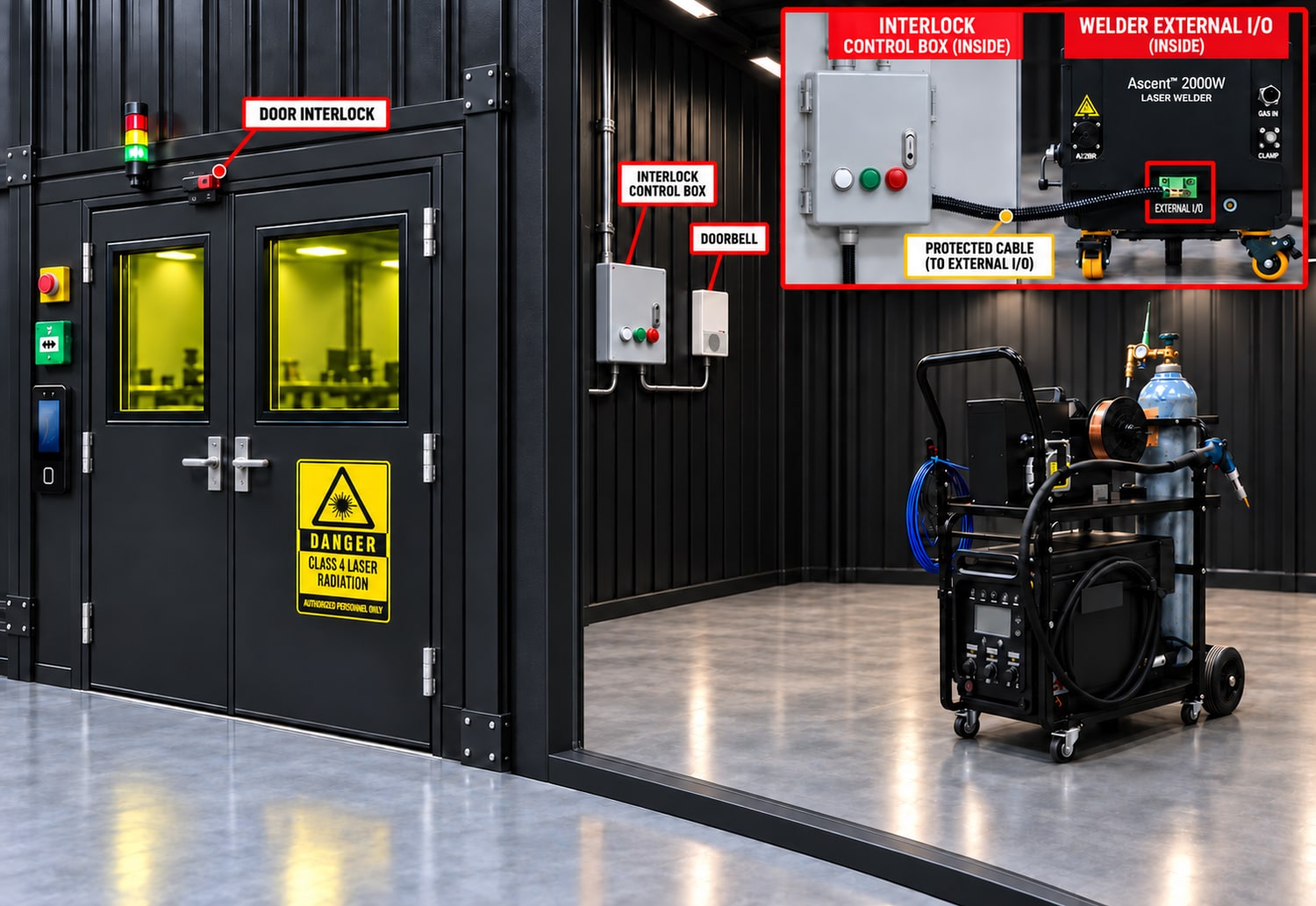
Nobody reaches into a working laser cutter. The cutting zone is enclosed, the doors are interlocked, and an extractor removes the fumes. Whatever loads the sheets must live inside those rules.
Our CNC fiber laser cutter comes with a 3000W or 4000W source, and a shuttle table carries sheets in and out of its 5 × 10 ft work area. One sheet is cut while the next one is placed on the table, and that spot outside the enclosure is where a lifter or loader would hand the sheet over. Confirm the details of that handoff with us first.
The dual-gantry cutter combines a 500W CO₂ laser (acrylic) and a 3000W or 6000W fiber laser (metal) above one bed of 5 × 10 ft or 6 × 12 ft. Sliding covers or laser-rated partitions enclose it, so a loader has to cooperate with them and with the interlocked doors. See our laser safety guide for what a compliant installation involves; a loader is added within that plan, never at its expense.
The 280W CO₂ laser cutter has a 4 × 8 ft bed. Sheets for it are smaller, which brings every weight below down to about 64%.
What the sheets weigh
Weight decides which systems are even possible. A full 5 × 10 ft sheet covers 50 square feet, and what it weighs depends heavily on the material and thickness:
| Material | Thickness | Approximate sheet weight |
|---|---|---|
| Acrylic | 1/8 inch | 39 lb / 18 kg |
| Acrylic | 1/4 inch | 77 lb / 35 kg |
| Acrylic | 1/2 inch | 154 lb / 70 kg |
| Aluminum | 0.040 inch | 28 lb / 13 kg |
| Aluminum | 0.063 inch | 44 lb / 20 kg |
| Aluminum | 0.080 inch | 56 lb / 25 kg |
| Aluminum | 1/8 inch | 88 lb / 40 kg |
| Aluminum | 1/4 inch | 176 lb / 80 kg |
Figures use typical densities of about 1.19 g/cm³ for acrylic and 2.70 g/cm³ for aluminum, so a real sheet may differ a little. For a 6 × 12 ft sheet, add 44%.
Don't size a robot from the sheet alone. Its vacuum gripper has a frame, hoses and fittings, and all of that rides along. Take 1/4 inch acrylic at about 35 kg (77 lb) with a 25 kg (55 lb) gripper: the robot lifts 60 kg (132 lb), and the arm's maker also caps where that mass can sit and how far it can hang out from the wrist.
Also check how far the arm can reach. It must pick up from the stack and set the sheet on the bed without hitting the gantry, the enclosure or its neighbors.
The seven systems, with budgets
All amounts are early planning numbers in US dollars. They assume a new system, suitable sheet tooling, and normal installation and start-up. They leave out the laser cutter itself, taxes, duties, major building work and complicated sorting of cut parts. A quote may land above or below them.
| System type | Best application | Installed budget (USD) |
|---|---|---|
| Vacuum lifter with jib crane | Lower-volume shops; operator-guided handling | $12,000 to $35,000 |
| Powered articulated handling arm | Frequent loading with operator guidance | $20,000 to $50,000 |
| Automatic vacuum gantry | Repetitive full-sheet loading | $60,000 to $150,000 |
| Six-axis industrial robot cell | Flexible handling or multiple stations | $120,000 to $250,000 |
| Collaborative robot cell | Selected lightweight sheets and suitable layouts | $75,000 to $150,000 |
| Integrated loading and unloading | High-volume production on a compatible machine | $90,000 to $250,000+ |
| Storage tower with automation | Multiple materials and extended runs | $200,000 to $500,000+ |
For context, published integrator ranges run from about $75,000 to $150,000 for a basic cobot cell and $150,000 to $350,000 for a mid-complexity cell built around an industrial robot. Those are general robot figures, so a loader made for 5 × 10 ft sheets still needs a quote of its own.
Vacuum lifter on a jib crane
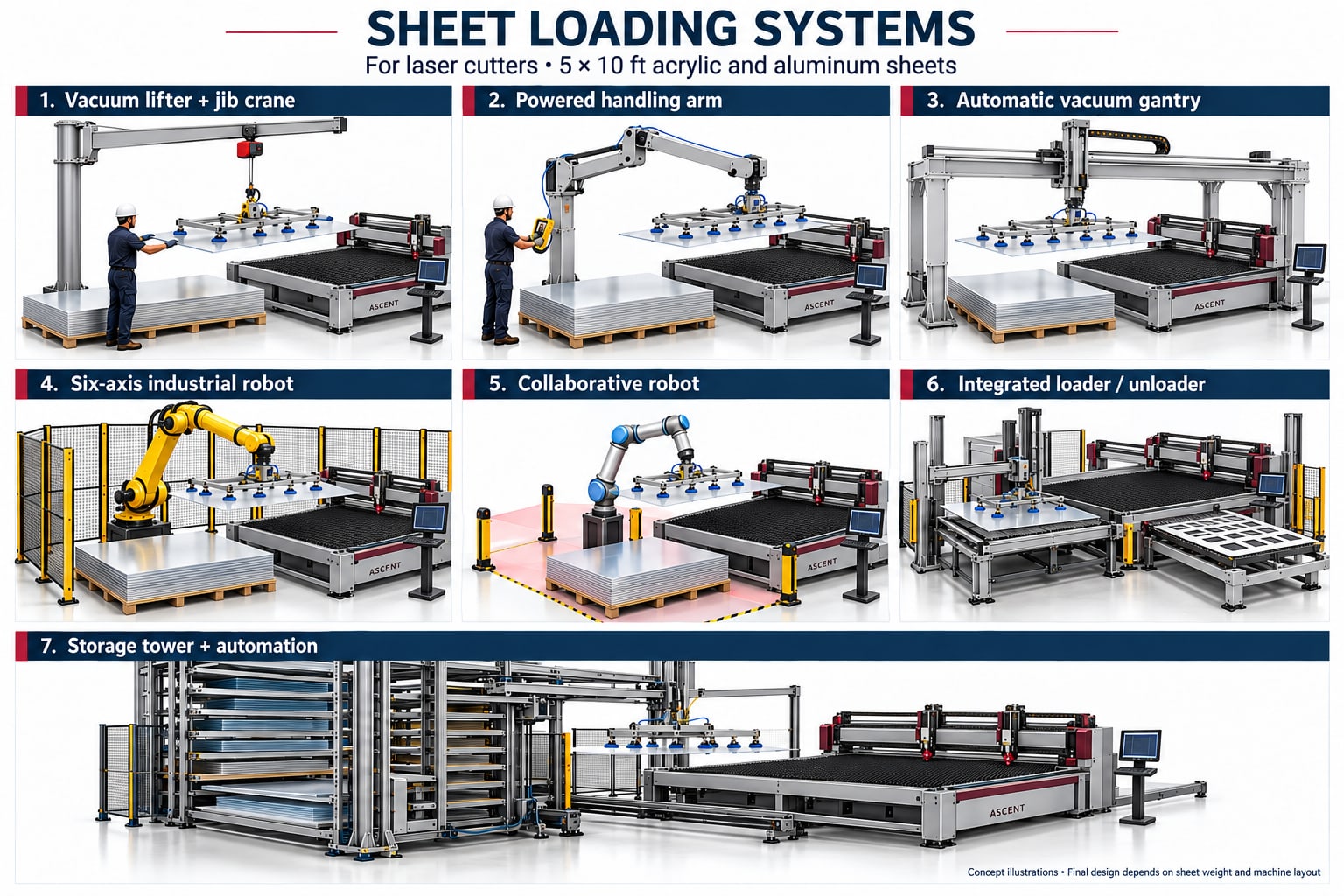
Suction cups hold the sheet while a jib crane or overhead rail bears its weight, and the operator walks it from the stack to the bed. When a shop cuts a changing mix of jobs, this is often the smart first step: nobody lifts the load, yet the crew keeps its flexibility with sizes and materials. Plan on a spreader frame matched to your sheet size and stiffness.
Powered handling arm
Instead of hanging from a hoist, the sheet rides on a rigid arm that air or electric power moves, with the operator steering. That is handy for delicate placement or for moving sheets between a vertical rack and the flat bed. Make sure the arm's swing covers the whole route between stack and table.
Vacuum gantry
A gantry carries a vacuum frame along straight lines: over the stack, up, then across to the bed. Since a whole sheet generally only needs to be lifted and slid sideways, straight axes can do it for less than a six-axis arm. Look for stack-height sensing, sheet separation, vacuum monitoring and alignment stops, and have the maker confirm it works with your cutter. It is a good fit for repeat full-sheet loading into a single machine.
Industrial robot cell
A six-axis robot can rotate a sheet, pass it between stations or look after two machines when the floor plan allows it. A mid-size model might lift 70 kg (154 lb) across roughly 2 meters (6.5 ft), a reminder to check capacity and path together. Thicker acrylic, heavier aluminum or a bulky gripper frame can call for a bigger model.
When one robot feeds two cutters, both machines can call for a sheet together, and the cell then needs a rule for who goes first. A linear track widens the reach, at added cost. Choose this route when you need rotation, several stations or other handling work in the future.
Collaborative robot cell
Lighter sheets are the realistic target for a cobot. The biggest ones are rated near 30 kg (66 lb) with a reach of about 1.3 meters (4.3 ft), which means a single 1/4 inch acrylic sheet is over that limit before the gripper is counted.
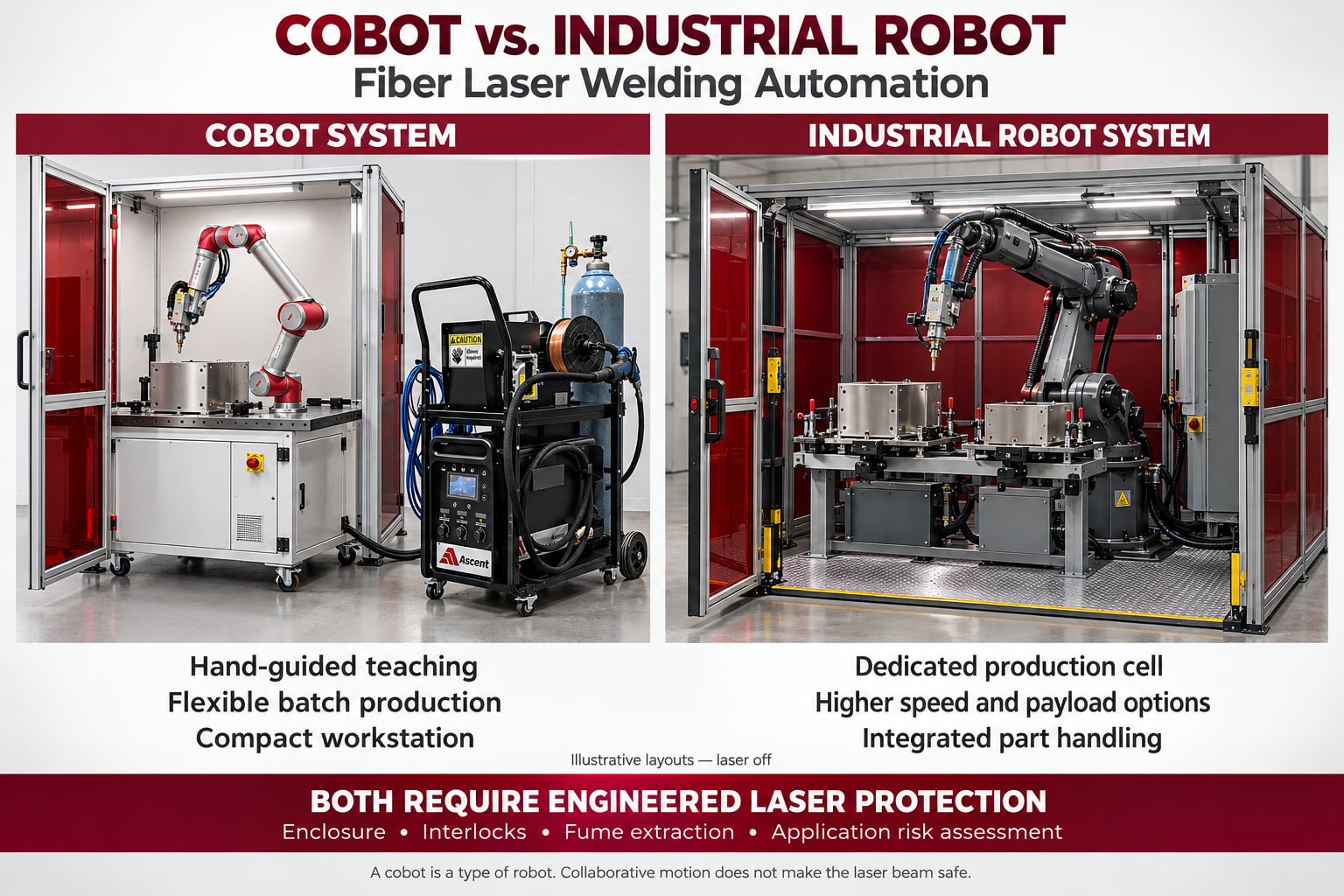
Safety depends on the complete installation. A large sheet in motion has sharp edges, pinch points and enough momentum to hurt someone, and the word collaborative does not make a cell safe to stand next to. A risk assessment of the actual cell does, and because a laser is part of it, the cell needs laser protection too. Our article on cobots and industrial robots in laser welding goes into why.
Loader and unloader built into the machine
Here the loader belongs to one machine. A fresh sheet enters on one side while the cut sheet leaves on the other, often over a second table, so the laser seldom waits for people. Expect $90,000 to $250,000 or more, and the best results come with a cutter that was designed around the feature. Talk to us about integration before you collect other quotes.
Storage tower
A tower stores a stock of sheets, often of mixed materials, and a handler pulls out whichever one the next job needs. It makes sense for shops with a wide mix of materials or long runs that nobody attends. Prices begin near $200,000 and can exceed $500,000, with floor space and power on top, so the volume must justify it.
Getting the cut parts out
Lifting an intact sheet is the simple half. Once cut, it can be dozens of loose pieces in a fragile frame, and a loader will not necessarily clear them.
A metal cutter can use forks to move the finished sheet onto a pallet, with sorting done by hand or automatically afterward. On any laser cutter, parts may tilt or fall as they separate, so settle how they leave the bed before spending money. Several laser makers offer loading and unloading equipment designed around their own cutters.
Run your acrylic trials with the masking film still on, the way the sheets actually arrive. A gripper has to hold a floppy sheet without letting it sag, marking it or lifting the film. For aluminum, ask how stacked sheets are peeled apart and how a double pick gets caught. Magnets can't separate either material.
Making the decision
For mixed work at moderate volume, an operator-guided vacuum lifter is often a sound first purchase. If one cutter gets full sheets all day, ask for an automatic vacuum gantry quote first. Move up to a six-axis robot only when flexibility or several stations outweigh the extra complexity.
Before you commit, see a demonstration on your own 5 × 10 ft sheets, thicknesses, films and floor plan. Ask for a quote that spells out:
- how long one sheet takes to load,
- how accurately it positions the sheet,
- how it detects two sheets stuck together,
- what protects the sheet if vacuum is lost,
- how it connects to the machine,
- the guarding, and
- whether cut parts are unloaded too.
Judge the payoff from time you have measured yourself. Suppose you save four minutes on each of 40 sheets a day. Over 250 working days that frees about 667 hours, worth roughly $23,000 at an assumed $35 an hour in loaded labor cost. Extra output only earns money if there is demand for it and the work after the laser can keep pace, so look at those steps before you count the savings.
Buying a laser cutter and wondering how to feed it? Ascent Lasers Pro can tie a loading system into a new cutter order. Send your sheet sizes, thicknesses and daily volume through the contact page and we'll help you plan it. Installation and operator training are included with the machine.
Learn more
- 5 × 10 ft CNC fiber laser cutter
- Dual-gantry combination CO₂ and fiber cutter
- 280W CO₂ laser cutter
- CO₂ or fiber laser cutter? Match the laser to the material
- Laser safety guide
Treat the dollar figures as budgeting guides, not quotations. Product facts were checked against the Ascent Lasers Pro site on October 12, 2026. Models and options change, so check with us before ordering.