
Picking aluminum for a sign is a trade-off. The metal has to bend, hold its shape, stand up to the weather, take a finish and weld. For channel letters, 3003 is the easy choice for detailed formed returns, 5052 is stronger sheet that still forms well, and 6061 is the alloy for frames, brackets and machined parts.
All three can be laser welded. 6061 is the one that needs extra care, because it is prone to cracking and it is more particular about filler.
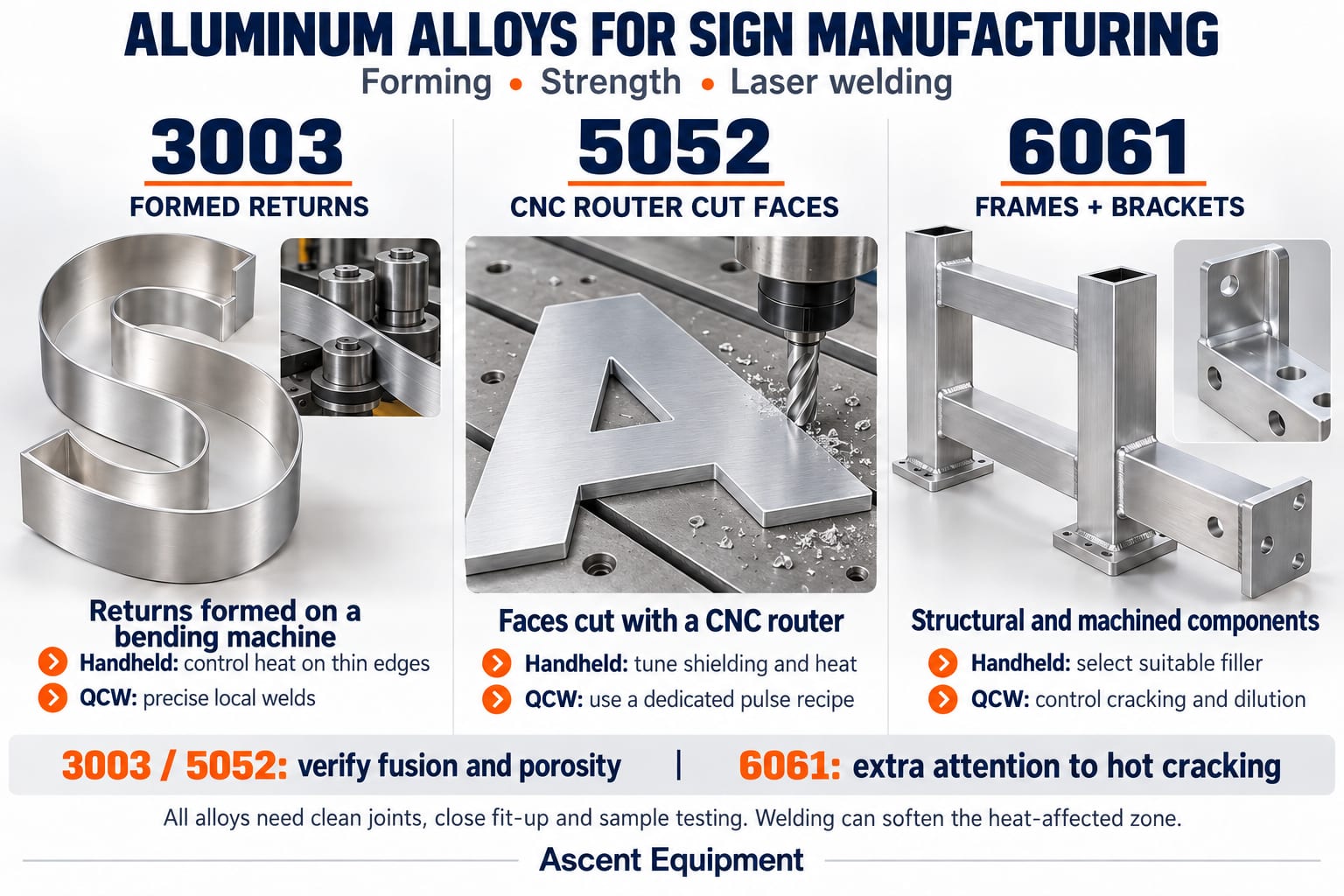
How the three alloys compare
| Property | 3003 | 5052 | 6061 |
|---|---|---|---|
| Main alloying element | Manganese | Magnesium | Magnesium and silicon |
| Common temper | H14 sheet or coil | H32 sheet | T6 sheet, plate or extrusion |
| Why shops pick it | Easiest to form | Stronger sheet that still forms well | High strength, machines well |
| Typical sign parts | Formed returns, decorative skins | Faces, backs, cabinets, formed parts | Frames, brackets, machined parts |
| Tight bends | Usually the easiest | Fine with the right radius | T6 needs a larger radius and care |
Treat the table as a starting point, not a material specification. Temper, thickness, bend direction, tooling and the quality of the metal all count. And a stronger alloy is not much stiffer. All three have about the same stiffness, so panel thickness and bracing do more to keep a sign face from flexing than the alloy number does.
Temper, and what welding does to strength
H14 and H32 mean the metal was strengthened by cold working. T6 means it was heat treated and artificially aged. Welding softens the heat-affected zone in all three alloys. In 6061-T6, the weld undoes part of the strength the heat treatment gave it.
A narrow laser weld keeps the softened zone small, but the joint still won't have full T6 strength. Size load-bearing supports with welded strength values, not the numbers for the base metal.
What the Ascent handheld welders are rated for
Ascent publishes a maximum single-side penetration for each of its refrigeration-cooled handheld welders. Aluminum is listed in two groups: 3000 and 5000 series together, and 6000 series on its own. There are no separate figures for 3003, 5052 or 6061.
| Material | 1500W (A-PRO-HW-550) | 2000W (A-PRO-HW-550P) | 3000W (A-PRO-HW-850) |
|---|---|---|---|
| Aluminum, 3000 and 5000 series | 0.24 in (6.0 mm) | 0.28 in (7.0 mm) | 0.35 in (9.0 mm) |
| Aluminum, 6000 series | 0.197 in (5.0 mm) | 0.24 in (6.0 mm) | 0.295 in (7.5 mm) |
| Minimum material thickness | 0.020 in | 0.020 in | 0.040 in |
3003 and 5052 fall in the first row and 6061 in the second. The minimum thickness is a general machine specification, not a separate promise for each alloy.
These are penetration limits. They aren't joint strengths, and they don't promise full penetration at that thickness for every temper, gap, filler, travel speed or joint design. Weld test pieces that match the job before you run production.
What the ratings mean for sign work
Most sign work uses 0.040, 0.063, 0.080 and 0.125 inch aluminum, well under those limits. On this material, controlled fusion, low distortion and the same fit-up every time matter more than maximum penetration. A more powerful machine still needs a gentle, low-heat procedure for thin returns.
The lower figures for 6000 series are a reason to keep separate settings for 6061. They don't mean 6061 can't be welded, or that every 6061 joint needs a fixed percentage more power.
The Ascent QCW welder
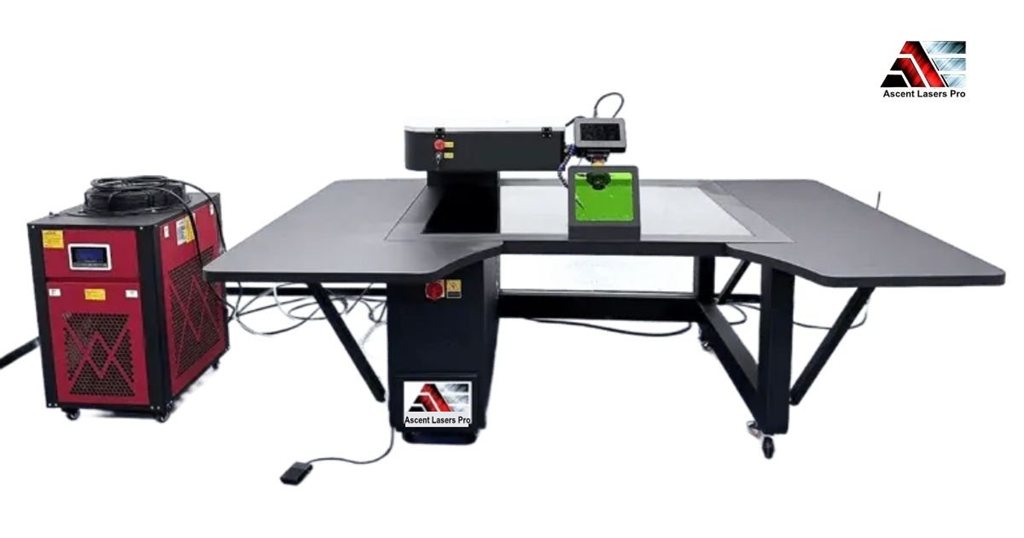
The Ascent QCW welder works as a tabletop station or a handheld torch. It runs at 300W average power with peak pulses up to 3,000W. Ascent lists aluminum from 0.020 to 0.063 inch, plus one channel letter combination: a 0.080 inch face on a 0.063 inch return. There are no separate ratings for 3003, 5052 or 6061.
That 0.080 inch figure describes the face-and-return joint. It isn't a general 0.080 inch full-penetration rating. And a 3,000W peak doesn't make the QCW a 3,000W continuous-wave welder. The penetration table above applies only to the refrigeration-cooled handheld models.
Welding 3003
3003 is a favorite for channel letter returns because it bends easily around detailed shapes on a channel letter bending machine. It resists corrosion and welds well, so it is the sensible pick when forming matters more than strength.
With a handheld continuous-wave welder, keep travel speed and bead size under control on thin material. Linger too long and you melt an edge away or warp the face. Tight fit-up means less molten metal is needed to close the joint. For clamping and heat control on thin sheet, see how to avoid warping when you laser weld aluminum.
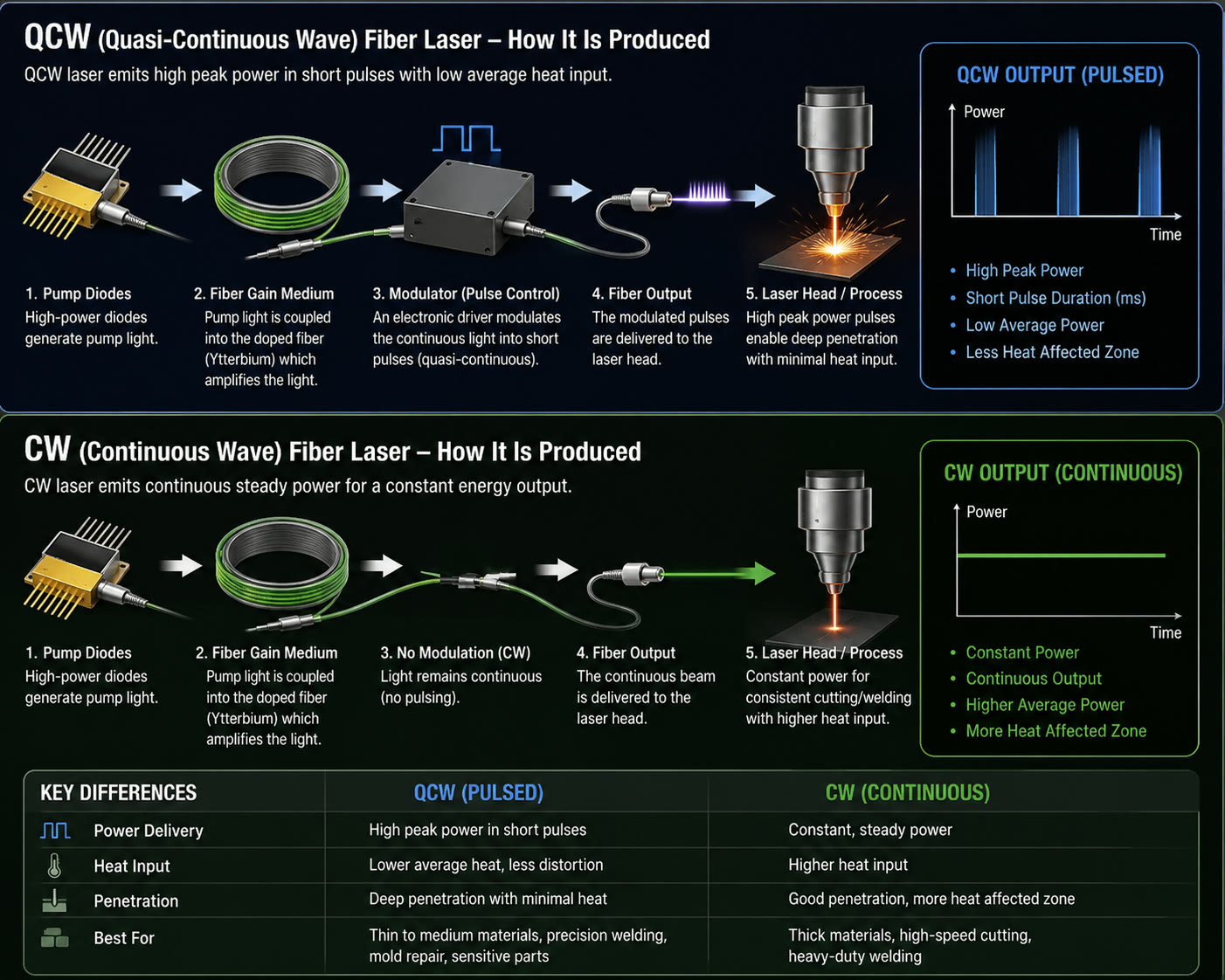
With the QCW, short local pulses suit small letters and detail work. Set pulse energy, pulse length and overlap so both parts fuse without burning through the thinner edge.
4043 is the usual filler to start with. Welding without filler can work when the fit-up is tight and the joint suits it, but test pieces have to prove fusion and strength. A good result on one thickness doesn't prove every face-and-return combination.
Welding 5052
5052 is the choice for stronger sheet-metal assemblies that still need to bend. It suits faces, backs, cabinet parts and outdoor work, as long as the finish and exposure suit it. Faces are often cut on a CNC router.
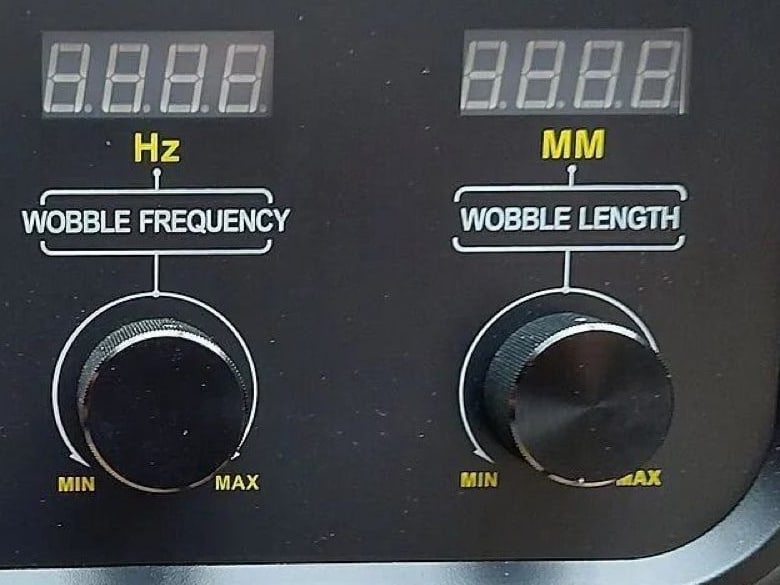
With a handheld welder, find steady settings for power, speed and wobble and for the shielding gas. 5052 carries magnesium, so its weld pool behaves differently from 3003, and the wrong settings bring spatter, pits or porosity. On the QCW, build a separate pulse recipe instead of reusing your 3003 settings.
5356 is the usual first filler for 5052. 4043 isn't ruled out, though: filler selection charts allow it for some jobs. Choose filler for the actual joint, the strength you need and the finish.
Welding 6061
6061-T6 works well for supports and machined parts, but it is awkward for tightly formed returns. Its weak spot in laser welding is solidification cracking, especially when you weld without filler. A bead can look smooth and still have a crack in it.
With a handheld welder, the right filler and a tested procedure make 6061 practical to weld. More power won't fix the wrong weld chemistry. On the QCW, small spots and lower total heat don't stop cracking on their own. Pulse shape, how tightly the part is held and how much filler mixes into the weld still matter.
Silicon-rich 4043 or 4047 filler helps control cracking in laser-welded 6061. Don't carry a no-filler 3003 recipe straight over to 6061.
Filler for sign assemblies
These are starting points for your tests. Standard filler charts show which alloys work together, but they don't qualify a laser process. When you join two different alloys, account for both of them and for how much of each melts into the weld.
| Joint | Filler to start with | What to watch |
|---|---|---|
| 3003 to 3003 | 4043 | How the weld flows, and joint strength |
| 5052 to 5052 | 5356 | Matching magnesium chemistry |
| 6061 to 6061 | 4043 or 4047 for laser tests | Hot cracking, and how much base metal mixes in |
| 3003 to 5052 | Usually 5356 | Mixed-alloy strength and finish |
| 5052 to 6061 | Usually 5356 | Test the mixed chemistry for cracking |
For anodized work, check the final look before you settle on a filler. Welds made with silicon-rich 4043 can come out noticeably darker than the metal around them. Paint hides color differences, but it doesn't fix porosity, cracks or poor fusion.
Handheld or QCW?
"Handheld" describes how the welding head is held. "QCW" describes the kind of laser output. The Ascent QCW itself switches between tabletop and handheld use. In this post, handheld continuous-wave means the refrigeration-cooled fiber welders, and QCW means the pulsed tabletop-and-handheld machine.
| What you need | Handheld continuous wave | QCW pulsed |
|---|---|---|
| Long seams and large assemblies | Usually faster | Usually slower |
| Small letters and local welds | Needs careful heat and hand control | Well suited to precise local welds |
| Main settings | Power, speed, wobble and wire feed | Peak power, pulse length, frequency and overlap |
| Thin visible faces | Watch heat building up | Watch pulse energy and overlap |
| 6061 | Work out the filler and procedure | Work out the filler and procedure |
Checks before production
Know the alloy and temper of both parts. Clean the joint and the filler wire, remove coatings and oxide from the weld area with a method made for aluminum, and keep everything dry. Moisture and oil are major sources of hydrogen porosity.
Clamp parts so the fit-up is the same every time. Match the settings to the thickness combination and use your approved shielding gas setup. Check test welds with peel or break tests, and cut sections where penetration matters. Structural sign supports need an engineered procedure and clear acceptance criteria.
The simple rule: pick the alloy for the part, then build the welding process around it. Use 3003 where forming comes first, 5052 for stronger formed sheet, and 6061 where structure or machining justifies the extra welding work.
Ascent Lasers Pro sells both the refrigeration-cooled handheld welders and the QCW tabletop and handheld welder. Shipping, on-site installation and training are included with every machine. Contact us to talk about your alloys and joints.
Questions answered
Can 6061 aluminum be laser welded?
Yes. Use a silicon-rich filler such as 4043 or 4047 and a tested procedure. 6061 is prone to solidification cracking, especially without filler, and a smooth bead can still hide a crack.
Which filler should I use for 5052?
Start with 5356. Some filler charts also allow 4043 for certain jobs, so choose for the actual joint, the strength you need and the finish.
Does welding weaken 6061-T6?
Yes. The heat-affected zone loses part of the strength the T6 heat treatment gave it. A narrow laser weld keeps that zone small, but design supports with welded strength values.
How thick can the Ascent handheld welders weld aluminum?
Ascent lists a maximum single-side penetration of 0.24, 0.28 and 0.35 inch (6.0, 7.0 and 9.0 mm) for 3000 and 5000 series aluminum on the 1500W, 2000W and 3000W models, and 0.197, 0.24 and 0.295 inch (5.0, 6.0 and 7.5 mm) for 6000 series. Most sign material is far thinner.
Will 4043 welds match anodized aluminum?
Not always. Welds made with 4043 can come out noticeably darker than the surrounding metal, so test the final finish before you choose the filler.
Sources
Ascent specifications were checked on October 25, 2026, and may change. This guide supports alloy and process choices; it does not certify any weld or installation.
- Ascent Lasers Pro: Refrigeration Laser Welders, maximum welding penetration table
- Ascent Lasers Pro: QCW Tabletop and Handheld Laser Welder specifications
- ANSI H35.1/H35.1(M), Alloy and Temper Designation Systems for Aluminum (H14, H32 and T6 tempers)
- AWS D1.2/D1.2M, Structural Welding Code: Aluminum (welded strength of heat-treated alloys)
- AWS A5.10/A5.10M, Welding Consumables: Wires and Rods for Aluminum and Aluminum Alloys (ER4043, ER4047 and ER5356 filler)