
Our laser safety guide covers the beam: enclosures, interlocks, eyewear and the controlled area. This post covers the other hazard, the one that stays in the air after the beam stops: fumes, smoke, fine particles and gases.
Laser welding, laser cleaning, and CO₂ and fiber cutting all need extraction where the laser meets the material. A good system catches the fine particles and deals with any harmful gases and vapors. Seeing little smoke doesn't mean the air is safe.
Start with what is on the part: the base metal, the filler wire, coatings, adhesives and any contamination. Choose and check the extraction for the work you actually do, not for the laser's power.
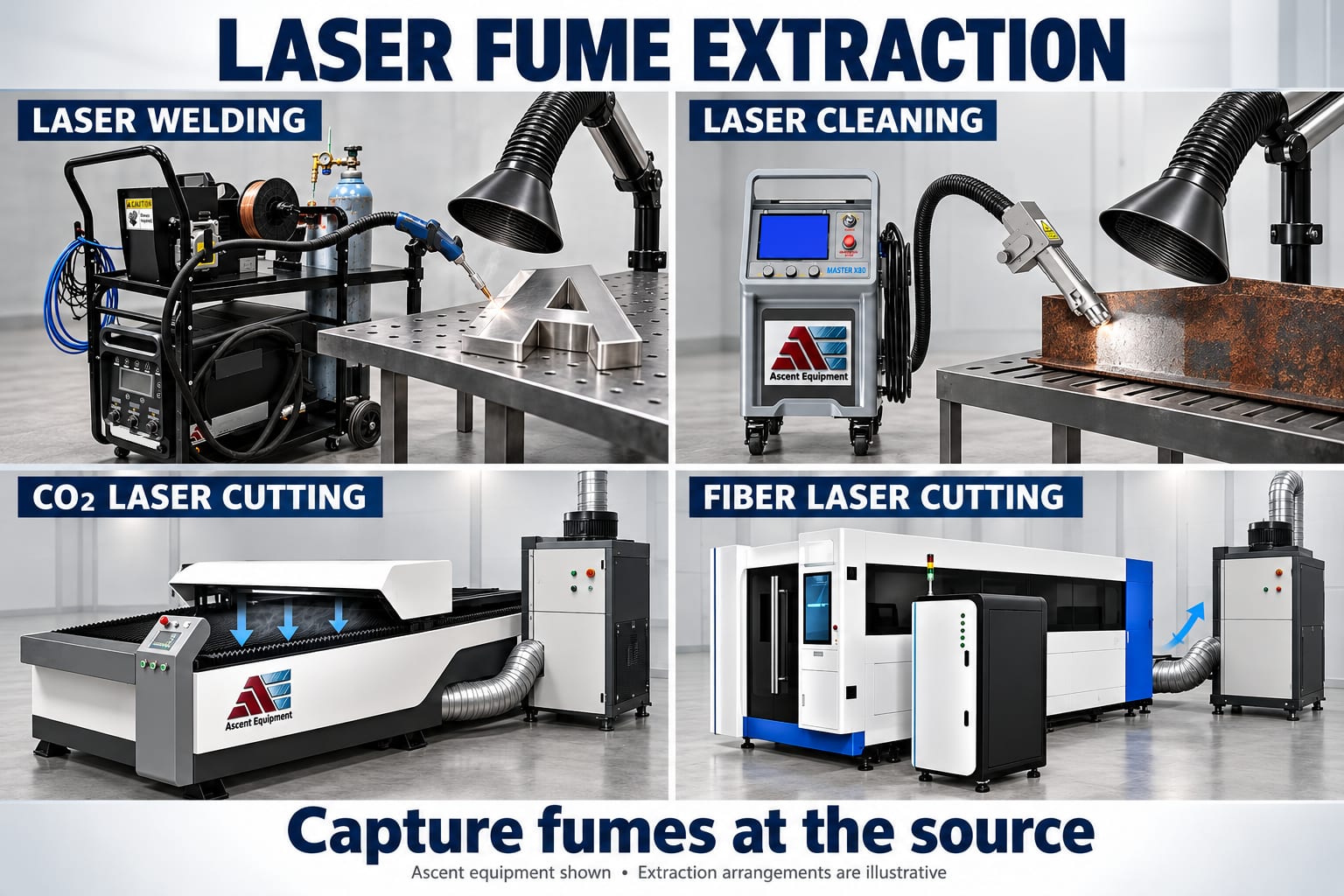
What laser welding releases
Welding fume forms when vaporized metal condenses into very fine particles. What it contains depends on the base metal, the filler, coatings, contamination and the settings. The table lists what to assess. It isn't a guaranteed list for every job.
| Material or task | What to assess and capture |
|---|---|
| Aluminum returns and faces | Aluminum fume, plus particles from alloying elements, filler wire and contamination |
| Stainless steel | Fume containing chromium and nickel; assess possible hexavalent chromium exposure |
| Mild steel | Iron fume, and manganese where the steel or the filler contains it |
| Galvanized steel | Zinc oxide fume, which can cause metal fume fever |
| Painted or plated metal | Metal fume plus breakdown products from the coating; some coatings contain hazardous metals |
Handheld fiber welders and tabletop QCW welders both need a fume assessment. A small weld, a short pulse or a narrow heat-affected zone doesn't prove the exposure is under control. Remove harmful surface contamination with a suitable, controlled method before you weld, and assess what that cleaning step releases too.
What laser cleaning releases
Laser cleaning takes material off a surface. Some of it falls as debris, and some goes into the air as particles, smoke or breakdown products. Both the layer you remove and the metal under it matter. Lasering a coating can produce gases as well as airborne solids.
| Material or task | What to assess and capture |
|---|---|
| Rust and oxide removal | Fine oxide particles, and anything removed from the metal underneath |
| Paint and powder coat | Coating particles, pigments, and gases or vapors from thermal breakdown |
| Oil, grease and adhesives | Aerosols, smoke and possibly harmful breakdown products |
| Plated or coated parts | Whatever the plating or coating contains, including hazardous metals where present |
| Unknown surfaces | Identify the coating and the contamination before you choose the process and the extraction |
Safety data sheets list ingredients, but they may not describe what a laser releases from the material. A part that looks clean afterward doesn't mean the material you removed was captured safely. Our guide to choosing a handheld laser cleaning system covers fume control when you compare machines.
What CO₂ laser cutters release
CO₂ cutters used for acrylic and other nonmetal sign materials need extraction for smoke, fine particles and the gases or vapors each material gives off. Check every layer, including films, coatings and adhesives, not only the sheet.
| Material or task | What to assess and capture |
|---|---|
| Acrylic (PMMA) | Fine particles and organic vapors from cutting |
| Wood, MDF and plywood | Smoke, fine particles, and breakdown products from the wood, resins and adhesives |
| Painted or laminated sheet | Emissions from the substrate, the coatings, the films and the bonding agents |
| Unknown plastics or composites | Identify the exact material, and confirm with the machine maker that it can be cut, before you cut it |
Catch the emissions before they escape into the shop, with extraction under the table, an extracted enclosure, or a designed combination of both. On a large table, the airflow across the area you are actually cutting matters more than the free-air CFM on a spec sheet. Zoned extraction can concentrate the suction where the cut is, as long as you verify how well it works.
If you cut mostly within a 5 x 5 ft area of a 5 x 10 ft table, ask the supplier about closing off the zones you don't use. Collection from the left and right sides still has to pull fumes from the middle and from under the sheet. Check capture with the sheet positions and cuts you really run. A smaller work area on its own doesn't prove the extraction is enough.
The Ascent CO₂ cutters come with an exhaust fan. Vent it outdoors or through a smoke purifier, as the laser safety guide explains.
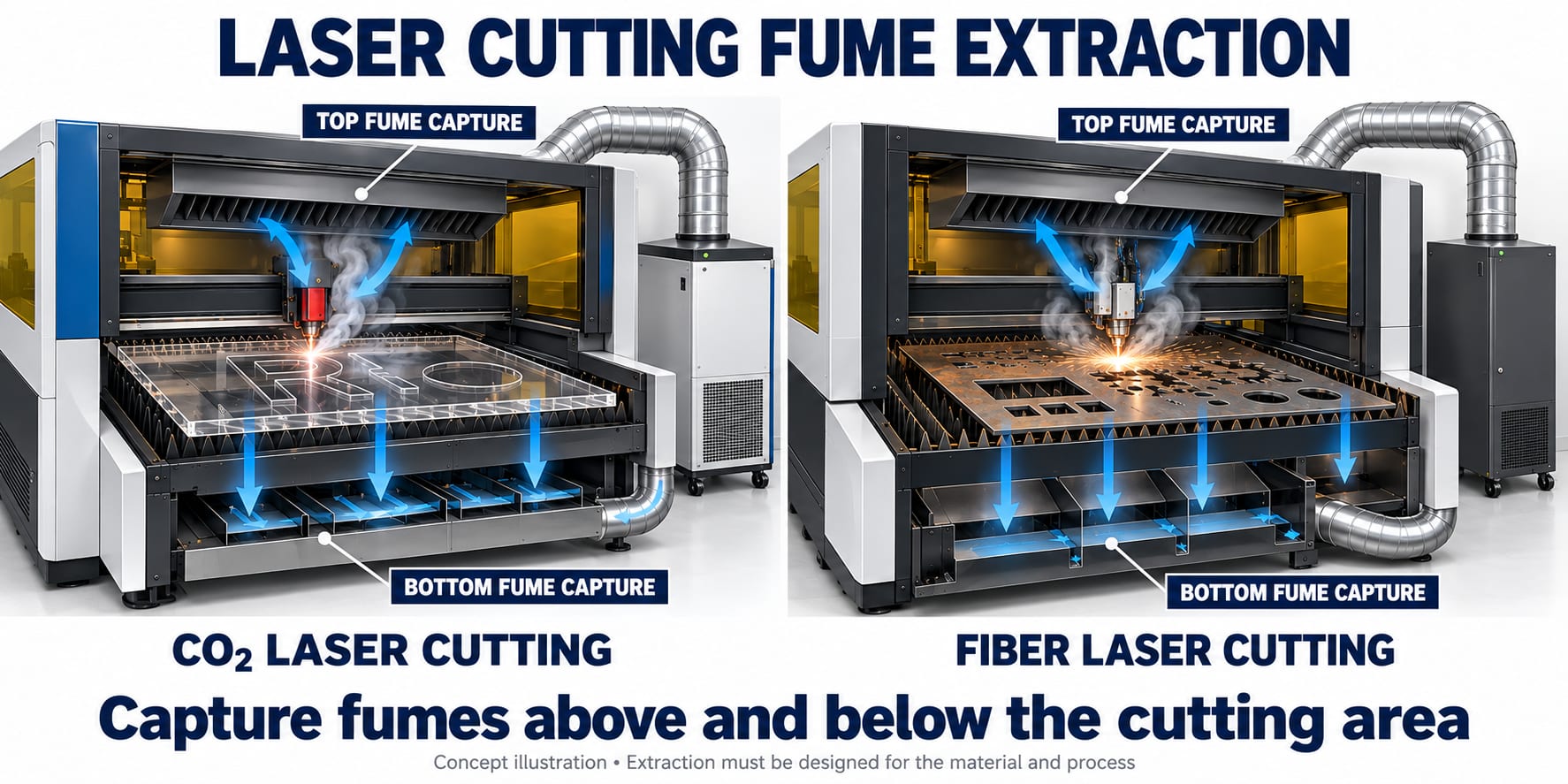
What fiber laser cutters release
Fiber cutting of metal produces fine particles that contain metal. Coatings and surface contamination can add other harmful emissions. Assess the actual exposure under normal working conditions.
| Material or task | What to assess and capture |
|---|---|
| Mild steel | Iron particles and other alloy elements |
| Stainless steel | Particles containing chromium and nickel; assess possible hexavalent chromium exposure |
| Aluminum | Aluminum particles and alloy elements; assess whether the collected dust can burn |
| Galvanized steel | Zinc fume and particles from the coating |
| Painted or coated metal | Metal particles plus breakdown products from the coating |
Use extraction designed for the cutting bed and the enclosure. Sectioned extraction can aim the airflow at the zone being cut. On the Ascent 5 x 10 ft fiber laser cutter, for example, the supplied dust and fume collector is a cyclone-type, negative-pressure system with outlets around a partitioned bed, and it switches sections to follow the cutting head.
Verify capture on your most demanding production cuts, and keep the extraction running while the remaining airborne dust clears. Set that clearing time during commissioning rather than by guesswork.
Catch the plume before it reaches the operator
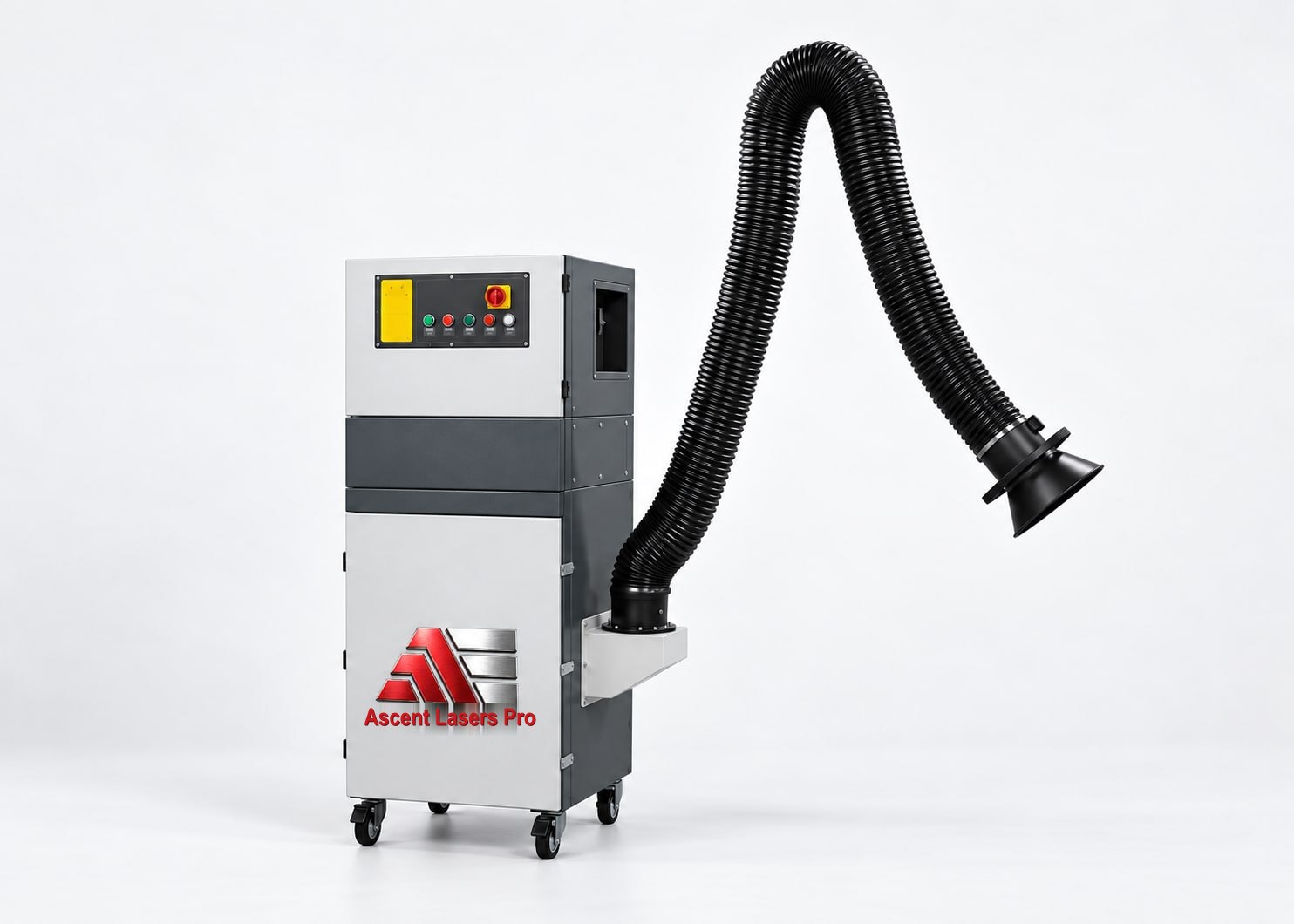
Local exhaust ventilation catches contaminated air close to where it forms. General room ventilation helps, but it shouldn't be the only control for welding fume. Set up the airflow so the plume goes into the hood without crossing the operator's breathing zone.
- Handheld welding: a movable hood close to the weld, moved as the operator moves, without disturbing the shielding gas or the weld.
- Tabletop QCW welding: a suitable partial enclosure, or a hood close to the work area.
- Handheld cleaning: extraction near the cleaning head, or a hood that follows the area being cleaned.
- Repeat production: an extracted enclosure or a fixture built around the part.
- Large cutting tables: extraction spread across, or zoned over, the active area.
Check capture inside deep channel letters and around large parts, where walls and fixtures can block the airflow. Commission the installed system while doing real work. For where the extractor goes in a welding station, see Setting Up for a Handheld Laser Welder, Step by Step.
Particles and gases need different controls
A HEPA filter catches particles. It does not remove gases or vapors. Where gases are present, the system may need the right gas-treatment media or a properly designed discharge outdoors. Activated carbon isn't a fix for everything: whether it works, how much it holds and how often it needs changing depend on the chemicals and the load.
Have the supplier specify the filtration, the discharge point and the makeup air for your actual process. An outdoor discharge has to meet the local requirements and stay away from air intakes and occupied areas. Before you return filtered air indoors, assess every contaminant involved. A particle filter rating alone isn't enough.
Combustible dust and shared collectors
Fine aluminum dust and some organic dusts can be a fire or explosion hazard. The risk depends on what the collected material is and what condition it is in. Don't assume an ordinary shop vacuum or a general-purpose fume collector is suitable. Have a qualified supplier assess the dust, the ignition sources and the protection required.
Sharing one collector between CO₂ and fiber cutting needs an engineering review. Metal cutting can carry hot particles into the collector, while acrylic, wood, coatings and some metal dusts leave combustible material in it. Review dust compatibility, both lasers running at once, ignition control, filtration and discharge. Separate systems may be the right answer, and a dual-gantry machine doesn't by itself justify one common collector.
For the Ascent dual gantry cutter, collection is offered as two separate options: one collector for the smoke and fumes of the CO₂ laser, and one for the debris of the fiber laser.
How to choose an extractor
Give the supplier this information before you ask for a system:
- Base metals, alloys, filler wires, and every nonmetal you process
- Coatings, adhesives, oils and films, with the safety data sheets you have
- Process settings, daily run time, and which operations run at the same time
- Part and table sizes, where the hood goes, and where the operator stands
- Hose and duct lengths, bends, the discharge point, and the makeup air available
Ask for the airflow at the hood under working conditions, with filter resistance included. A high free-air CFM figure doesn't prove capture once the system is installed. Commissioning should show that the capture works, and air sampling should confirm control where the assessment calls for it. Don't pick a one-size airflow from the laser wattage.
Daily operation and maintenance
- Before you start the laser, confirm the extraction is running and the airflow indicators read normal.
- Position the hoods, and check the hoses, ducts, seals and enclosure openings.
- Follow the filter-loading indicators and the maintenance schedule. Don't judge filter life by smell.
- Handle collected dust and used filters according to what they contain and their fire risk, without stirring dust back into the air.
- Reassess capture whenever the materials, settings, table layout or production volume change.
Respirators may be needed when engineering controls don't control the exposure well enough. Choose them for the particles and gases you identified, and meet the applicable respiratory protection and fit-testing rules.
Fume extraction doesn't replace beam protection. You still need the right enclosure, interlocks and laser eyewear: minimum OD 5; prefer OD 7 or 8. See the laser safety guide for the rest.
Questions answered
Does a laser welder need fume extraction if there is little smoke?
Yes. Laser welding fume is made of very fine particles, and you may see little smoke while they are still in the air. Capture it at the source and assess it for the metals, filler and coatings you weld.
Does a HEPA filter remove laser fumes?
It catches particles, but it does not remove gases or vapors. Where gases are present, the system may need gas-treatment media or a properly designed outdoor discharge.
How much airflow does a laser fume extractor need?
There is no single number based on laser wattage. Ask the supplier for the airflow at the hood under working conditions, with filter resistance included, and confirm capture during commissioning.
Can one collector serve both CO₂ and fiber cutting?
Only after an engineering review. Hot metal particles from fiber cutting and combustible dust from acrylic, wood or coatings can end up in the same collector, so separate systems may be the right choice.
Is fume extraction included with Ascent laser cutters?
The Ascent 5 x 10 ft fiber laser cutter comes with a dust and fume collector, and the Ascent CO₂ cutters come with an exhaust fan. On the dual gantry and combination cutters, fume and debris collectors are options.
Sources
- OSHA Technical Manual, Section III, Chapter 6: Laser Hazards
- OSHA fact sheet: Controlling Hazardous Fume and Gases during Welding
- Government of Canada: Guide to health hazards and hazard control measures with respect to welding and allied processes
- UK Health and Safety Executive: Controlling airborne contaminants at work, a guide to local exhaust ventilation (HSG258)
- Canadian Centre for Occupational Health and Safety: Combustible Dust
- OSHA Technical Manual, Section IV, Chapter 6: Combustible Dusts
- Research paper: gas and particle flow from laser irradiation of a urethane-coated stainless steel surface (arXiv 1605.04558)
- Ascent Lasers Pro: laser safety guide; 5 x 10 ft fiber laser cutter; dual gantry CO₂ and fiber cutter; combination cutter FAQ