
Dual-gantry and combination laser cutters run a fiber laser and a CO₂ laser on one machine, so they make three very different kinds of fumes. Fiber cutting of aluminum throws off fine metal dust. CO₂ cutting of acrylic gives off vapor, and CO₂ cutting of wood makes smoke and soot.
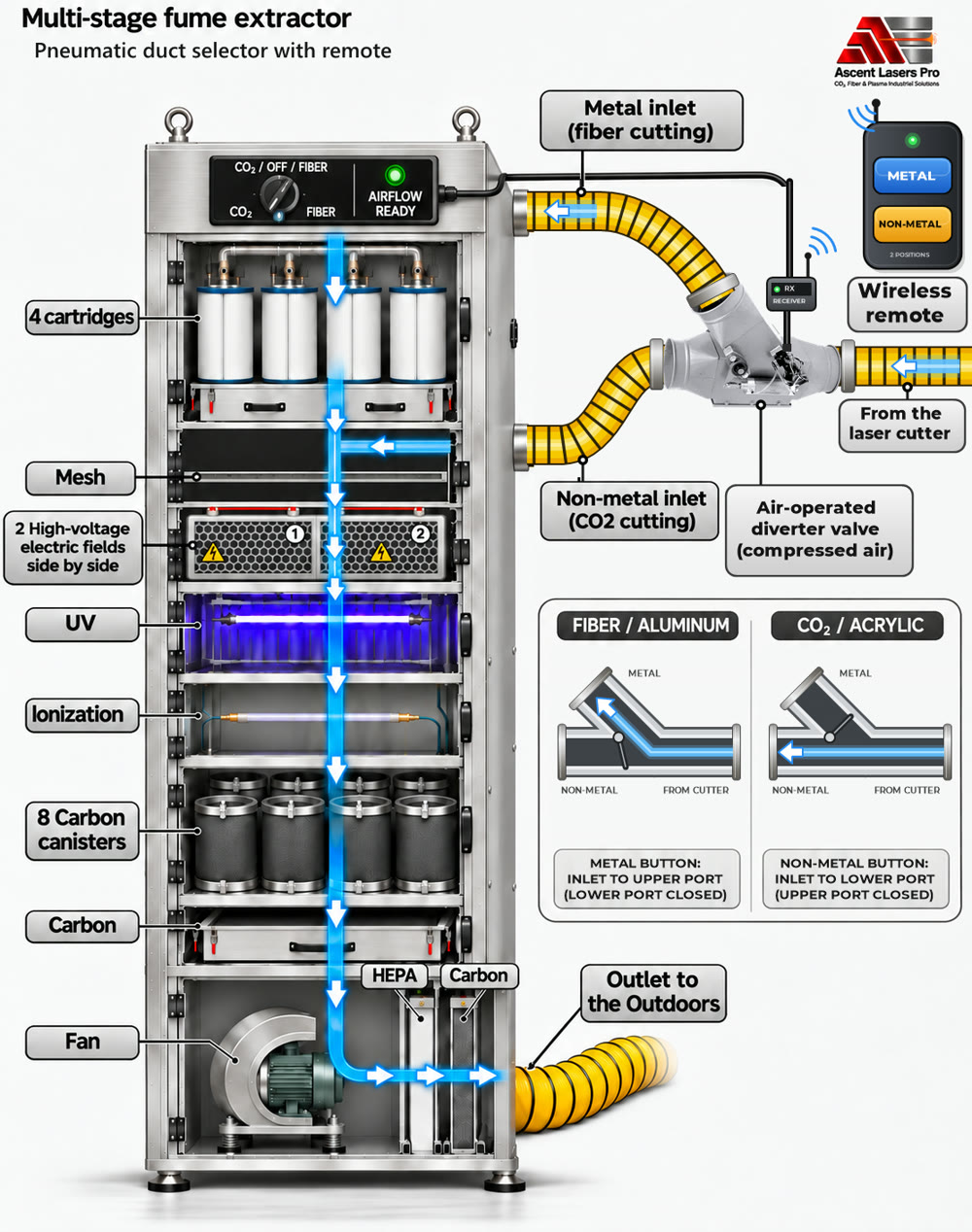
Figure 1 shows an Ascent Lasers Pro concept for one extractor that serves both lasers. A diverter valve on the duct from the cutter sends the air to one of two inlets. Aluminum dust from the fiber laser goes in at the top and passes through four filter cartridges. Fumes from the CO₂ laser go in lower, at the mesh, and skip the cartridges. Both routes share the duct before the diverter and the cabinet below the mesh.
Each material needs different treatment. The tables below go stage by stage, one column per material.
Capturing the fumes and collecting the particles
Stages 1 to 7 catch what the laser throws off and take out the particles.
| Stage | Fiber / aluminum | CO₂ / acrylic | CO₂ / wood |
|---|---|---|---|
| 1. Bed and debris trolleys | Heavy offcuts and dross drop into the trolleys. Fine dust in the air goes into the duct. | Offcuts and larger residue drop into the trolleys. Aerosol and vapor in the air go into the duct. | Coarse char drops into the trolleys. Soot, vapors, and possibly hot particles go into the duct. |
| 2. Air-operated diverter and remote | The METAL button selects the upper inlet. Check the valve position and the real airflow separately. | The NON-METAL button selects the lower inlet, which enters at the mesh. | Uses the same lower inlet as acrylic. |
| 3. Four cartridges (upper route) | The main particle filter on the metal route. How well it works depends on the media and the seals. | The lower route skips the cartridges. Ordinary particle media would let acrylic vapor through anyway. | Skipping the cartridges sends the soot on to the mesh and the electrical stages, so they load up faster. |
| 4. Mesh screen | Stops larger debris. Fine metal particles can get through. | Stops coarse debris. Fine aerosol and vapor carry on downstream. | Stops coarse char. Fine soot and gases get through. If it also has to stop sparks, check that separately. |
| 5. Two high-voltage fields | With collector plates, they can catch charged particles. | With collector plates, they can catch some of the aerosol. MMA vapor passes on. | They can catch some fine soot, but soot buildup lowers their efficiency. |
| 6. UV lamp | Does little for metal particles in the air. | A UV lamp on its own does not reliably remove MMA. | Does not reliably control soot, CO, or smoke vapors. Some UV lamps make ozone. |
| 7. Ionizer | Puts a charge on the particles. A plate or filter downstream still has to catch them. | Can charge the aerosol. The vapor still needs its own gas treatment. | Can charge the soot. CO goes straight through. Some ionizers make ozone. |
Treating the vapor and venting outdoors
Stages 8 to 12 deal with gases and odors, move the air, and send it outside.
| Stage | Fiber / aluminum | CO₂ / acrylic | CO₂ / wood |
|---|---|---|---|
| 8. Eight carbon canisters | The particle filters handle the metal. Dust that gets past them can foul the carbon. | The main gas-treatment stage in this design. Choose a carbon suited to methyl methacrylate (MMA) and the rest of the expected vapor mix. | Can take up some smoke vapors and odors. Ordinary activated carbon does not reliably remove carbon monoxide (CO). |
| 9. Carbon drawer | Adds little for metal particles. | Adds vapor capacity if the bed is sealed and holds enough media for enough contact time. | Can take up more of some vapors. Soot that reaches the drawer can foul the media. |
| 10. Fan and airflow light | Make sure the fan still holds capture at the bed when the filters are loaded. | Check the real capture airflow. A light that only shows the fan is running does not prove the fumes are being pulled away. | Soot buildup can cut the airflow. The last filter panels sit on the fan’s discharge side, so their seals have to keep leaks down. |
| 11. Final HEPA and carbon panels | A sealed HEPA filter catches the last fine particles. The carbon is there for gases. | HEPA catches the leftover aerosol. Carbon takes up some vapors until it is used up. | HEPA catches the leftover soot. The carbon panel can cut some of the odor. CO can pass through both. |
| 12. Outdoor outlet | Sends the cleaned air outside. | Sends the leftover vapor outside. Put the outlet where the air can’t come back in through doors or air intakes. | Exhausts the leftover gases, including any CO. Capture the smoke at the cutter even when the exhaust looks clear. |
Design priorities
The fiber route: The four cartridges are the main particle filter for aluminum dust, and how well they work depends on their media and seals.
The CO₂ route: Put a particle prefilter ahead of the carbon. For acrylic, size the gas treatment for MMA. For wood, plan for heavy soot loading and send gases such as CO outdoors. [1–3]
Questions answered
Can one fume extractor serve both a fiber laser and a CO₂ laser?
It can be laid out that way, with a diverter that sends each job to its own inlet, as in Figure 1. Aluminum dust from the fiber laser goes through the cartridges, and fumes from the CO₂ laser enter at the mesh.
Does activated carbon remove carbon monoxide?
Not reliably. Ordinary activated carbon takes up some smoke vapors and odors, but CO can pass through both the carbon and the HEPA filter. Send the exhaust from wood cutting outdoors.
Do UV lamps and ionizers clean laser fumes?
Not on their own. A UV lamp does not reliably remove MMA, soot, or CO. An ionizer only charges the particles, so a plate or filter downstream still has to catch them. Some UV lamps and ionizers also make ozone.
Related reading
- Laser fume extraction for welding, cleaning, and cutting
- Laser safety
- Dual gantry CO₂ and fiber laser cutter
- Combination CO₂ and fiber laser cutters
Sources
- Characterization of Emissions from Carbon Dioxide Laser Cutting Acrylic Plastics. ACS Chemical Health & Safety, 2023.
- Respirable Particles and Gas Contaminants Emissions from a Desktop Laser Cutter and Engraver. Aerosol and Air Quality Research, 2024 (CDC Stacks).
- U.S. EPA. Residential Air Cleaners: A Technical Summary, 3rd edition.